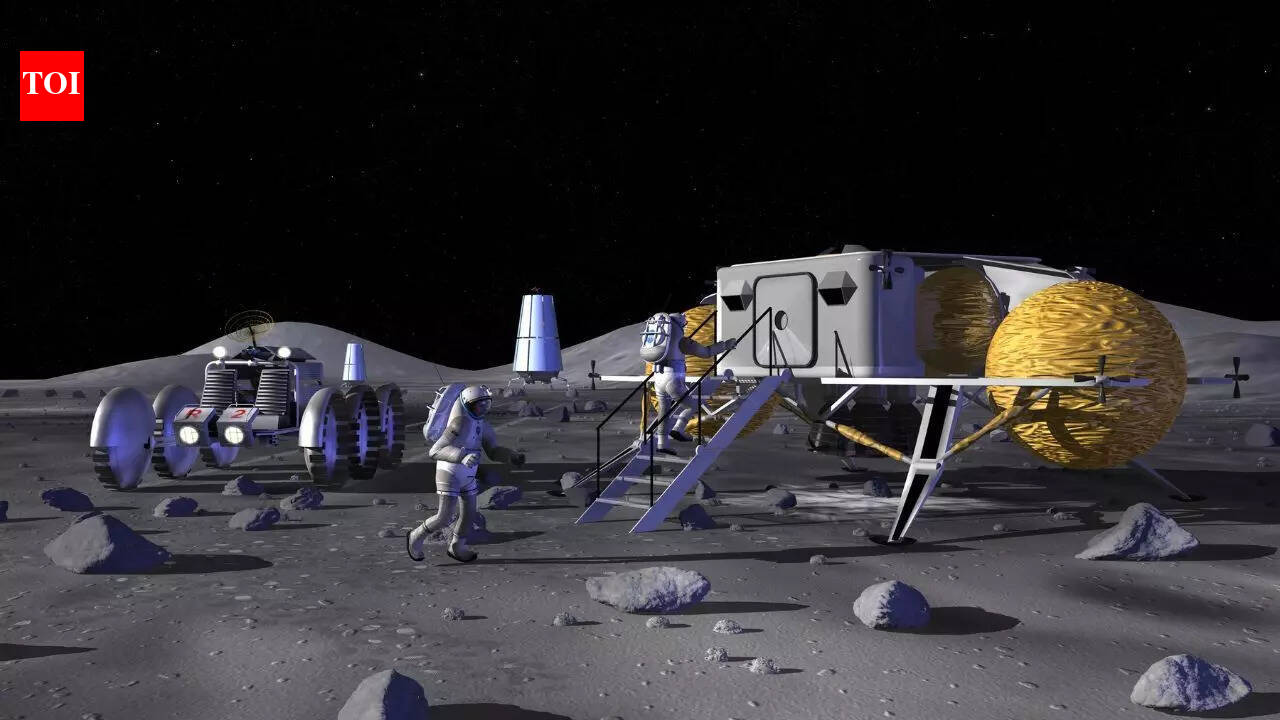
In a ambitious push toward sustainable space exploration, NASA is advancing plans to establish a permanent human presence on the Moon, with the lunar south pole emerging as the prime location for a long-term base. According to a recent report from the Times of India, the space agency is preparing for what could be one of its most transformative missions, moving beyond short visits to create a lasting outpost on the lunar surface.
The focus on the lunar south pole stems from its unique environmental features that could support human habitation. Scientists have identified potential deposits of water ice in permanently shadowed craters in this region, which could be crucial for drinking water, oxygen production, and even rocket fuel. 'NASA seems to be gearing up for one of its boldest missions yet,' the Times of India article states, emphasizing that this initiative goes far beyond symbolic achievements like 'planting a flag and snapping photos.'
Background on NASA's lunar ambitions traces back to the Artemis program, launched in 2017 as a successor to the Apollo missions. Artemis aims to return humans to the Moon by 2025, with subsequent missions building toward a sustainable presence. The south pole was selected after extensive studies by NASA's Lunar Reconnaissance Orbiter, which mapped the area revealing areas of near-constant sunlight on crater rims ideal for solar power, contrasted with shadowed regions preserving volatiles like water ice.
Officials at NASA have highlighted the strategic importance of this location. In related announcements, NASA Administrator Bill Nelson has described the south pole as a 'gateway to the solar system,' noting its resources could enable deeper space exploration, including missions to Mars. The Times of India report aligns with these statements, reporting that the agency is actively developing technologies for the base, such as habitats, rovers, and resource utilization systems.
Details from the report indicate that the permanent base could house astronauts for extended periods, potentially months or years, fostering scientific research in geology, astrophysics, and biology. The south pole's rugged terrain, with peaks up to 10,000 feet high, offers diverse sites for experiments, while its proximity to the Moon's equator facilitates launches back to Earth or beyond. According to the article, NASA envisions international partnerships, including contributions from the European Space Agency and Japan's JAXA, to share costs and expertise.
Challenges abound, however. The extreme cold in shadowed craters, dipping to minus 280 degrees Fahrenheit, poses risks to equipment and human health. Radiation exposure remains a concern without Earth's protective atmosphere. The Times of India piece notes that NASA is investing in radiation shielding and advanced life support systems to mitigate these issues, with prototypes already undergoing testing at facilities like the Johnson Space Center in Houston.
From a historical perspective, the Apollo program in the late 1960s and early 1970s landed 12 astronauts on the Moon, but all missions were brief, lasting no more than three days on the surface. Today's plans draw lessons from those expeditions while incorporating modern robotics and AI. For instance, the VIPER rover, scheduled for launch in late 2024, will scout the south pole for water ice, providing data to inform base placement.
Experts outside NASA have weighed in on the feasibility. Dr. Sarah Noble, a program scientist for Artemis, has said in public forums that the south pole's resources 'could make the Moon a stepping stone for humanity's expansion into space.' Conversely, some critics, including space policy analysts at the Planetary Society, argue that the timeline may be optimistic, citing delays in the Space Launch System rocket development, now pushed to 2026 for Artemis II.
The report from the Times of India underscores the economic implications, with NASA's budget for lunar exploration exceeding $4 billion annually. Private sector involvement is growing, with companies like SpaceX and Blue Origin competing for contracts to deliver cargo and crew. Elon Musk, CEO of SpaceX, has tweeted support for lunar bases as precursors to Mars colonization, though he has not directly commented on the south pole site.
Environmental considerations for the Moon are also emerging. While the lunar surface has no biosphere, scientists advocate for protocols to avoid contaminating potential microbial life in ice deposits. The International Astronomical Union has called for 'planetary protection' measures, which NASA has pledged to follow, as reported in related coverage.
Looking at global competition, China's Chang'e program has landed rovers near the south pole, with plans for a crewed mission by 2030. Russia's Roscosmos has expressed interest in joint ventures, but geopolitical tensions could complicate collaborations. The Times of India article reports that NASA is prioritizing the U.S.-led Artemis Accords, now signed by 20 nations, to establish norms for lunar activities.
Technological milestones are on the horizon. The Artemis I uncrewed test flight in November 2022 successfully orbited the Moon, validating the Orion spacecraft. Upcoming Artemis II in 2025 will send four astronauts on a lunar flyby, while Artemis III aims for the first landing near the south pole, potentially including the first woman and person of color on the Moon.
Beyond immediate goals, a permanent base could enable astronomical observations from the Moon's far side, shielded from Earth's radio interference. Telescopes there might detect exoplanets or study cosmic events with unprecedented clarity. The report suggests this could revolutionize our understanding of the universe, with the south pole's stable temperatures aiding instrument performance.
As preparations accelerate, public interest is surging. Educational outreach, including NASA's Lunar Surface Innovation Initiative, engages students in base design challenges. Community events at observatories worldwide are drawing crowds eager for the next giant leap.
The path forward involves rigorous testing and international diplomacy. With the lunar south pole poised to become humanity's first off-world home, NASA's vision promises not just exploration, but a new era of human endurance in space. As the agency continues to refine its strategy, updates from mission control will keep the world watching the stars.