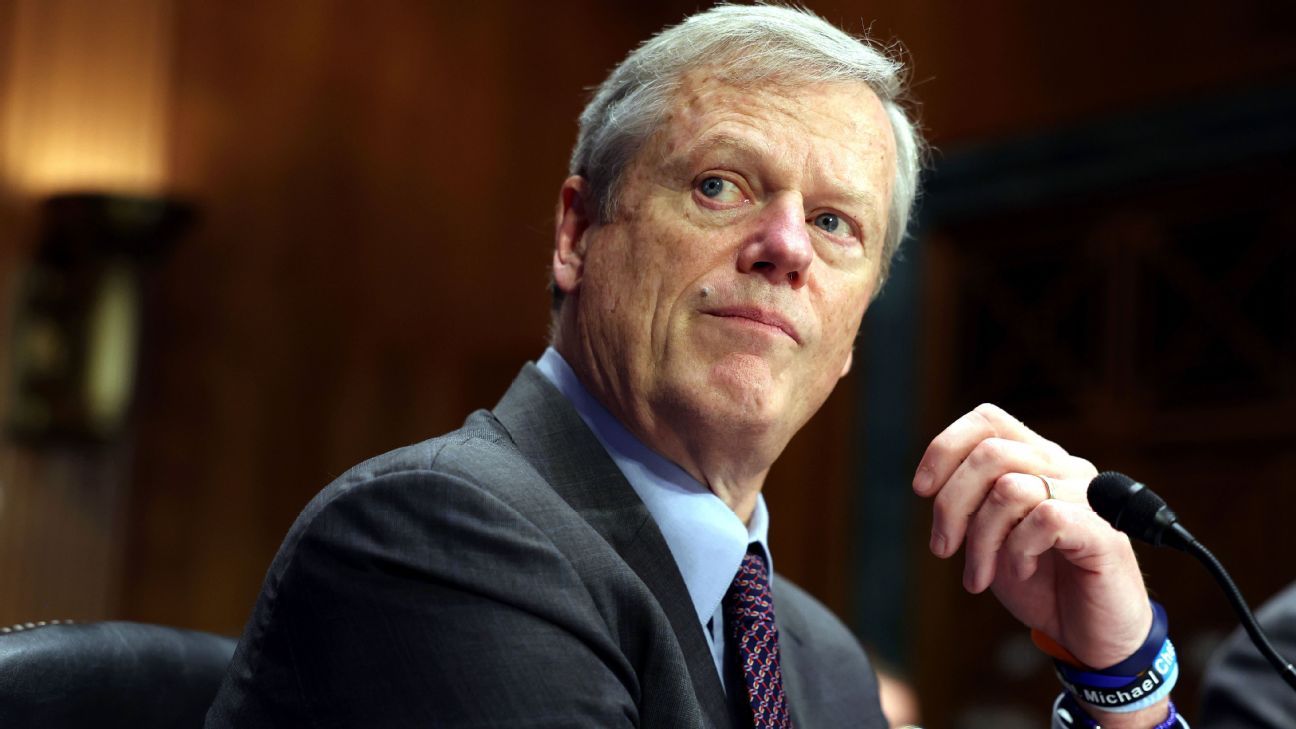
PHOENIX — NCAA President Charlie Baker defended the organization's two-site regional format for the women's basketball tournament on Friday, countering sharp criticism from UConn coach Geno Auriemma by pointing to surging attendance and viewership numbers.
Baker's comments came during a media availability ahead of the Women's Final Four at State Farm Stadium here, where he addressed Auriemma's recent outburst against the NCAA's tournament structure. Auriemma, whose Huskies are pursuing an unprecedented three-peat, had vented frustrations last week at the Fort Worth Regional, calling out what he saw as poor planning that hindered teams' preparations.
"I just don't understand some of the decisions that are made about our game when we're trying to grow the goddamn game," Auriemma said at the time, according to reports from the event. He highlighted issues like unfamiliar basketball hoops that hadn't been properly broken in and scheduling conflicts that forced teams to adapt to limited court availability for practices and shootarounds.
The two-site format, introduced in 2023, consolidated the regional semifinals and finals into just two locations instead of the previous four, aiming to streamline logistics and boost fan engagement. The NCAA has committed to this setup for at least five more seasons, as confirmed to ESPN's Michael Voepel earlier this month.
Auriemma has been vocal about his dissatisfaction since the change took effect. In Fort Worth, he specifically complained about UConn's shootaround before a Friday game, which was held outside the arena and started at 6:20 a.m. "Title IX legislation, in practice, is pretty much out the window," he added, suggesting broader failures in NCAA governance. "I think most of the NCAA laws have gone out the window."
Baker acknowledged the scheduling concerns but emphasized the overall success of the format based on hard data. "If you look at all the data, the ticket data, the attendance data, the viewership data, it's all gone up dramatically over the past few years," he said. "We talk to the teams, and the committee will go back and take a look at all the stuff that was raised around all of those issues and make decisions about what to do going forward."
Attendance at the women's tournament has indeed climbed steadily, with the 2024 event drawing record crowds. Final Four tickets sold out quickly this year, and television ratings have shattered previous marks, particularly for high-stakes matchups involving powerhouses like UConn, South Carolina, Iowa, and NC State.
"But it's pretty hard to argue when attendance is up, viewership is up and ticket sales are up consistently year over year that this formula isn't working," Baker continued. "I understand the issue around the scheduling, and that's something I think the committee will take a very hard look at."
The debate underscores ongoing tensions between coaches pushing for operational improvements and administrators focused on expanding the sport's reach. Auriemma, a Hall of Famer with 11 national titles under his belt, has long advocated for better resources in women's athletics, especially as the game's popularity explodes in the wake of stars like Caitlin Clark and Angel Reese.
Baker also addressed Auriemma's broader gripes about equity, particularly regarding Title IX compliance. He highlighted recent policy shifts that have expanded opportunities for female athletes. Before a federal injunction in the House v. NCAA case lifted scholarship caps, women's sports often operated under restrictive limits, he explained.
"Before the House injunction got passed, we had limits all over the place on scholarships, and those limits often translated in women's sports into a quarter for you, a quarter for you, a quarter for you and a quarter for you," Baker said. "The fact that we now have roster maxes in all sports, but scholarships are uncapped, I think the data at the end of the year is going to show an enormous increase in the number of fully scholarship women athletes."
These changes have led to the addition of new NCAA-sanctioned women's sports, including wrestling, acrobatics and tumbling, and stunt. Scholarship numbers across women's programs are expected to rise significantly once final 2024 figures are tallied, according to NCAA officials.
The two-site format was designed to create more centralized, festival-like atmospheres at the regionals, similar to the men's tournament's model, while reducing travel burdens for some teams. However, critics like Auriemma argue it creates inequities, such as early-morning practices or subpar facilities at non-primary venues.
As the Women's Final Four unfolds this weekend, with UConn facing Iowa in one semifinal and South Carolina taking on NC State in the other, the spotlight remains on the tournament's growth. The event, which tips off Saturday at 6 p.m. ET, is projected to draw over 20,000 fans per session, building on last year's attendance highs.
Looking ahead, the NCAA's selection committee is set to review feedback from this year's tournament, including Auriemma's points. While Baker expressed confidence in the current model, he left the door open for tweaks. "The committee will go back and take a look," he reiterated, signaling potential adjustments without committing to major overhauls.
For coaches and players on the ground, the focus now shifts to the court, but the exchange between Baker and Auriemma highlights the growing pains of a women's game that's outpacing its infrastructure. As viewership continues to soar—last year's championship game averaged 18.7 million viewers—the pressure mounts to balance expansion with excellence.
In the end, both sides agree on the goal: elevating women's basketball to new heights. Whether the two-site format endures or evolves will depend on how the data and dialogue play out in the coming months.