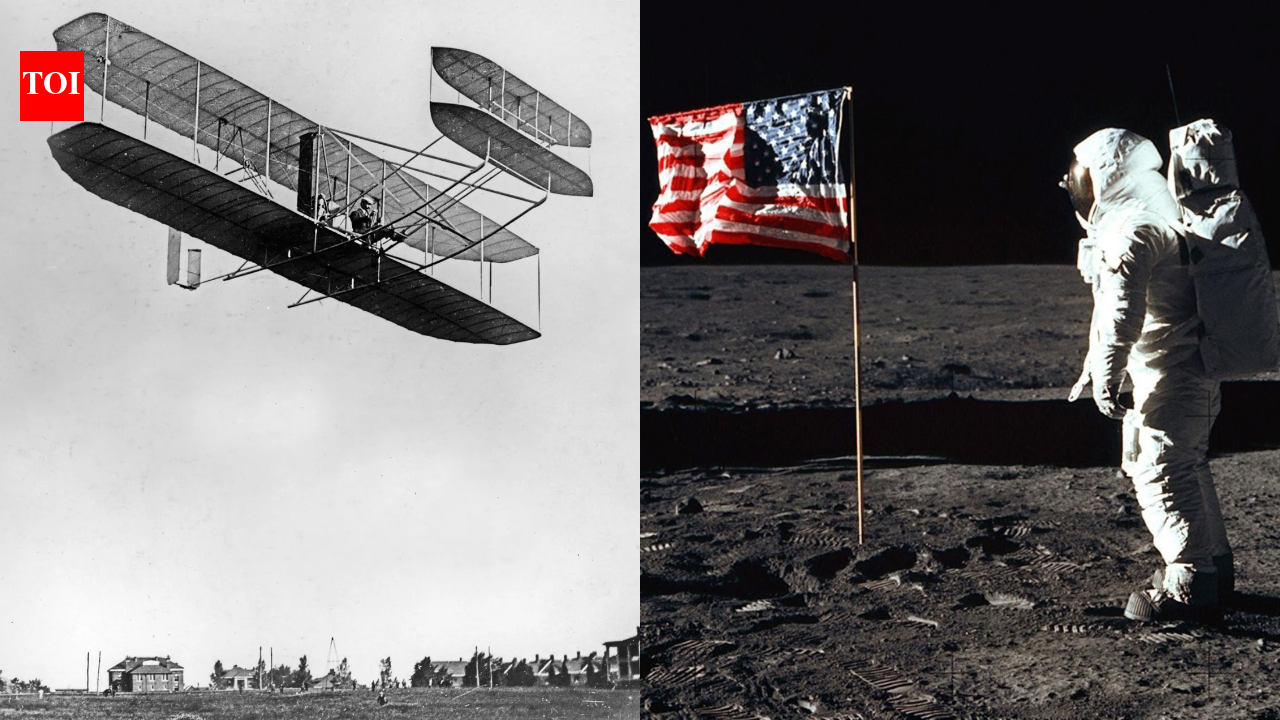
In the annals of human achievement, few stories rival the breathtaking leap from the Wright brothers' tentative 12-second flight to Neil Armstrong's giant step on the moon just 66 years later. This remarkable progression, driven by ingenuity, wartime urgency, and the relentless ambition of NASA, underscores the power of collective scientific endeavor. On December 17, 1903, in the sandy dunes of Kitty Hawk, North Carolina, Orville and Wilbur Wright achieved the first powered, controlled flight in a heavier-than-air craft, covering a mere 120 feet at an altitude of about 10 feet. Fast forward to July 20, 1969, when Armstrong, commander of Apollo 11, descended the lunar module's ladder and uttered the iconic words, "That's one small step for man, one giant leap for mankind," on the dusty surface of the moon, 240,000 miles from Earth.
The journey between these milestones was anything but linear, marked by rapid technological advancements and pivotal decisions that accelerated progress. According to a recent feature in The Times of India, the Wright brothers themselves were skeptical about the feasibility of flight in the early 20th century. Wilbur Wright once remarked, “I confess that in 1901, I said to my brother Orville that man would not fly for 50 years.” This admission, reflecting the era's doubts, now seems quaint given how swiftly aviation evolved into space travel.
World War I played a crucial role in propelling aviation forward, transforming experimental gliders into military assets. By 1918, aircraft were capable of speeds exceeding 100 miles per hour and altitudes of over 20,000 feet, according to historical records from the Smithsonian National Air and Space Museum. The interwar period saw further innovations, with pioneers like Charles Lindbergh completing the first solo transatlantic flight in 1927, covering 3,600 miles from New York to Paris in just 33.5 hours aboard the Spirit of St. Louis. These feats captured global imagination and laid the groundwork for commercial aviation.
The outbreak of World War II supercharged engine and aerodynamics research. Nazi Germany's development of the V-2 rocket, the world's first long-range guided ballistic missile, demonstrated the potential for spaceflight. Launched from Peenemünde in 1944, the V-2 reached altitudes of 100 kilometers, crossing the boundary of space as defined by the Kármán line. After the war, the United States and Soviet Union raced to recruit German scientists, including Wernher von Braun, whose expertise would prove instrumental. Von Braun, who designed the V-2, later became a key figure at NASA, overseeing the Saturn V rocket that propelled Apollo missions.
The Cold War space race formalized this competition. On October 4, 1957, the Soviet Union stunned the world by launching Sputnik 1, the first artificial satellite, into orbit from the Baikonur Cosmodrome in Kazakhstan. Weighing 184 pounds and beeping simple radio signals, Sputnik orbited Earth every 96 minutes, sparking fears in the U.S. of technological inferiority. President Dwight D. Eisenhower responded by creating NASA on July 29, 1958, through the National Aeronautics and Space Act, consolidating military and civilian space efforts under one agency.
Under NASA's leadership, the Mercury program marked America's entry into human spaceflight. On May 5, 1961, Alan Shepard became the first American in space, suborbital flight reaching 116 miles altitude aboard Freedom 7, launched from Cape Canaveral, Florida. Just weeks later, on May 25, 1961, President John F. Kennedy addressed Congress, declaring, "I believe that this nation should commit itself to achieving the goal, before this decade is out, of landing a man on the moon and returning him safely to the Earth." This audacious goal galvanized the nation, funneling billions into research and development.
The Gemini program followed, testing critical technologies like spacewalks and docking maneuvers. Gus Grissom and John Young piloted Gemini 3 on March 23, 1965, the first crewed Gemini mission, orbiting Earth three times. These missions, conducted from the same Florida launch site, honed skills essential for lunar travel. Meanwhile, the Soviet Union achieved its own milestones, with Yuri Gagarin becoming the first human in space on April 12, 1961, aboard Vostok 1, circling Earth once in 89 minutes.
By 1967, tragedy struck with the Apollo 1 fire on January 27, during a launchpad test at Kennedy Space Center. Astronauts Virgil "Gus" Grissom, Edward White, and Roger Chaffee perished in a cabin blaze, prompting sweeping safety reforms. NASA Administrator James Webb later said, "We must learn from this to ensure no more lives are lost." These changes, including redesigned spacecraft and rigorous testing, were vital for subsequent successes.
The Apollo program's pinnacle came with Apollo 11. Launched on July 16, 1969, from Launch Complex 39A, the Saturn V rocket carried Armstrong, Buzz Aldrin, and Michael Collins skyward. Collins remained in lunar orbit aboard the command module Columbia, while Armstrong and Aldrin descended in the Eagle lunar module to the Sea of Tranquility. Their moonwalk lasted about 2.5 hours, during which they collected 47 pounds of lunar samples and deployed scientific instruments, including a seismometer and solar wind collector.
Armstrong's descent was tense; the Eagle's landing computer overloaded with alarms, and fuel was dwindling. Armstrong manually piloted the craft, avoiding a boulder field, and touched down with seconds to spare. Aldrin joined him outside 19 minutes later. Back on Earth, an estimated 650 million people watched the grainy black-and-white broadcast, a testament to the event's global impact. President Richard Nixon called it "the most historic telephone call ever made from the White House," speaking live to the astronauts: "For one priceless moment in the whole history of man, all the people on this Earth are truly one."
Subsequent Apollo missions expanded exploration. Apollo 12 landed on November 19, 1969, near the Surveyor 3 probe, with Charles Conrad and Alan Bean retrieving parts for analysis. Apollo 13, intended for the Fra Mauro highlands in April 1970, faced a near-catastrophic explosion in its service module, 200,000 miles from Earth. Thanks to the ingenuity of the ground crew at Mission Control in Houston, James Lovell, Fred Haise, and Jack Swigert safely returned using the lunar module as a lifeboat. Lovell later recounted, "Houston, we've had a problem."
Apollos 14 through 17 followed, with the last, Apollo 17, lifting off on December 7, 1972, carrying Eugene Cernan and Harrison Schmitt, the only geologist to walk the moon. Over six missions, 12 astronauts explored the lunar surface, driving the lunar rover on later flights and conducting experiments that revealed the moon's geological history. NASA invested over $25 billion in the program, equivalent to about $150 billion today, employing 400,000 people at its peak.
Looking back, experts credit NASA's success to a confluence of factors: massive funding, interdisciplinary collaboration, and a clear national objective. Historian Roger Launius of the Smithsonian noted in interviews that "the space race was as much about prestige as science, but it yielded technologies like microchips and GPS that transformed daily life." Yet, not all views are uniformly celebratory; some critics, including budget watchdogs at the time, argued the program's costs diverted resources from domestic needs, though proponents countered that the inspirational value outweighed the expense.
Today, as NASA sets sights on Mars and private companies like SpaceX revive lunar ambitions, the Apollo era's lessons endure. The Artemis program aims to return humans to the moon by 2025, building on that 66-year sprint from Kitty Hawk to Tranquility Base. Whether echoing Wilbur Wright's early pessimism or Kennedy's bold vision, the story reminds us that what once seemed impossible can become history in a remarkably short span.