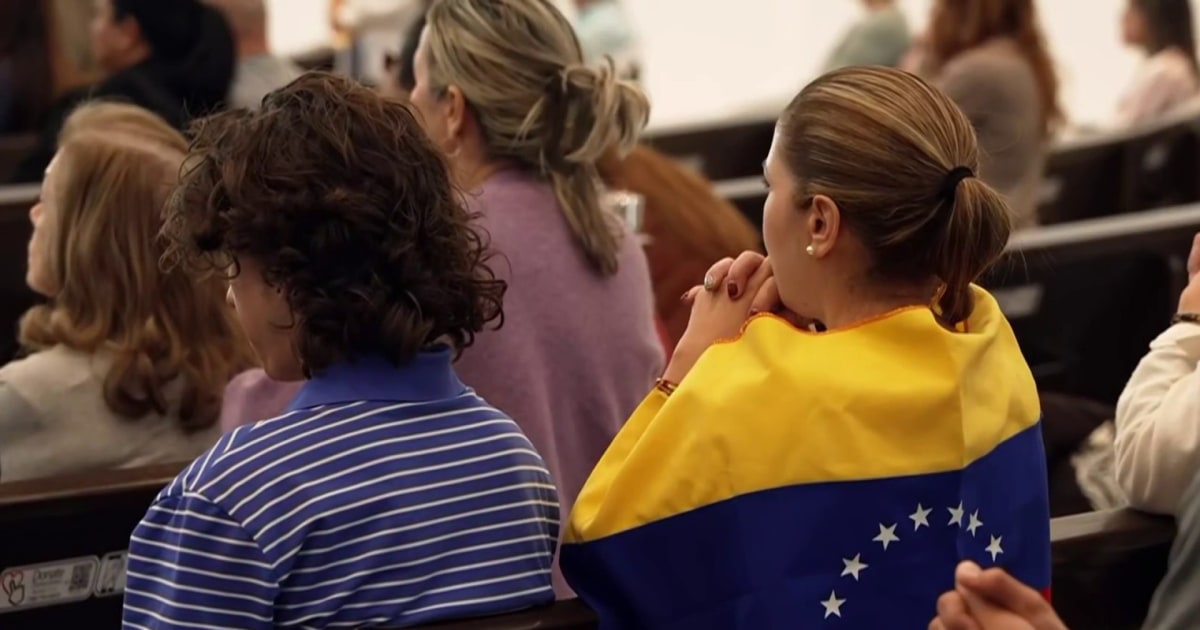
In the heart of Doral, Florida, a city often called the 'Venice of America' for its vibrant Venezuelan community, the news of Nicolás Maduro's removal from power in Venezuela sent ripples of emotion through the streets on Tuesday. Home to the largest concentration of Venezuelans in the United States, Doral erupted in a mix of jubilation and cautious optimism as exiles and their families processed what many described as the dawn of a new era. According to reports from NBC News, Maduro's capture by opposition forces marked a dramatic end to his 11-year rule, which had been marred by economic collapse, widespread protests, and international sanctions.
The events unfolded rapidly in Caracas, where Venezuelan military officials announced Maduro's detention early Tuesday morning local time, citing defections within the armed forces and pressure from international allies. Opposition leader María Corina Machado, who has long challenged Maduro's regime, declared victory in a televised address, stating, 'This is the moment we have fought for—the people of Venezuela will rise again.' Her words echoed across the Atlantic, reaching the ears of thousands in Doral who had fled the very turmoil she referenced.
At El Arepazo 2, a popular Venezuelan restaurant in Doral's CityPlace, patrons gathered around televisions, their conversations a blend of Spanish and English laced with disbelief. 'I never thought I'd see this in my lifetime,' said Carlos Mendoza, a 52-year-old mechanic who emigrated from Caracas in 2017. Mendoza, wiping tears from his eyes, added, 'Maduro destroyed our country, but now, maybe my children can go back one day.' His sentiment was shared by many in the crowd, where Venezuelan flags waved alongside American ones, symbolizing a dual identity forged in exile.
Yet, not all reactions were uniformly celebratory. Some community members expressed skepticism about the transition, pointing to the history of political instability in Venezuela. Ana López, a 45-year-old teacher and longtime resident of Doral, voiced concerns over potential power vacuums. 'We've seen promises before,' López said in an interview outside her home. 'What if the military steps in or another strongman emerges? We need real democracy, not just a change of faces.' Her words highlight the deep scars left by years of hyperinflation, food shortages, and human rights abuses under Maduro's socialist government, which began with the death of Hugo Chávez in 2013.
The Venezuelan diaspora in South Florida numbers over 200,000, according to U.S. Census data, with Doral serving as its epicenter. Many arrived after the 2014 protests that left dozens dead, or during the 2019 blackout that plunged the country into darkness for days. Local leaders, including Doral Mayor Julián Fernández, a Venezuelan-American himself, organized an impromptu gathering at City Hall. 'This is a historic day for our community,' Fernández said in a statement. 'We stand ready to support a free Venezuela and welcome our brothers and sisters home.'
Background on Maduro's downfall provides crucial context. His regime faced mounting challenges, including U.S. sanctions imposed in 2017 that targeted oil exports, Venezuela's economic lifeline. The Biden administration, continuing policies from the Trump era, recognized Juan Guaidó as interim president in 2019, though that effort faltered. Recent reports indicate that internal dissent, fueled by economic woes— with inflation hitting 130,000% in 2018—led to key military figures switching sides. According to unconfirmed reports from Venezuelan media outlets, Maduro was apprehended at a military base near Caracas without resistance, though details remain sparse.
International reactions poured in swiftly. The United States, through Secretary of State Antony Blinken, issued a statement congratulating the Venezuelan people and calling for free elections. 'The end of Maduro's authoritarian rule is a step toward stability in the region,' Blinken said. In contrast, allies like Russia and Cuba condemned the move as a 'coup orchestrated by imperialists,' with Russian Foreign Minister Sergey Lavrov warning of potential retaliation. These diverging viewpoints underscore the geopolitical stakes, as Venezuela holds the world's largest proven oil reserves.
Back in Doral, the Venezuelan American Chamber of Commerce hosted a panel discussion at the Doral Country Club, drawing over 300 attendees. Experts like Dr. Javier Rodríguez, a political scientist at Florida International University, provided analysis. 'Maduro's removal could unlock billions in frozen assets, but rebuilding will take decades,' Rodríguez noted. He pointed to the exodus of over 7 million Venezuelans since 2015, many of whom remitted money home despite restrictions. One attendee, Sofia Ramirez, a nurse who left Venezuela in 2016, shared her story: 'I sent every penny I could to my family during the shortages. Now, I hope they can thrive without fear.'
The mixed emotions stem partly from personal losses. Community organizers reported that at least 50 Venezuelans in Doral have family members still unaccounted for from past crackdowns. 'Joy is tempered by grief,' said Maria Gonzalez, head of the Venezuelan Exile Support Network. Gonzalez recounted how her brother was imprisoned for protesting in 2017. 'We celebrate, but we demand justice for the disappeared.' Her organization has aided over 1,000 families with legal and financial support since its founding in 2018.
Economically, Maduro's ouster raises hopes for recovery. Venezuela's GDP shrank by 75% under his watch, per International Monetary Fund estimates. In Doral, businesses like bakeries and areperas—serving traditional cornmeal pockets—have boomed by catering to nostalgic tastes. Owner Luis Herrera of La Casita Venezolana said, 'Our sales spiked 30% last year alone. If Venezuela stabilizes, we might expand there.' Yet, Herrera cautioned that corruption remains a hurdle, citing scandals like the 2020 PDVSA oil thefts that siphoned millions.
Looking ahead, the path forward involves forming a transitional government. Opposition figures have proposed a unity council including civil society, with elections slated within 12 months. However, reported infighting among factions could complicate matters. 'Unity is key,' Machado reiterated in her address. International observers, including the United Nations, have offered to monitor the process, potentially averting further chaos.
For the Venezuelan Americans in Doral, the news evokes a collective sigh of relief mixed with vigilance. Vigils planned for Wednesday at Bayfront Park in Miami aim to honor victims and push for accountability. As one elder, 78-year-old Rafael Ortiz, put it while sipping café con leche at a local spot, 'We've waited too long. Now, let's build something lasting.' Ortiz, who fled in the 1960s, represents generations of resilience.
The broader implications extend beyond Venezuela. A stable government could ease migration pressures on neighbors like Colombia, which hosts 2.5 million Venezuelans, and reduce drug trafficking routes through the region. U.S. policymakers, including Florida Senator Marco Rubio, have advocated for lifting sanctions in exchange for democratic reforms. Rubio tweeted, 'A new Venezuela means a stronger hemisphere.'
As details emerge, the community in Doral remains glued to news feeds, phones buzzing with updates from relatives. While celebrations continue with music and empanadas, the underlying message is clear: hope, but not complacency. The removal of Maduro, after years of suffering, signals potential renewal, yet the true test lies in what follows.
In this 'new era,' as many call it, Venezuelan Americans are poised to play a pivotal role, leveraging their networks to aid reconstruction. Whether through remittances, investments, or advocacy, their story is one of endurance and aspiration, woven into the fabric of South Florida's diverse tapestry.