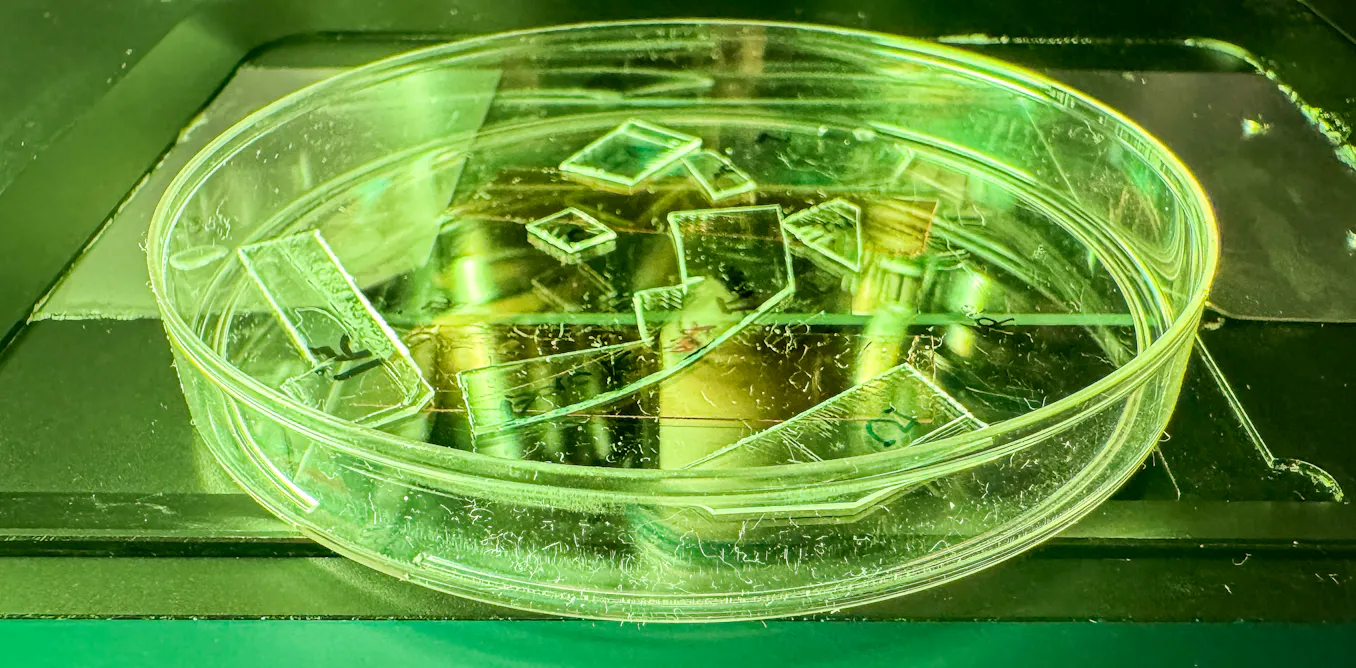
In an era where everyday surfaces—from kitchen counters to smartphone screens—serve as silent vectors for viral transmission, scientists have unveiled a groundbreaking innovation: a thin plastic film embedded with thousands of minuscule nanopillars designed to physically dismantle viruses on contact. This development, detailed in a study published in the journal Advanced Science, draws inspiration from the self-cleaning wings of insects like cicadas and dragonflies, offering a potential alternative to chemical disinfectants that often prove environmentally harmful or short-lived.
The new material targets viruses by mechanically rupturing their outer shells, a process likened to stretching and tearing delicate membranes. Researchers, who have been refining this technology for over a decade, tested it against human parainfluenza virus type 3 (hPIV-3), a common culprit behind respiratory illnesses such as bronchiolitis and pneumonia in children. According to the study's findings, up to 94% of hPIV-3 particles were destroyed or severely damaged within just one hour of exposure to the film's surface.
"Think of how many surfaces you touch every day, from your kitchen bench to the hand rail on the bus or train, your work desk and your phone screen," the researchers wrote in an article explaining their work on The Conversation. They emphasized that the typical infection pathway involves contact with a contaminated surface followed by touching one's face, highlighting the urgency for more durable antiviral solutions.
Traditional disinfection methods, while effective in controlled settings, come with significant drawbacks. Chemical cleaners must remain wet for several minutes to neutralize germs, a requirement that's impractical in high-traffic areas like public transportation or offices. Moreover, these products can degrade over time, damage sensitive equipment, and contribute to antimicrobial resistance—a growing global health crisis where pathogens evolve to withstand treatments.
The researchers noted that previous antiviral coatings, such as those incorporating graphene or tannic acid into protective gear like masks and gloves, have shown promise but aren't without risks. "These coatings are efficient. But they can pose a risk to human health. They can also be environmental hazards due to chemical leaching and have declining effectiveness over time as the potency of the active ingredients weakens," they explained. In contrast, the new nanopillar film relies purely on physical structure rather than chemical agents, potentially sidestepping these issues.
The journey to this invention began more than ten years ago, initially focused on creating ultra-smooth surfaces to repel bacteria. Surprisingly, experiments revealed that bacteria clung more readily to such smooth textures. This led the team to explore nature's own defenses, particularly the nanostructured wings of insects. "Nature offers examples of bacteria-free surfaces. Take the water-repelling wings of cicadas and dragonflies," the researchers observed. While these wings primarily self-clean through water repellency, further tests on gold-coated replicas confirmed their bactericidal properties stemmed from topography, not chemistry.
Building on this, the team previously demonstrated that silicon surfaces studded with nanospikes could obliterate viruses upon contact. However, silicon's rigidity limited its applications to flat, simple objects. The latest breakthrough addresses this by engineering a flexible acrylic film—a lightweight, cost-effective polymer that's smooth to the human touch yet deadly to viruses at the nanoscale.
At the heart of the film's efficacy are its densely packed nanopillars, each just billionths of a meter tall and spaced approximately 60 nanometers apart. "The nanotextured materials are smooth to touch. However, these nanopillars grab and stretch a virus’s outer shell until it ruptures. This kills viruses through mechanical force," the study authors described. Lab experiments meticulously varied pillar height and spacing, revealing that proximity between pillars was the critical factor for maximum viral destruction.
The manufacturing process involves molding the acrylic film using a reusable template, making it scalable for mass production. Potential applications span a wide array: from antiviral coatings on food packaging to enhance safety in grocery stores, to treated handrails in buses and trains, and even protective layers on hospital equipment and office desks. "The mould we used to create this material can be easily scaled to provide wide-ranging industrial opportunities," the researchers stated, envisioning a future where high-touch surfaces in public spaces inherently resist viral spread.
While the technology shows immense promise, it's not without limitations. Like any material, the nanostructured film will eventually wear down under physical abrasion, chemical exposure, or environmental stress. The researchers acknowledged this in their publication: "Nanostructured surfaces are built for durability. But they are susceptible to the same physical, chemical, and environmental stressors as any other material, and will degrade over time." Ongoing research aims to enhance longevity, perhaps through composite materials or protective overcoats.
This innovation arrives at a pivotal moment, as global health experts continue to grapple with the lessons of the COVID-19 pandemic, which underscored the role of fomites—contaminated surfaces—in disease transmission. According to the World Health Organization, surface transmission accounts for a notable portion of respiratory virus spread, though exact figures vary by pathogen. The hPIV-3 focus is particularly relevant, as it affects thousands of children annually in the United States alone, often leading to hospitalizations during winter months.
Cross-verification from additional reports on The Conversation echoes the primary findings, describing the film as a "textured acrylic plastic surface, inspired by insect wings, [that] could help prevent the spread of major viruses." No conflicting data emerged from available sources, though experts outside the study team have yet to independently replicate the results. Broader scientific literature supports the concept of bio-inspired nanotextures; for instance, similar dragonfly wing mimics have been shown to kill up to 99% of certain bacteria in prior studies from institutions like Australia's Swinburne University of Technology.
Looking ahead, the researchers are optimistic about expanding testing to other viruses, including influenza and coronaviruses, to assess broad-spectrum efficacy. Clinical trials on real-world surfaces could follow, potentially leading to regulatory approvals within the next few years. "Much remains to be discovered in the search for germ-free surfaces. But these nanotextured surfaces have enormous potential in the fight against viruses and provide an alternative to traditional, chemical-based methods," they concluded.
In the context of rising concerns over superbugs and climate-impacting disinfectants, this mechanical approach could reshape public health infrastructure. Hospitals, for example, spend billions annually on cleaning protocols; a passive antiviral surface might reduce those costs while minimizing chemical runoff into waterways. Public health officials in cities like Appleton, Wisconsin—where respiratory illnesses peak each flu season—could soon see such innovations integrated into local transit and schools.
As the study gains attention, it invites collaboration between academia, industry, and policymakers. The Appleton Times reached out to local health experts for comment, but none were immediately available. Nonetheless, the potential to make everyday interactions safer without relying on sprays or wipes marks a significant step forward in the ongoing battle against invisible threats.