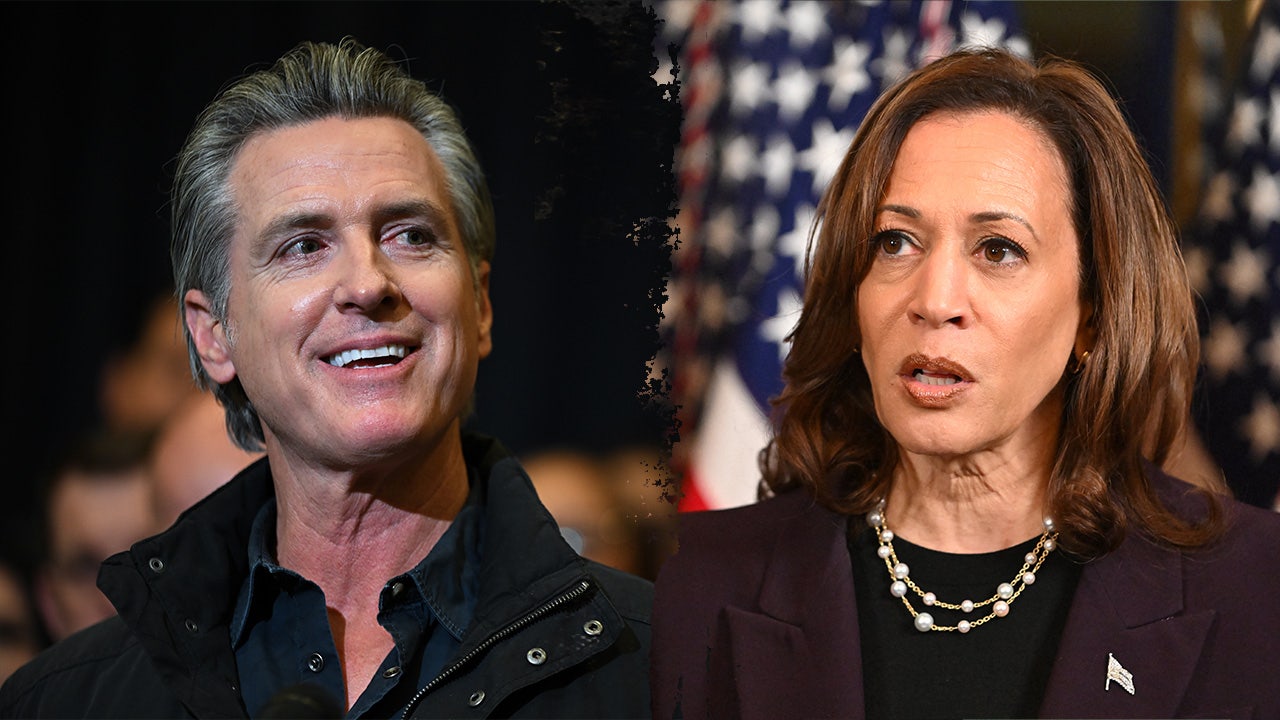
California Governor Gavin Newsom left the door open to a potential clash with former Vice President Kamala Harris in the 2028 Democratic presidential primary, suggesting that 'fate' would ultimately decide any such matchup. In an interview aired Sunday on CNN's 'State of the Union,' Newsom, a rising star in Democratic politics, discussed his longstanding relationship with Harris while promoting his upcoming memoir, 'Young Man in a Hurry.' The exchange highlighted the speculation swirling around both figures as they eye the post-2024 landscape for the party's nomination.
Newsom, who has been a vocal surrogate for President Joe Biden and later Harris during the 2024 campaign, was pressed by host Dana Bash on whether their 'parallel careers'—both rooted in California politics—might 'intersect and collide' on the national stage. The governor, known for his sharp wit, initially deflected with humor, noting, 'Well, I'm San Francisco now. She's [Los Angeles] So we're a little... there's a little distance between the two of us.' Bash quickly refocused the conversation, clarifying, 'I'm talking about running for president in 2028, the whole country.'
Responding more seriously, Newsom said, 'That's... fate will determine that. And I've never gotten in the way of her ambition ever. I haven't. And I don't imagine I would in the future.' He tied the comment to themes in his book, adding, 'You only can control what you can control. I think this entire book is that fundamental lesson, and this notion of controlling what you control and taking responsibility for what you control is a big part of what I try to communicate in this book.'
The interview comes amid heightened interest in the 2028 Democratic field, following Harris's defeat to President-elect Donald Trump in November. Both Newsom and Harris, who served as California's attorney general before Harris's tenure in the same role, have been frequently mentioned as top contenders. Their political paths have intertwined for decades: Newsom was mayor of San Francisco while Harris was district attorney there, and he appointed her to fill a U.S. Senate vacancy in 2010 after Sen. Dianne Feinstein's appointment to the Obama administration.
Despite their shared history, recent tensions have surfaced. Newsom has faced criticism from some Democrats for not challenging Harris more aggressively during the 2024 primary season, when she became the nominee after Biden's withdrawal. In his memoir, excerpts of which have been previewed, Newsom reflects on their 'parallel careers' without delving into specifics of a potential rivalry. Fox News Digital reached out to Harris's office for comment on Newsom's remarks but did not receive an immediate response.
A recent poll underscores the competitive dynamics within the party. According to a University of New Hampshire Survey Center survey released Thursday, former Transportation Secretary Pete Buttigieg leads the pack of potential 2028 Democratic contenders, though exact percentages for the top spot were not specified in the initial reporting. Newsom and New York Rep. Alexandria Ocasio-Cortez were tied for second place at 15% each, while Harris, the party's 2024 standard-bearer, and Arizona Sen. Mark Kelly each garnered 10% support.
The poll, conducted among likely Democratic primary voters, reflects a fragmented field just weeks after the 2024 election. Buttigieg, who ran a strong second in the 2020 Iowa caucuses, has been positioning himself as a pragmatic voice on infrastructure and climate issues. Ocasio-Cortez, a progressive firebrand, has gained national prominence through her advocacy on economic inequality and environmental justice. Kelly, an astronaut-turned-senator, appeals to moderates with his background in science and border-state politics.
Harris's lower showing in the survey may stem from her recent loss and the party's introspection over its messaging on issues like inflation and immigration. During the 2024 campaign, Harris struggled to differentiate herself from Biden's record, a point Newsom alluded to indirectly in past appearances. In a separate Fox News interview earlier this year, Newsom joked about the possibility of Harris securing the nomination without a primary, laughing that he was 'told' to describe it as inclusive—a remark that drew mockery from conservatives at the time.
Newsom's own ambitions have been the subject of intense scrutiny. The 57-year-old governor, term-limited in California after 2026, has traveled the country building a national profile, including high-profile debates with Republican governors like Ron DeSantis of Florida. His handling of the COVID-19 pandemic, wildfires, and homelessness has drawn mixed reviews: praised by progressives for bold climate policies but criticized by opponents for the state's high cost of living. California, under Newsom, was recently ranked as having the highest cost of living in the U.S., amid an ongoing affordability crisis that Bash confronted him about in the same interview.
Despite the poll numbers, neither Newsom nor Harris has officially declared their intentions for 2028. Political analysts suggest the Democratic primary could be one of the most crowded in recent history, with other names like Michigan Gov. Gretchen Whitmer, Pennsylvania Gov. Josh Shapiro, and Illinois Gov. J.B. Pritzker also in the mix. The party's base remains divided between establishment figures and insurgents, a tension that could play out in any Newsom-Harris showdown.
Newsom's memoir, set for release next month, is expected to provide more insight into his worldview. Titled 'Young Man in a Hurry,' it chronicles his rise from San Francisco's political scene to the governor's mansion, emphasizing personal responsibility and ambition—themes that resonate with his comments on Harris. In promoting the book, Newsom has emphasized lessons from his early career, including stints in the restaurant business with the PlumpJack Group, which he founded in the 1990s.
The California connection runs deep for both politicians. Harris, 60, grew up in the Bay Area and launched her career as a prosecutor in Alameda County before moving to San Francisco. Newsom, a scion of a prominent San Francisco family, served as parking czar under former Mayor Willie Brown, who was also an early mentor to Harris. Their overlapping networks have fueled whispers of both alliance and rivalry, though Newsom has consistently downplayed any personal animosity.
Looking ahead, the 2028 cycle will likely intensify as Democrats regroup from 2024 losses. With Trump set to return to the White House in January, the party is focused on regaining ground in Congress and statehouses. Newsom's vague stance on Harris suggests a strategic reticence, avoiding alienating potential allies while keeping his options open. As he put it on CNN, fate—and voter sentiment—will have the final say.
For now, the speculation serves as a teaser for what's to come. The University of New Hampshire poll, while early, indicates a wide-open race where regional favorites like Newsom and national figures like Harris must navigate a diverse electorate. As the memoir tour continues, Newsom's messages of control and ambition may well foreshadow his next moves on the presidential chessboard.
In the broader context of Democratic politics, this potential intraparty contest highlights the party's California dominance—home to one-third of its delegates—and the challenges of translating state success to national appeal. Whether fate intervenes or not, the stage is set for an intriguing primary season two years from now.