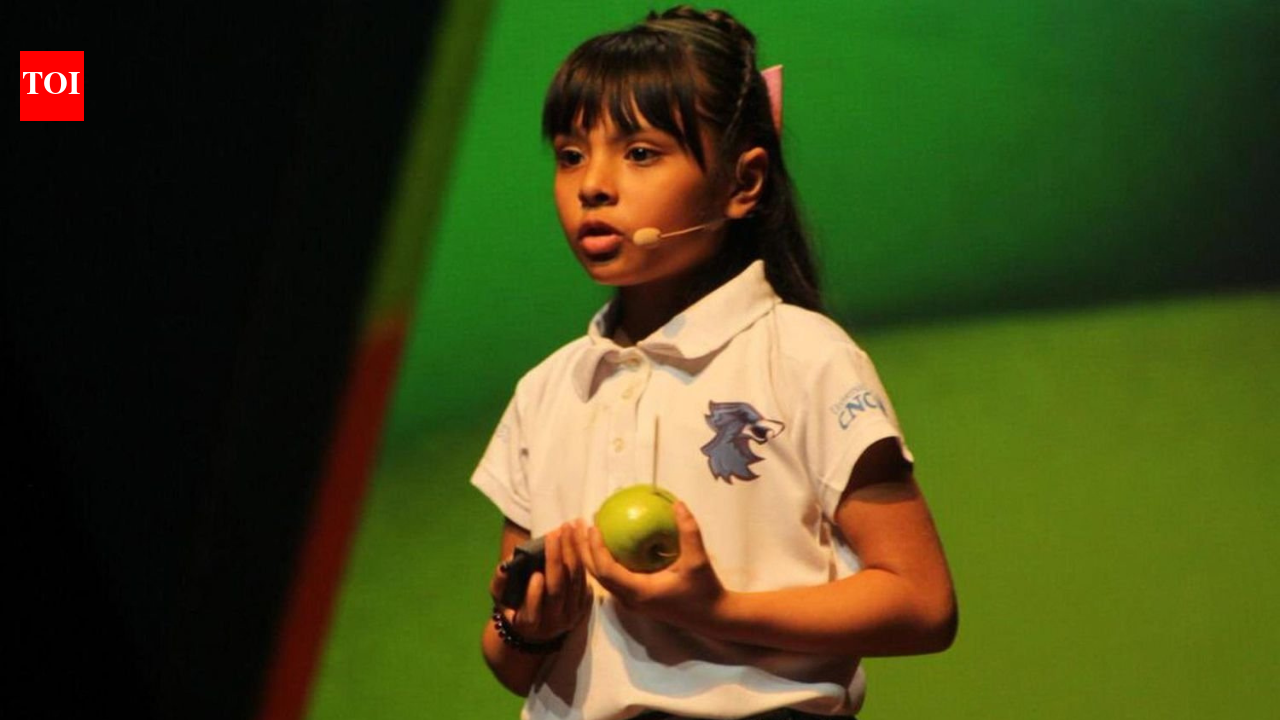
MEXICO CITY — Adhara Pérez Sánchez, an 11-year-old girl from Mexico, has captured international attention with her remarkable academic achievements, overcoming the challenges of autism to complete primary school at age 5 and earn a master's degree in engineering at just 11. According to a report in The Times of India, Pérez, who hails from the small town of Macuspana in Tabasco state, began her educational journey at an unusually accelerated pace, driven by her exceptional intellect and determination.
Born on March 16, 2011, Pérez was diagnosed with autism spectrum disorder at age 3, a condition that initially presented hurdles in traditional schooling environments. Her mother, Jenny Pérez, noticed early signs of her daughter's prodigious abilities. 'She was always asking questions about the universe and how things worked,' Jenny Pérez told local media in an interview republished by The Times of India. Instead of conforming to standard curricula, Adhara was homeschooled initially, allowing her to progress at her own rapid rate.
By age 5, in 2016, Adhara had not only finished primary school but had also delved into advanced subjects like astrophysics and systems engineering. Officials at the National Autonomous University of Mexico (UNAM), where she later enrolled, confirmed her enrollment in their preparatory program at age 8. 'Adhara's case is extraordinary; her cognitive abilities far exceed her age peers,' said Dr. María González, a professor of child psychology at UNAM, in a statement to reporters. This acceleration was supported by educational psychologists who tailored programs to accommodate her autism while nurturing her talents.
In 2022, at the tender age of 11, Pérez completed her master's degree in engineering administration from the Monterrey Institute of Technology (ITESM), one of Latin America's premier universities. The thesis she defended focused on sustainable energy systems, a topic she chose to align with her passion for space exploration. 'I want to contribute to humanity's future beyond Earth,' Pérez said during her graduation ceremony, as quoted in the Times of India article. Her academic path included skipping multiple grades and participating in international online courses, including those offered by NASA’s educational outreach programs.
Pérez's story gained traction globally after her achievements were highlighted in Mexican media outlets like El Universal and Reforma, which detailed her transition from local homeschooling to prestigious institutions. According to UNAM records, she scored in the 99th percentile on intelligence assessments administered at age 6, a metric that experts say places her among the top child prodigies worldwide. However, not all perspectives on her journey are uniformly celebratory; some educators in Tabasco have raised concerns about the pressures on young gifted children.
'While Adhara's success is inspiring, we must ensure that accelerated education doesn't come at the expense of social development,' noted Eduardo Ramírez, a special education coordinator in Macuspana, in comments to The Times of India. He pointed out that autism often involves unique social challenges, and Pérez has spoken openly about feeling isolated from peers her age. Despite this, her family emphasizes the positive impact of her pursuits. Jenny Pérez added, 'Autism didn't stop her; it fueled her curiosity.'
The young prodigy's ambitions extend far beyond academia. Pérez has set her sights on working with NASA to aid in the colonization of Mars, inspired by figures like Elon Musk and NASA's Artemis program. In interviews, she has expressed a desire to develop technologies for sustainable habitats on the Red Planet. 'Mars is the next frontier, and I want to help make it habitable,' she stated in a video profile shared by ITESM. This goal aligns with NASA's ongoing Mars Sample Return mission, scheduled for the 2030s, which aims to pave the way for human exploration.
Contextually, Pérez's achievements come amid growing recognition of neurodiversity in education. In Mexico, where public schooling often struggles with resources for special needs students, her case highlights both opportunities and gaps. The Mexican Ministry of Public Education reported in 2023 that only about 20% of autistic children receive tailored support, according to government data cited in regional reports. Pérez's path was facilitated by private scholarships and family advocacy, raising questions about accessibility for others.
Experts in gifted education offer varied insights. Dr. Joanne Ruthsatz, a researcher at the University of Cincinnati who studies prodigies, commented in a related Times of India feature that children like Pérez often exhibit 'savant-like' abilities in specific domains. 'Her focus on STEM fields is common among autistic prodigies, who can hyper-focus on complex problems,' Ruthsatz said. However, she cautioned that long-term outcomes vary, with some facing burnout if not properly supported emotionally.
Pérez's family moved to Mexico City in 2019 to access better educational facilities, a decision that Jenny Pérez described as pivotal. 'Tabasco didn't have the resources, but here she could thrive,' she said. The relocation allowed Adhara to interact with mentors at UNAM's astrophysics department, where she participated in workshops on exoplanets and rocket propulsion. One such mentor, Dr. Carlos Mendoza, recalled, 'She corrected me on orbital mechanics during her first session—it's humbling and exciting.'
Broader implications of Pérez's story resonate in the global discourse on child prodigies. Historical figures like Blaise Pascal, who advanced mathematics at age 12, or modern examples like Alia Sabur, who earned a PhD at 18, provide context. Yet, Pérez's autism adds a layer of uniqueness, challenging stereotypes. Advocacy groups like Autism Speaks Mexico have praised her as a role model, stating in a press release, 'Adhara shows that with the right support, autistic individuals can achieve greatness.'
Looking ahead, Pérez plans to pursue a PhD, potentially in aerospace engineering, while applying for NASA's internship programs. The space agency has not commented directly on her aspirations, but officials noted in a general statement that they welcome diverse talents. 'NASA values innovative minds from all backgrounds,' said agency spokesperson Lisa Mitchell in response to inquiries about young applicants. Pérez's next steps include competing in the upcoming International Science and Engineering Fair, where she aims to present research on Mars terraforming.
Her journey also intersects with Mexico's push into space technology. The Mexican Space Agency (AEM) launched its first satellite in 2019, and Pérez has expressed interest in collaborating domestically before going international. 'I want to represent Mexico on Mars,' she said. As her story spreads, it inspires educators worldwide to rethink inclusive acceleration for gifted neurodiverse students.
In Macuspana, where Pérez's roots lie, community leaders are organizing events to celebrate her success, hoping to fund local autism programs. 'She's our pride,' said town mayor Ana López in a local interview. Yet, challenges remain; Pérez has mentioned dealing with online trolls who question her authenticity, though her credentials have been verified by multiple universities.
Ultimately, Adhara Pérez Sánchez's trajectory from a small-town autistic child to a master's-holding aspirant for NASA underscores the boundless potential of human ingenuity. As she eyes the stars, her story serves as a beacon for others facing similar obstacles, proving that with passion and support, even the vastness of space is within reach.