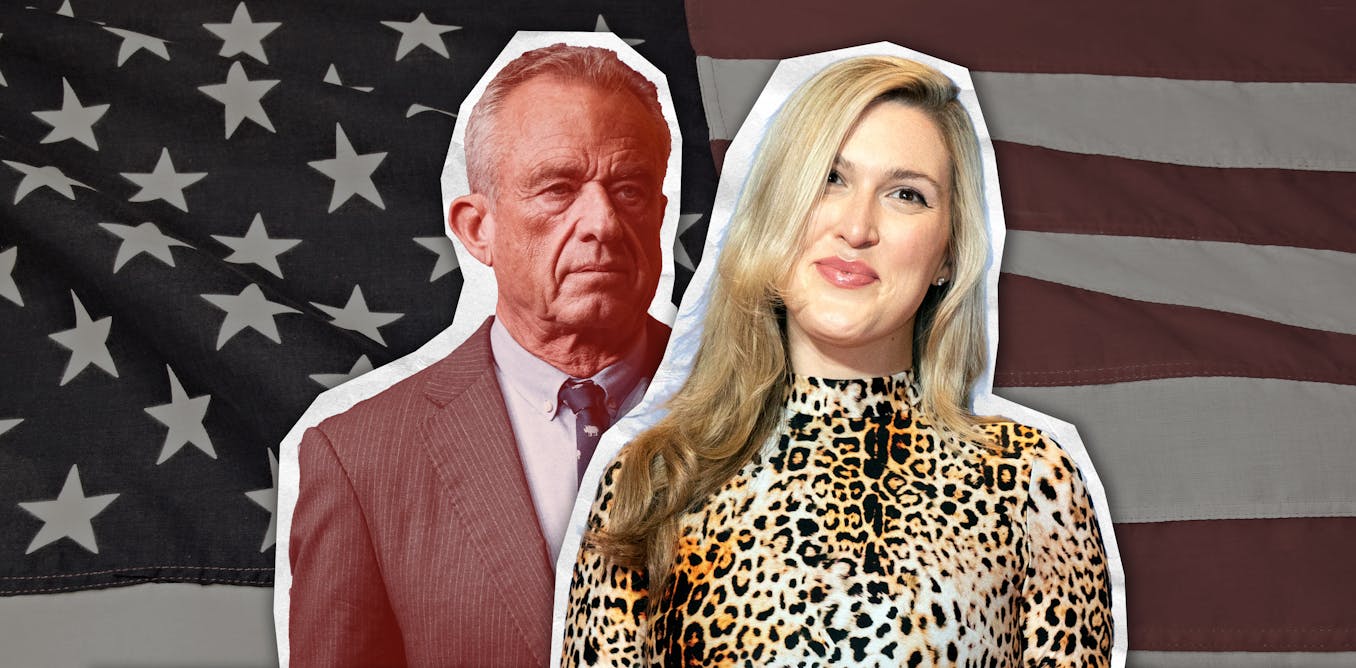
Washington, D.C. – The recent release of Olivia Nuzzi's memoir American Canto has reignited debates over journalistic ethics, particularly in light of her past relationship with Robert F. Kennedy Jr., now the U.S. Health Secretary. Published by Avid Reader Press, the book details what Nuzzi describes as a 'digital affair' with Kennedy that began in November 2023 during her profile of him as a presidential candidate for New York magazine, where she served as Washington correspondent. The affair, exposed publicly, led to her dismissal from the publication and has raised questions about whether Nuzzi withheld information that could have influenced Kennedy's Senate confirmation hearings for his current role.
Since his confirmation as Health Secretary ten months ago, Kennedy has been at the center of controversy, most notably last month when he directed the Centers for Disease Control and Prevention (CDC) to drop its longstanding position that vaccines do not cause autism. This move, according to a recent article in New York magazine, contributed to a dramatic shift within the agency, transforming it from what staff described as 'a fun place to work' in early January to a 'dark, empty shell' marked by widespread distress. The piece highlighted 'a lot of crying,' multiple firings, and high-profile resignations, including the September dismissal of CDC Director Dr. Susan Monarez after she refused Kennedy's order to terminate vaccine experts 'without cause.'
Monarez's ouster triggered a cascade of departures, with the chief medical officer and vaccine director resigning in solidarity. Hundreds of CDC staff rallied in protest, carrying signs that read 'SCIENCE NOT CONSPIRACIES' and 'YOU ARE HEROES.' The New York magazine article, which delved into 'the agony and absurdity' of working under Kennedy, was published in the same outlet where Nuzzi had been employed until her scandal surfaced.
Nuzzi's book, initially hyped as a chronicle of her entanglement with Kennedy, has struggled commercially, selling just 1,165 hardcover copies in its first week. Its release was delayed to avoid overlapping with a memoir by Kennedy's wife, actress Cheryl Hines, a decision a publishing insider called 'a debacle of epic proportions.' Shortly after the launch, Nuzzi lost her position as West Coast editor at Vanity Fair, where her contract expired amid claims it was 'in the best interest of the magazine.'
In American Canto, Nuzzi recounts offering Kennedy informal advice during their relationship, such as suggesting which tie to wear on camera and alerting him to the Central Park bear controversy in 2023, urging him to address it proactively. She downplays her influence, insisting she was not his adviser, but the disclosures have drawn sharp criticism. Pulitzer Prize-winning journalist Michelle Goldberg, in a review, argued that Nuzzi's failure to report such details – if accurate – represented a significant ethical lapse, as they 'would have been of great public interest before [Kennedy's] Senate confirmation hearings to become the secretary of health and human services.'
Nuzzi portrays Kennedy, a prominent anti-vaccine activist, as a 'pathological liar' who 'orchestrated a narrative in which [she] was not just reduced to [her] sexuality but into a hyper-sexualised honeypot.' Yet, she characterizes their affair as 'a monumental fuckup' while deflecting blame for her professional fallout onto a 'public harassment campaign' led by her ex-fiancé, Ryan Lizza. Lizza, a former political reporter who ended their engagement after the Kennedy affair came to light, has accused Nuzzi of similar involvement with South Carolina Governor and former Congressman Mark Sanford, another presidential hopeful she covered. Lizza, who was fired from The New Yorker in 2017 over allegations of improper sexual conduct, has since serialized his side of the story on Substack, timed to coincide with Nuzzi's book release.
The memoir blends personal history with political reflection, rooted in Nuzzi's upbringing in Middletown, New Jersey, as the daughter of an abusive alcoholic mother with a 'borderline personality gaze' and a distant father who both passed away. Nuzzi writes that her father 'liked crazy women' and was unable to protect her, framing her narrative around themes of love, loss, and American character. She declares, '[This] is a book about life in America as I have lived and observed it, and about the nature of reality, and about character; [Trump’s] and my own […] It is also a book about love, because everything is about love, and love of country.'
However, the book has been criticized for its lack of honesty, with Nuzzi admitting to reflexive lying, such as denying the affair to her boss at New York magazine despite knowing he did not believe her. During a 2024 work trip to Mar-a-Lago that overlapped with Kennedy's visit – which he reportedly thought 'would be fun' – Nuzzi writes, 'I lied for him. It would not be the last time.' Even in mundane encounters, like meeting self-proclaimed whistleblowers from the right-wing film 2,000 Mules in Yuma County, Arizona, while covering the 'Take Our Border Back' trucker convoy, she lied about having seen the movie to avoid discussion.
Nuzzi extends her reflections on deception to the broader political landscape, particularly the Trump era, noting, 'The angel and the devil on my shoulders now sounded alike. It became impossible to say who believed what, whose beliefs were real, whether such a thing as realness could be verified and whether it even mattered. Verified by whom? There existed no agreed-upon neutral arbiter of facts.' She compares her dynamic with Kennedy to tectonic plates and describes America as 'a Gemini nation under a Gemini ruler,' gushing over their shared astrological moon: 'We had been born under the same kind of moon, the January waxing gibbous in Capricorn, 97 percent illumination, thirty-nine years apart.' Kennedy reportedly asked, 'Do you think this means we’re compatible?'
Structurally, the 320-page book lacks chapters or breaks, weaving haphazardly through celebrity gossip, philosophical quotes from figures like Friedrich Nietzsche, Carl Jung, and Jordan Peterson, and stream-of-consciousness asides on topics from Britney Spears to manta rays as 'angels of the sea.' It includes abrupt insertions like a 1,500-word report on the 2022 assault of Nancy Pelosi's husband and references to the 2024 self-immolation of conspiracy theorist Max Azzarello. Kennedy appears midway, anonymized as 'the Politician,' described in hallucinatory terms, including his psychedelic experiences and poetry like, 'I am a river. You are my canyon. I mean to flow through you. I mean to subdue and tame you.'
Nuzzi avoids naming most figures, referring to Lizza as 'the man [she] did not marry' and others with monikers like 'the MAGA General' for what appears to be Steve Bannon or 'the Failed Candidate' for Kari Lake. She claims her infatuation with politics stemmed not from policy but 'characters,' starting with Donald Trump, whom she interviewed at age 21 and calls 'the greatest character of all.' Nuzzi writes, 'In truth I consider news to be a burden and I would almost always rather someone else break it,' and adds, 'I do not think of myself as a reporter, really.'
Post-release, Nuzzi displayed wry humor on Instagram, listing 'Signs Your Book Rollout Has Gone Awry,' including 'Your agent texts you, unprompted and with no elaboration, “I love you,”' and 'Monica Lewinsky reaches out to check on your mental health.' Commenters noted the post might outperform the book itself. One of the book's sharper observations comes in its critique of politicians: 'A politician’s greatest trick is to convince you that he is not one. And what is a politician? Any man who wants to be loved more than other men and through his pursuit reveals why he cannot love himself.'
Critics, including the review in The Conversation, describe American Canto as 'muddled, maudlin and dishonest,' a 'pretentious, gushing mess' that sidesteps accountability. Nuzzi positions herself as a victim – 'a viral allegory of hubris,' akin to a female Icarus – rather than addressing her ethical breaches head-on. Lizza has emphasized that the scandal concerns 'not really a scandal about sex, but a scandal about journalistic ethics.' Nuzzi counters that Kennedy was 'briefly, my subject' and 'not my source,' but the debate persists over whether her proximity compromised her reporting on a figure whose policies now affect public health.
The implications extend beyond Nuzzi's career, touching on the integrity of political journalism in an era of blurred lines between reporters and subjects. As Kennedy continues to reshape agencies like the CDC, questions linger about what undisclosed influences may have played in his ascent. Nuzzi, now 31 and navigating further professional uncertainty, has not commented publicly on future plans, while the publishing world watches to see if her candid – if flawed – memoir finds a niche audience amid the fallout.