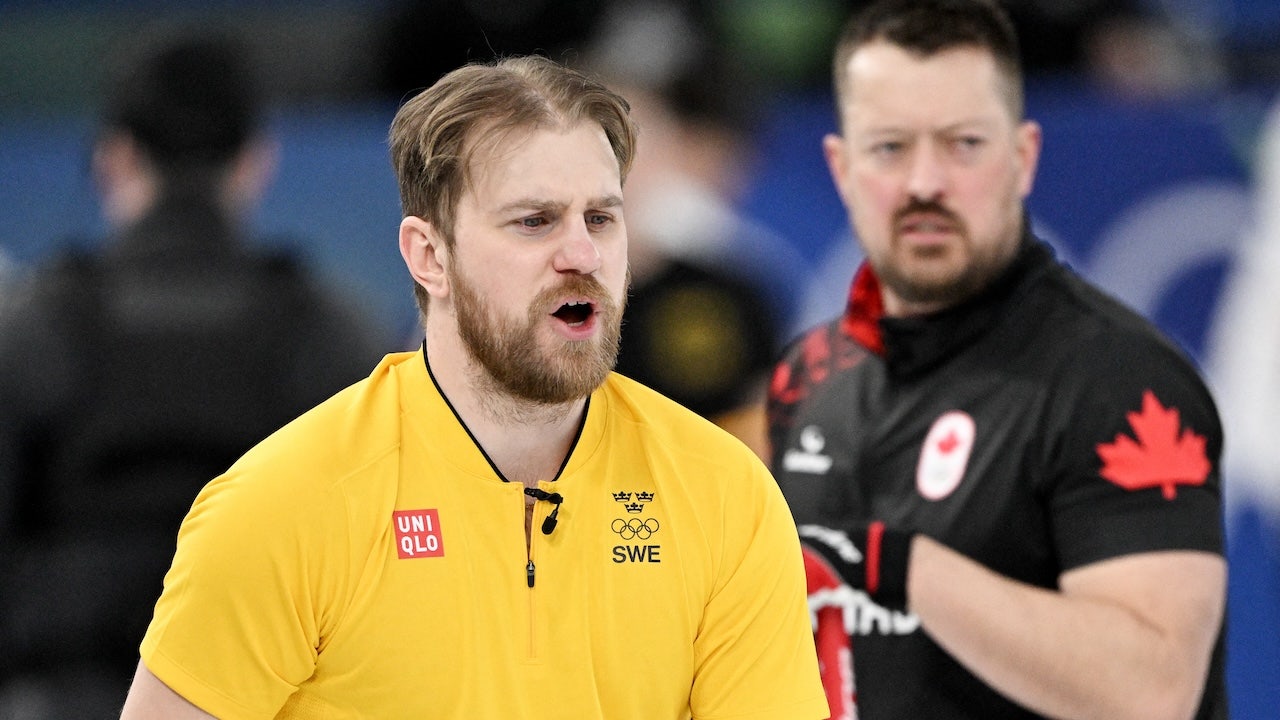
CORTINA D'AMPEZZO, Italy — A heated exchange marred the conclusion of an otherwise competitive men's curling round-robin match at the Milano Cortina 2026 Winter Olympics on Friday, as Canada's Marc Kennedy unleashed a profane outburst at Sweden's Oskar Eriksson following accusations of cheating.
The incident unfolded after Canada secured an 8-6 victory over Sweden at the Cortina Curling Olympic Stadium. With the game in its ninth end, tensions boiled over when Eriksson, a veteran Swedish curler, alleged that Kennedy had committed an illegal procedure known as double-touching stones after releasing them at the hog line. According to World Curling policy, a moving stone cannot be touched beyond the hog line, though double-touching the rock before the line is permitted and not considered a violation.
Kennedy, serving as the third for the Canadian team led by skip Brad Jacobs, immediately rejected the claim. Eyewitnesses reported that he shouted, "I haven’t done it once. You can f--- off," directing the insult directly at Eriksson. The Swedish player fired back, saying, "I’ll show you a video after the game. I’ll show you a video where it’s two meters over the hog line."
Both teams quickly appealed to the on-ice officials, seeking a review of the disputed play. However, after deliberation, the referees upheld the original calls, and no adjustments were made to the score or match outcome. The confrontation highlighted the intense scrutiny that defines elite curling, a sport where precision and adherence to rules can swing the momentum in tight contests.
The Canadian squad, featuring Ben Hebert, Brad Jacobs, and Brett Gallant, entered the match as part of the round-robin phase, where teams vie for positioning ahead of the playoffs. Sweden, captained by Eriksson, has long been a powerhouse in the discipline, with Eriksson himself regarded as one of the sport's all-time greats. Friday's game added to the drama of the Olympics, which kicked off earlier in the week on February 4, 2026, in the Italian Alps.
Post-match, Kennedy addressed the media, expressing frustration while maintaining respect for his opponent. "I have a ton of respect for Oskar Eriksson," he said. "He’s one of the best players to ever play. I just told him … I would never accuse you of cheating. I’ve been on tour for 25 years. He pulled a hog line official on us to make sure we weren’t double-touching. The hog line official was there for six ends, never said a thing and he’s still talking about it in the ninth end."
"I don’t like being accused of cheating, so I told him what I thought of it," Kennedy added, underscoring the personal sting of the allegation in a sport built on sportsmanship and fair play.
From the Swedish side, the response was more measured. Team leader Fredrik Lindberg issued a statement indicating restraint. "At this point, the Swedish Olympic Committee will not seek an investigation regarding the events during Friday’s game," Lindberg said, according to reports from The National Review. This decision suggests that while the accusation was serious enough to spark on-ice debate, Swedish officials are opting not to escalate the matter further at this stage of the competition.
The hog line violation in question is a nuanced rule in curling, often subject to interpretation under the pressure of high-stakes play. Double-touching occurs when a player inadvertently brushes the stone twice during delivery, but as long as it happens before the hog line—a transverse line marking the point of release—it's typically overlooked. Eriksson's claim implied a more egregious infraction, potentially involving contact after the line, which could nullify a shot and award points to the opposing team.
Images from the match captured the intensity: Sweden's Rasmus Wranaa reacting alongside Canada's Ben Hebert, and the broader scene at the Cortina Curling Olympic Stadium under the February chill. The venue, hosting curling events for the second time after the 1956 Games, has been a focal point of the Milano Cortina Olympics, though not without its own hiccups. Just days earlier, a power outage briefly halted competitions at the start of matches, adding to the logistical challenges of the event.
This wasn't the only controversy rippling through the Olympics. Separately, a judging dispute in the ice dance final drew ire when a French judge was accused of inflating scores for the host Italian team, reportedly jeopardizing Team USA's shot at gold. While unrelated to the curling clash, it underscored a broader theme of officiating concerns at these Games, where national pride and international competition intersect sharply.
Curling, often called the "chess on ice," demands not just physical skill but mental fortitude, with players sweeping the ice to guide 42-pound granite stones toward a target called the house. The Canada-Sweden matchup exemplified this, with both teams trading ends and points in a back-and-forth battle that kept spectators on edge until the final stone. Canada's win bolsters their standing in the round-robin, positioning them favorably as the tournament progresses toward medal rounds later in the week.
Eriksson, who has medaled multiple times in prior Olympics, including gold in mixed doubles at Beijing 2022, brings a wealth of experience to the Swedish lineup. His decision to challenge Kennedy verbally reflects the passion that fuels top-level athletes, even if it crossed into uncharacteristic territory. Kennedy, a two-time Olympian himself, has been a fixture on the World Curling Tour, amassing over two decades of competitive play.
As the Milano Cortina Games continue, organizers and the World Curling Federation may review protocols for handling such disputes to prevent future escalations. Officials have emphasized that video reviews are available post-match, aligning with Eriksson's offer to present evidence. For now, the focus shifts to upcoming fixtures, with Canada facing stiffer competition in the playoffs and Sweden aiming to rebound from the loss.
The incident has sparked discussions among curling enthusiasts and analysts about the sport's growing visibility at the Olympics. What began as a routine round-robin game has become a talking point, reminding viewers that even in a game of finesse and strategy, emotions can run as hot as the competition itself. With medals on the line, expect the intensity to only heighten in the days ahead.