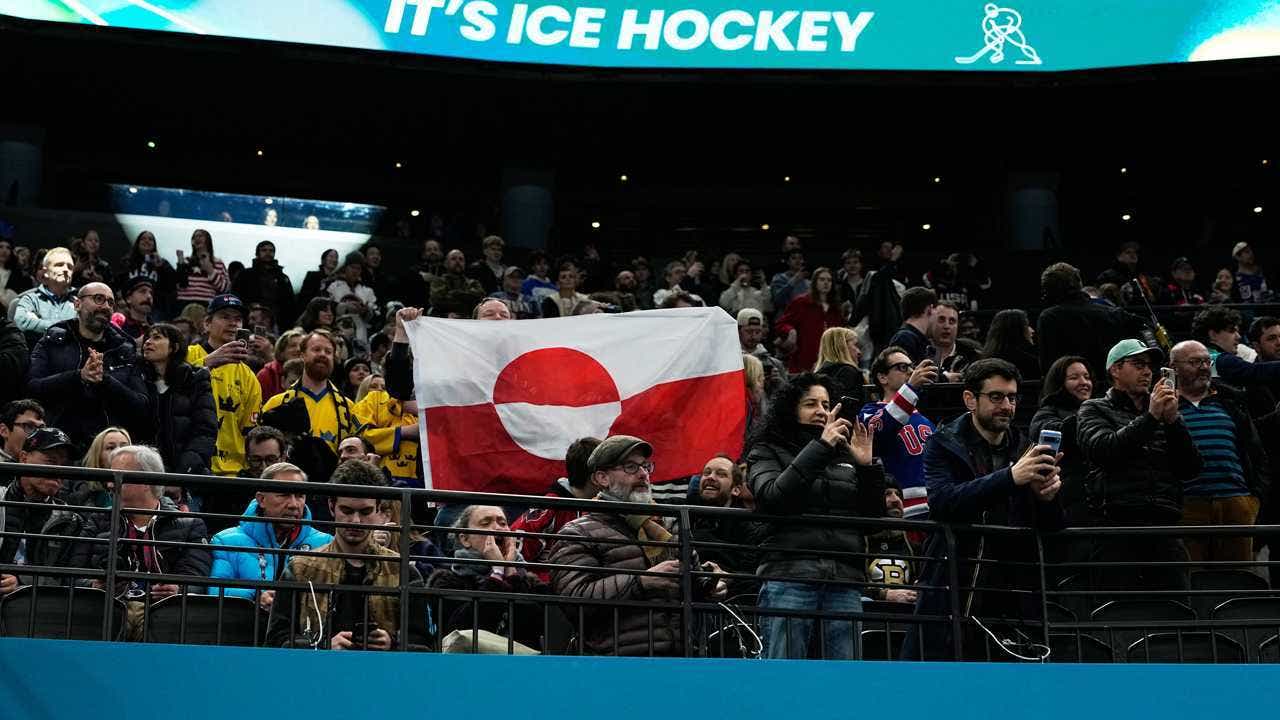
MILAN, Italy — In a striking blend of sports and geopolitics at the 2026 Winter Olympics, two fans unfurled a large Greenland flag during Team USA's 6-3 comeback victory over Denmark in men's ice hockey on Saturday, February 14, drawing widespread attention and sparking a wave of viral reactions online. The display, which occurred amid warmups and after Denmark's opening goal, was intended as a protest against President Donald Trump's longstanding interest in acquiring Greenland from Denmark, a notion that has simmered in U.S. foreign policy discussions since his first term.
The game, played at the Mediolanum Forum in Milan as part of the preliminary round, saw Denmark jump to an early 2-1 lead after the first period. But the Americans, featuring a roster heavy with NHL talent, mounted a dominant offensive surge in the second period, scoring three unanswered goals to shift the momentum. Brady Tkachuk of the Ottawa Senators, Jack Eichel of the Vegas Golden Knights, and Noah Hanifin, also of Vegas, lit the lamp in quick succession, paving the way for the eventual 6-3 win. The U.S. outshot Denmark 47-21, showcasing their firepower with 14 players recording points, including brothers Brady and Matthew Tkachuk, as well as Jack and Quinn Hughes.
Amid the on-ice action, Vita Kalniņa and her husband, Alexander Kalniņš, Latvian hockey enthusiasts living in Germany, held up the Greenland flag to voice their solidarity with Europe. The couple, who support the Latvian team but attended the U.S.-Denmark matchup, raised the banner enthusiastically as a show of support for Denmark, which administers Greenland as an autonomous territory. "We are Europeans, and I think as Europeans we must hold together," Kalniņš told The Associated Press after the game. He added, "The Greenlandic people decide what will happen with Greenland, but, as it is now, Greenland is a part of the Danish kingdom and, as Greenland is a part of Denmark, as in this case, we support both countries against the U.S."
The flag-raising moment quickly captured the crowd's attention and spread rapidly on social media, where it elicited a mix of amusement, support, and criticism. One user quipped in response to the U.S. pulling ahead 4-2, "Now that the USA is up 4-2 could we place a wager that if the USA wins the game, Denmark gives up Greenland?" Another posted after the final buzzer, "Team USA won, do we get Greenland now?" Similar sentiments echoed across platforms, with some American fans tying the victory to the island's strategic value in the Arctic.
Not all reactions were lighthearted. Some conservative influencers amplified the jokes, using the U.S. triumph as fodder for commentary on Trump's territorial ambitions. Trump has repeatedly expressed interest in purchasing Greenland, citing its mineral resources, military positioning, and climate significance, a proposal that drew international backlash during his presidency. In a recent development, Vice President JD Vance addressed U.S. efforts related to Greenland while speaking to reporters at Zvartnots International Airport in Armenia on February 10, 2026, though details of his remarks focused on broader Arctic strategy rather than direct acquisition talks.
Danish supporters at the arena pushed back against the political intrusion into the sporting event. Dennis Petersen, a fan from Denmark, emphasized the separation of athletics from international affairs. "It doesn’t matter whatever sport it is — it could be tennis, it could be bobsledding, it can be ice hockey, it could be football — it has nothing to do with politics," Petersen said. "They are athletes, not politicians." His view highlighted a common Olympic ideal of unity through competition, even as global tensions occasionally spill into the Games.
American attendees, meanwhile, expressed a desire for apolitical enjoyment. Rem de Rohan, watching from the stands, remarked, "I think this is the time for people to kind of put that down and compete country versus country and enjoy." He continued, "We love rooting on every country that’s been here." De Rohan's comments reflected a broader sentiment among U.S. fans, who traveled to Milan despite advisories urging caution due to suspected sabotage on Italian railways affecting Olympic visitors.
The incident unfolds against a backdrop of renewed U.S. interest in Greenland, which boasts vast untapped reserves of rare earth minerals critical for technology and defense. Denmark has firmly rejected any sale, with Greenlandic leaders asserting self-determination. The territory's status as part of the Danish realm dates to 1953, but Greenland has pursued greater autonomy since a 2009 referendum, controlling its internal affairs while Denmark handles foreign policy and defense. Trump's 2019 tweet about buying Greenland prompted a diplomatic row, with then-Danish Prime Minister Mette Frederiksen calling the idea "absurd."
Recent U.S. actions have included increased military cooperation and investments in Greenland's infrastructure, such as airport upgrades, framed as climate adaptation aid but viewed by some as strategic encroachment. According to reports, the Biden administration continued these efforts before Trump's return, though with less overt territorial rhetoric. The flag protest at the Olympics revives these debates, blending them with the pageantry of the Games, where Milan and nearby Cortina d'Ampezzo host events through February 25.
On the ice, the U.S. team's performance solidified their status as medal contenders. Every goal came from a different scorer, underscoring the depth of the roster, which includes 20 NHL players. Coach David Quinn praised the comeback, noting the team's resilience after the slow start. Denmark, ranked lower but competitive with NHL stars like Oliver Bjorkstrand, fought valiantly but couldn't match the Americans' second-period onslaught.
As the preliminary round concludes, the U.S. faces Germany on Sunday at 3:10 p.m. ET in their final group game. With only eight NHLers on the German side, the Americans enter as heavy favorites. A win secures a direct path to the knockout stage, while even an overtime loss would suffice. Their advancement could hinge on other results, including Canada's matchup against France and tiebreakers involving point differentials with teams like Slovakia, Finland, and Sweden.
The Greenland flag episode isn't the first time politics has intersected with Olympic hockey. Past Games have seen protests over issues from human rights to territorial disputes, though such displays are rare in the NHL-dominated men's tournament. Organizers have not commented on the incident, but International Olympic Committee rules prohibit political demonstrations, potentially subjecting the fans to review.
Beyond the rink, the viral moment underscores how Trump's foreign policy echoes continue to resonate globally. Social media amplified the story, with hashtags linking hockey highlights to Arctic geopolitics garnering thousands of views. While some dismissed it as harmless fun, others saw it as a reminder of Europe's wariness toward U.S. expansionism in a region warming due to climate change.
For the athletes, the focus remains on the puck. U.S. captain Jack Eichel celebrated his third goal of the game with visible relief, helping erase the early deficit. Danish forward Bjorkstrand, who challenged Tkachuk physically, represented his nation's pride despite the loss. As the Olympics progress, such storylines add layers to what is ostensibly a celebration of winter sports.
Looking ahead, the U.S. team's tournament trajectory points toward a potential gold-medal run, echoing their 2010 silver and 2002 bronze. Yet the Greenland flag's appearance ensures the Denmark game will be remembered as much for its off-ice drama as its on-ice excitement, highlighting the Games' role as a global stage where sports and world affairs inevitably collide.