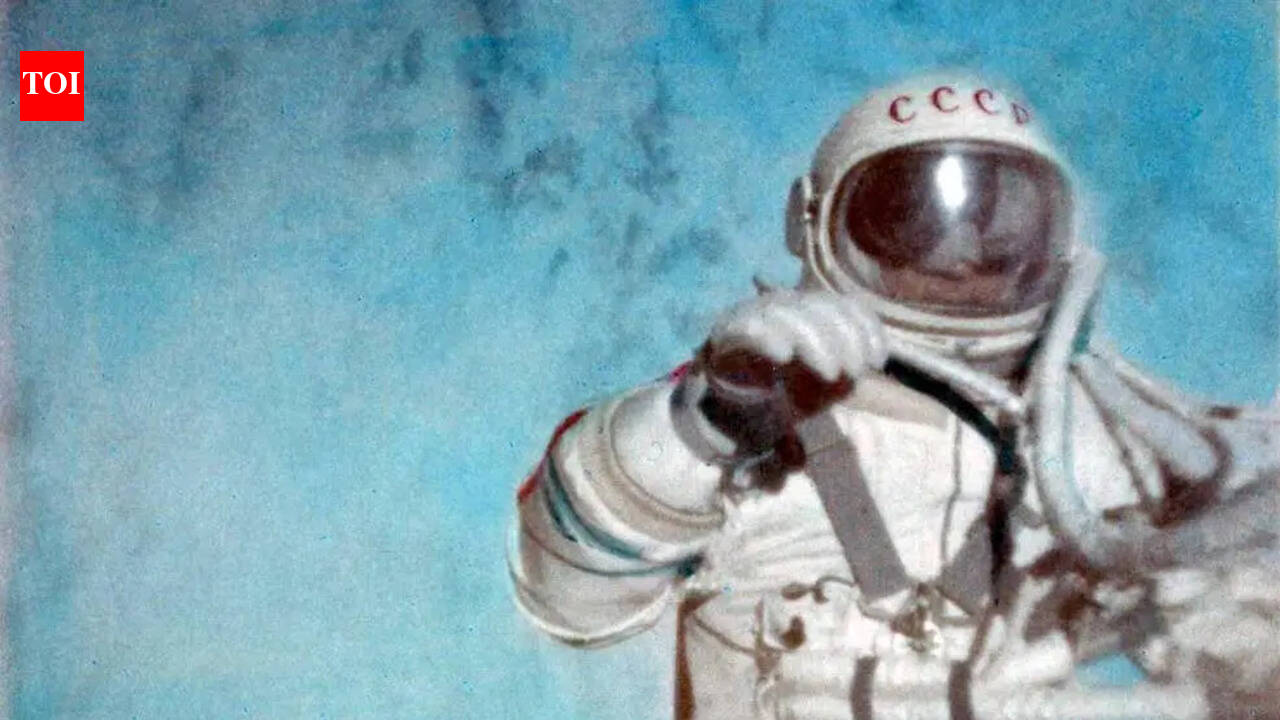
On March 18, 1965, the Soviet Union etched its name further into the annals of space exploration by achieving what was then the ultimate frontier feat: the first human spacewalk. Cosmonaut Alexei Leonov, aboard the Voskhod 2 spacecraft, stepped out into the vacuum of space, floating above Earth for a brief but groundbreaking 12 minutes and 9 seconds. This daring maneuver not only outpaced the United States in the intensifying Cold War space race but also came perilously close to disaster due to an oxygen crisis that threatened the lives of Leonov and his commander, Pavel Belyayev.
The mission, launched from the Baikonur Cosmodrome in Kazakhstan just two days earlier on March 16, was a bold response to American ambitions in space. At the time, the U.S. was gearing up for its own Gemini program, with NASA officials closely monitoring Soviet advancements. According to reports from the Times of India, the Voskhod 2 flight represented a pivotal moment in the Soviet push for dominance, as Leonov became the first person to venture outside a spacecraft while it was in orbit. The spacecraft, carrying only two crew members without the luxury of spacesuits for all, underscored the high-stakes improvisation characteristic of the era's space programs.
Leonov's spacewalk began at approximately 8:30 a.m. Moscow time, as Voskhod 2 hurtled through its 166th orbit at an altitude of about 354 kilometers above the Pacific Ocean. Clad in the innovative Berkut spacesuit, designed to withstand the harsh conditions of space, Leonov pushed open the airlock hatch and propelled himself into the void. He later described the experience in interviews as both exhilarating and terrifying, with the Earth appearing as a vast, curved blue marble against the blackness. 'I felt like I was in a dream,' Leonov reportedly said in a 2005 recollection, though details from contemporary Soviet announcements were tightly controlled.
But the triumph was almost eclipsed by technical peril. As Leonov floated free, tethered by a 5.35-meter umbilical cord that supplied oxygen and communications, his suit began to balloon due to a pressure differential between the spacecraft's atmosphere and the near-vacuum outside. The Berkut, pressurized at 0.27 atmospheres internally while the cabin was at 1 atmosphere, expanded uncomfortably, restricting Leonov's movements. According to mission logs cited in historical accounts, he struggled to bend his limbs, turning what was planned as a 10-minute excursion into a desperate fight for survival.
The oxygen crisis intensified as Leonov's breathing grew labored. With his suit's fabric stiffening, he couldn't squeeze back through the airlock as intended. Reports indicate he vented some air from the suit to reduce its volume, a risky improvisation that dropped his oxygen levels perilously low. 'I could feel my heart pounding; it was like being squeezed in a vice,' Leonov recounted in later memoirs, emphasizing the split-second decisions that saved his life. After 12 minutes and 9 seconds—the longest he could endure without risking unconsciousness—he finally contorted his body sideways to re-enter the airlock, collapsing exhausted inside.
Back in the capsule, Belyayev faced his own challenges in sealing the airlock and repressurizing the cabin. The two cosmonauts then dealt with a malfunctioning orientation system that prevented an automatic re-entry, forcing a manual landing that went awry. Voskhod 2 touched down on March 19 in the dense taiga forests of the Perm Oblast in western Siberia, far from the intended recovery zone. According to Soviet state media at the time, the crew endured a cold night in the wilderness before being located by helicopter the next morning, but unconfirmed reports from defectors later suggested they fired signal flares and even shot a bear to defend their position.
The Soviet achievement sent shockwaves through the American space program. NASA administrator James Webb acknowledged the milestone in a press conference shortly after, stating, 'The Soviets have demonstrated a significant capability, and we must accelerate our efforts.' Behind the scenes, U.S. intelligence had tracked the launch, with analysts at the CIA noting the Voskhod program's rapid progression from the three-man Vostok flights of 1964. Yet, while the spacewalk was a propaganda victory for Moscow, it highlighted the dangers of cutting corners—Voskhod 2 lacked ejection seats, unlike upcoming American missions, a decision driven by the need to beat the U.S. to the punch.
Contextually, the 1965 spacewalk capped a series of Soviet firsts that had kept the U.S. on the defensive since Yuri Gagarin's orbital flight in 1961. The Voskhod series itself was an adaptation of the Vostok capsule, modified to carry multiple crew without major redesigns, reflecting the urgency of the space race amid escalating Cold War tensions. President Lyndon B. Johnson, facing domestic pressures from the Vietnam War, urged NASA to prioritize extravehicular activity, leading to the first American spacewalk by Edward White just three months later on June 3, 1965, during Gemini 4.
Leonov's feat was not without controversy. Western analysts, drawing from declassified documents, pointed to the oxygen crisis as evidence of Soviet engineering flaws. The Times of India article notes that the incident was 'shadowed by an oxygen crisis,' underscoring how close the mission came to tragedy. Soviet officials downplayed the risks in initial reports, proclaiming the walk a unqualified success and Leonov a hero of the socialist state. Premier Alexei Kosygin awarded both cosmonauts the title of Hero of the Soviet Union upon their return, with parades in Red Square celebrating the victory over capitalist rivals.
From a technical standpoint, the spacewalk validated key concepts for future missions. The Berkut suit, though problematic, proved that humans could survive brief exposure to space, paving the way for more ambitious endeavors like the American Apollo program and eventual Soviet Salyut stations. Experts at the time, including those from the Royal Aeronautical Society in London, praised the tether system and airlock design, even as they criticized the lack of redundancy. 'It was a giant leap, but one taken on a tightrope,' said British space historian Patrick Moore in a 1965 BBC broadcast.
Leonov himself went on to contribute significantly to space art and diplomacy, sketching views from orbit and advocating for international cooperation. In the decades following, he reflected on the near-miss with the oxygen supply as a lesson in humility. 'Space doesn't forgive mistakes,' he told reporters in 2011, shortly before his death in 2019. Belyayev, who commanded the mission, passed away in 1970 from health complications possibly linked to the stresses of the flight.
The broader implications of Voskhod 2 extended beyond the immediate space race. It intensified global interest in space as a domain of human endeavor, inspiring scientists and engineers worldwide. In the U.S., it spurred investments that culminated in the Moon landing four years later, while in the Soviet Union, it temporarily masked underlying program struggles, including the tragic loss of Vladimir Komarov in Soyuz 1 in 1967. Today, as private companies like SpaceX revive spacewalking for satellite repairs and station maintenance, Leonov's pioneering step remains a cornerstone of orbital history.
Looking ahead, the event's legacy influences modern discussions on space safety. With NASA's Artemis program planning lunar walks and China's Tiangong station expanding capabilities, the oxygen crisis of 1965 serves as a cautionary tale. International Space Station crews, drawing from lessons learned, now conduct extravehicular activities with multiple redundancies and real-time medical monitoring. As space becomes more accessible, the unyielding demands of the environment—evident in that fateful March day—continue to shape protocols.
In commemorating the 59th anniversary this year, space agencies worldwide honor Leonov's courage. The European Space Agency's exhibit at the 2024 International Astronautical Congress featured replicas of the Berkut suit, reminding visitors of the thin line between breakthrough and breakdown. For historians, Voskhod 2 encapsulates the era's blend of innovation and peril, a testament to human ambition pushing against the unknown.