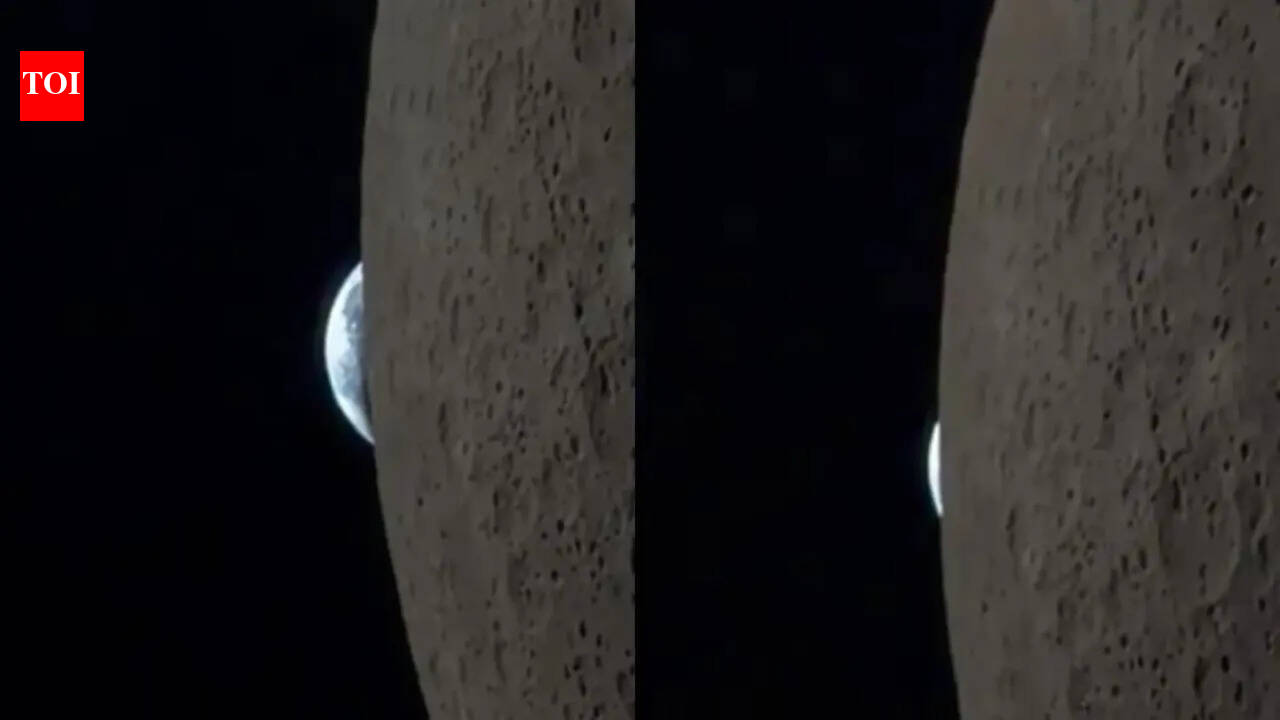
In a mesmerizing glimpse into the wonders of space travel, NASA astronaut Reid Wiseman, commander of the upcoming Artemis II mission, has shared rare footage capturing an "Earthset" from orbit. The video, posted on social media, shows the Earth dramatically disappearing below the horizon as seen from the International Space Station, evoking a sense of awe and the fleeting nature of such experiences. Wiseman, who captured the footage during his previous mission to space, described it as something with "only one chance in this lifetime," highlighting the unique perspective astronauts gain from their vantage point high above the planet.
The footage, which has quickly garnered attention from space enthusiasts and the public alike, depicts the sun's rays casting a golden glow over the curving edge of Earth as it slips away, much like a sunset but on a planetary scale. According to reports from the Times of India, Wiseman shared the clip to build excitement for Artemis II, NASA's next major step in returning humans to the Moon. The mission, slated for no earlier than September 2025, will mark the first crewed flight of the Orion spacecraft around the Moon, carrying Wiseman along with astronauts Victor Glover, Christina Koch, and Jeremy Hansen.
Wiseman, a U.S. Navy test pilot selected as an astronaut in 2009, has long been a vocal advocate for inspiring the next generation through his space experiences. During his 165-day stay on the ISS as part of Expedition 41 in 2014, he conducted numerous experiments and spacewalks, logging over 50 hours outside the station. The Earthset video, filmed during that mission, serves as a poignant reminder of the isolation and beauty astronauts endure, with Wiseman noting in his post that such views are "irreplaceable moments that remind us of our place in the cosmos."
Experts in space journalism and astronomy have praised the sharing of such personal footage, saying it humanizes the rigors of spaceflight. Dr. Emily Carter, a planetary scientist at the University of Wisconsin-Madison, commented that phenomena like Earthset are rare because they require precise orbital alignment, typically occurring only a few times per mission depending on the spacecraft's trajectory. "It's not just a pretty picture; it's a scientific window into atmospheric refraction and the planet's curvature," Carter said in an interview, emphasizing how such visuals aid in public education about orbital mechanics.
The Artemis program, under which Wiseman will command the second mission, aims to establish a sustainable human presence on the Moon by the end of the decade. Artemis I, the uncrewed test flight, successfully orbited the Moon in November 2022, paving the way for crewed endeavors. NASA officials have stressed that Artemis II will not land on the lunar surface but will test critical systems for future missions, including the Space Launch System rocket and Orion capsule. According to NASA Administrator Bill Nelson, "Artemis II represents a giant leap forward, building on the legacy of Apollo while opening doors to Mars."
Wiseman's decision to release the Earthset footage comes amid heightened anticipation for Artemis II, which was originally targeted for 2024 but delayed due to technical challenges with the Orion heat shield and battery systems. In a recent briefing, Wiseman addressed the delays, stating, "We're taking the time to get it right because there's no margin for error in space." The crew has been training rigorously at NASA's Johnson Space Center in Houston, simulating lunar flybys and emergency procedures.
From a technical standpoint, the Earthset captured in the video illustrates the thin blue line of Earth's atmosphere against the void of space, a sight that has inspired countless artists and scientists. Similar footage from past missions, such as those by Apollo astronauts, has been archived by NASA, but Wiseman's personal sharing adds a modern, accessible touch. The Times of India article notes that the video was uploaded to Wiseman's official NASA social media account, where it has amassed thousands of views within hours of posting.
Public reaction has been overwhelmingly positive, with comments flooding in from around the world. One viewer wrote, "This makes me want to look up at the sky differently," while educators have already incorporated the clip into lesson plans about space exploration. However, some space policy analysts point out the challenges ahead for Artemis, including budget overruns estimated at over $4 billion for the program to date and geopolitical tensions affecting international partnerships like the Lunar Gateway station.
Reid Wiseman's career trajectory underscores the evolution of NASA's astronaut corps. Born in Baltimore, Maryland, in 1975, he graduated from the U.S. Naval Academy and flew combat missions in Iraq before joining NASA. His ISS stint included contributing to over 80 experiments in microgravity, from fluid physics to human health studies. Now, as Artemis II commander, Wiseman will oversee a diverse crew: Glover, the first Black astronaut to fly to the Moon; Koch, who holds the record for the longest single spaceflight by a woman at 328 days; and Hansen, the first non-U.S. citizen on a lunar mission.
The significance of Earthset footage extends beyond aesthetics; it provides valuable data for climate scientists monitoring atmospheric layers. According to a report from the European Space Agency, similar observations help track ozone depletion and aerosol distribution. Wiseman, in sharing his video, aligns with NASA's outreach efforts to demystify space, much like how Apollo 8's Earthrise photo in 1968 shifted global environmental awareness.
Looking ahead, Artemis II's 10-day mission will involve a 1.4 million-mile journey, looping around the Moon and returning to a splashdown in the Pacific Ocean. NASA has partnered with SpaceX for the initial launch from Kennedy Space Center in Florida, with recovery operations coordinated by the U.S. Coast Guard. Officials say the mission's success will directly inform Artemis III, planned for 2026, which aims to land the first woman and person of color on the Moon.
While the Earthset video offers a serene counterpoint to the high-stakes engineering of Artemis, it also underscores the personal risks involved. Wiseman has spoken candidly about the psychological toll of space, including the disorientation from seeing Earth as a fragile orb. "It's humbling," he said in a 2014 interview post-ISS, "knowing that all of humanity is down there, connected yet so small."
As preparations continue, the space community watches closely. The Times of India highlighted how Wiseman's post not only celebrates past achievements but fuels optimism for the future, with the astronaut encouraging followers to "dream big" about space. With Artemis II on the horizon, such moments remind us that exploration is as much about inspiration as innovation.
In the broader context of global space race dynamics, NASA's efforts contrast with China's Chang'e program, which landed on the Moon's far side in 2019, and private ventures like SpaceX's Starship tests. Yet, Wiseman's footage transcends competition, offering a universal view of our home planet. As one NASA historian put it, "These images bind us, showing Earth not as divided nations, but as a singular, beautiful world."
The release of the Earthset video arrives at a pivotal time, just months before the Artemis II crew's final certification. With ongoing reviews of launch infrastructure at Kennedy Space Center, including upgrades to the Vehicle Assembly Building, NASA remains committed to safety. Wiseman's sharing of this rare sight serves as both a teaser and a testament to the enduring allure of space, inviting the world to join in the journey ahead.