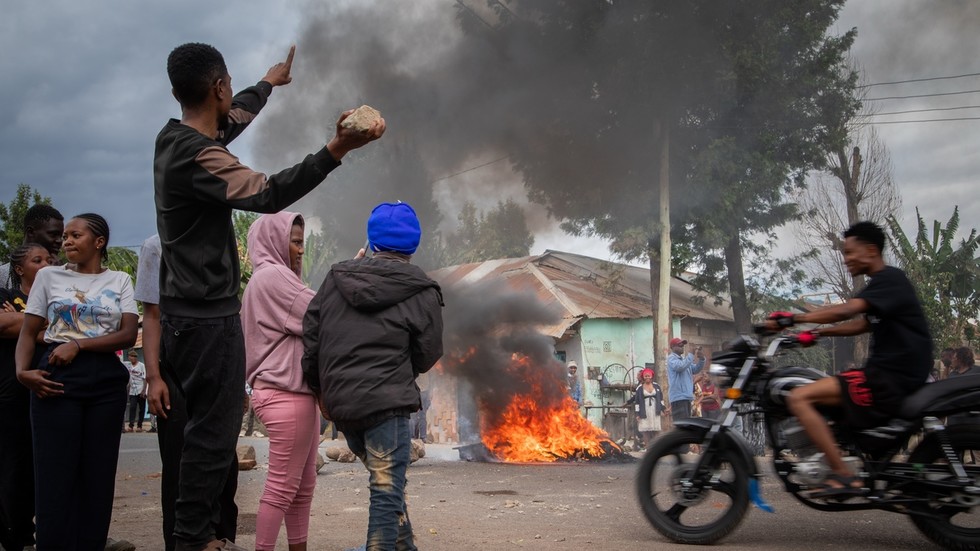
In a stark revelation that has shaken the East African nation, a government-appointed commission in Tanzania has reported that at least 518 people, including 21 children, lost their lives in post-election violence following the disputed October 29 vote last year. The unrest, which erupted across the country after President Samia Suluhu Hassan secured a landslide victory with 97% of the votes, marked a turbulent chapter in the country's democratic history. Hassan, who became one of only two female heads of state in Africa upon assuming the presidency in March 2021 following the death of her predecessor John Magufuli, was granted her first full five-year term as an elected leader.
The commission, chaired by retired Chief Justice Mohamed Chande Othman, detailed in its findings released on Thursday that the deaths resulted from 'unnatural causes,' with 197 individuals shot dead amid the chaos. More than 2,000 people were injured, including 833 who suffered gunshot wounds, according to the report. Othman emphasized the tragic impact on the young, stating, 'Of the 518 deaths, 21 were children. In this group, 15 were children aged between 15 and 17 years, four were aged between seven and ten years, and two were under five years of age.'
The violence stemmed from widespread protests triggered by the disqualification of Hassan's main challengers, notably Tundu Lissu, the leader of the opposition Chadema party. Lissu, who has been in detention for months on treason charges, was among those barred from running, fueling accusations of electoral manipulation. Demonstrations quickly turned chaotic, with authorities imposing an internet shutdown to curb the spread of information during the unrest.
While the commission did not directly assign blame for the fatalities, it called for deeper probes into the deployment of firearms by security forces. It also highlighted ongoing uncertainties, noting that 245 people remain missing and that 39 families reported viewing the bodies of relatives in morgues only for them to vanish later. The report cautioned that the death toll could climb further due to undocumented burials and incomplete records from the period.
International observers had raised alarms early on. In November, the United Nations Human Rights Office (OHCHR) issued a statement reporting that hundreds of people were killed, with an unknown number injured or detained. The OHCHR condemned what it described as the alleged use of 'unnecessary or disproportionate force,' including lethal weapons, by police against protesters.
Domestically, human rights groups have echoed these concerns with even graver claims. A 208-page report released on Monday by the Tanzania Human Rights Defenders Coalition documented allegations of mass graves, based on accounts of bodies being removed from morgues and buried in undisclosed locations without family notification. These assertions paint a picture of systematic efforts to conceal the scale of the violence, according to coalition representatives.
In contrast, the government commission firmly rejected the notion of mass graves in its conclusions. It portrayed the demonstrations not as peaceful assemblies but as 'unlawful and coordinated acts of violence' that violated Tanzanian laws. The report stated, 'The information and evidence confirm that there were people roaming around in various places… inciting and recruiting various people to participate in violence during and after the general election.'
This divergence in narratives underscores the polarized views surrounding the events. While opposition figures and rights advocates point to state repression as the root cause, official accounts emphasize orchestrated disruption aimed at undermining the electoral process. The commission's findings, spanning detailed investigations into the unrest, aim to inform future safeguards against such turmoil.
Tanzania's electoral landscape has long been dominated by Hassan's Chama Cha Mapinduzi (CCM) party, which has held power since the country's independence in 1961. The 2025 election—marking the first under Hassan's full leadership—promised reforms after Magufuli's tenure, which was criticized for authoritarian measures like banning opposition rallies and restricting media freedoms. Yet, the disqualification of key rivals reignited fears of backsliding, with Lissu's Chadema party decrying the process as rigged from the outset.
Protests were most intense in urban centers like Dar es Salaam, the commercial capital, and Arusha in the north, where clashes between demonstrators and security forces led to the bulk of reported casualties. Eyewitness accounts, as cited in the coalition's report, describe scenes of tear gas, live ammunition, and arbitrary arrests, with some protesters alleging targeted killings of opposition supporters. The internet blackout, lasting several days, isolated communities and hampered real-time reporting, leaving families in anguish over missing loved ones.
The commission's work, initiated shortly after the election, involved reviewing police records, medical reports, and testimonies from affected areas. Othman, a respected jurist with a history of probing human rights abuses, led a panel that sifted through evidence from across Tanzania's 26 regions. Their report, while acknowledging the human cost, stopped short of implicating specific actors, instead recommending the establishment of a permanent investigative body to ensure accountability.
Beyond the immediate toll, the violence has strained Tanzania's social fabric and international standing. The East African Community, of which Tanzania is a key member, has urged dialogue to restore trust in institutions. Economically, the unrest disrupted trade routes and tourism, sectors vital to the nation of over 60 million people, many of whom live in poverty despite rich natural resources like gold and natural gas.
Looking ahead, the commission's recommendations include constitutional reforms to address electoral flaws and enhance protest rights. President Hassan, in a recent address, pledged to act on the findings, saying her administration is committed to 'healing the nation' through inclusive governance. Yet, with Lissu still detained and opposition voices muted, skepticism persists among critics who view the report as a step toward whitewashing rather than genuine reckoning.
As Tanzania navigates this aftermath, the international community watches closely. The OHCHR has called for independent verification of the commission's data, while Amnesty International and other groups advocate for releasing political prisoners. The true path to reconciliation may hinge on bridging the gap between official narratives and grassroots accounts, ensuring that the 518 lives lost are not in vain but catalysts for a more equitable democracy.
In the end, this episode serves as a reminder of the fragility of democratic transitions in Africa, where high-stakes elections often collide with deep-seated grievances. For the families of the missing and the bereaved, justice remains elusive, but the commission's spotlight on the carnage offers a starting point for accountability in a nation striving to uphold its post-colonial ideals.