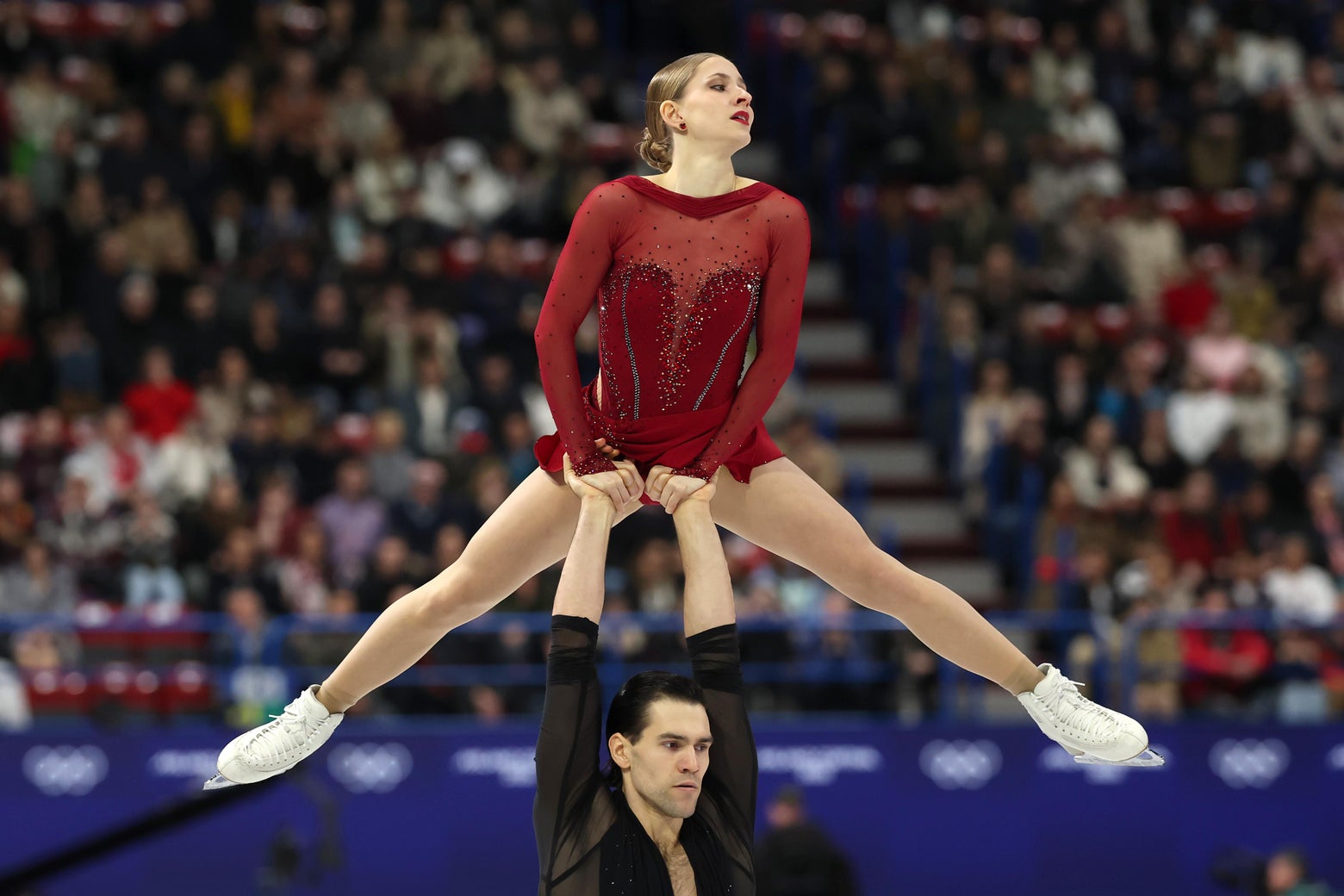
BEIJING — In a discipline known for its breathtaking lifts, daring throws, and the constant specter of spectacular falls, the pairs figure skating short program at the 2026 Winter Olympics delivered a mix of triumph, heartbreak, and unexpected standout performances on Sunday evening at the Capital Indoor Stadium. Germany's Minerva Hase and Nikita Volodin emerged as the surprise leaders, posting a commanding score that positions them 4.55 points ahead of the field heading into Monday's free skate. Their near-flawless routine to the tango piece "El Abrazo," composed especially for them, showcased the kind of precision and passion that could propel the duo to their first Olympic medal.
The event, part of the ongoing Olympic figure skating competition, highlighted the athleticism and artistry of pairs skating, where teams must synchronize jumps, spins, lifts, and throws under immense pressure. According to coverage from Slate, pairs skaters are akin to "American Ninja Warriors of figure skating, doing X Games–level stunts with the gentility and grace of the Bolshoi Ballet." This blend of high-risk elements and elegant expression has long made the discipline a fan favorite, though it also carries the highest risk of injury among skating events.
Hase and Volodin, who have been partners for just three years, have already amassed two World Championship medals and two golds at the Grand Prix Final. Their short program opened with a floating triple twist, followed by confident side-by-side triple salchows and a throw triple loop landed with what observers described as a "buttery, soft-kneed" execution. The only minor blemish was a tiny trip by Hase at the start of one sequence, but their overall synchronicity earned them an additional 10 points in grade of execution scores. "It’s such a joy to see two people in such synchronicity," Slate reported, emphasizing how their performance proved "it takes two to tango to the top."
Trailing them in second place were Georgia's Anastasiia Metelkina and Luka Berulava, a young duo together since 2023 and the reigning European Champions. Making their Olympic debut, the pair opened with a striking pose—Berulava holding Metelkina in a headstand—before launching into a routine set to Maurice Ravel's iconic "Bolero." Metelkina's choice of bright red pants over a traditional dress drew attention for accentuating her long lines and the team's unified appearance, complete with snake-like bangs that added a bold stylistic flair.
The Georgians executed a feather-light triple twist, nailed side-by-side triple salchows, and delivered what was called the best side-by-side spin of the night. A step-out on the throw triple flip and some rough footwork in a lift were their primary errors, but their fierce attack and thrilling speed left a strong impression. Georgia, which has never won a Winter Olympic medal, now eyes a historic podium finish. As Slate noted, the team's performance was a "declarative ‘we’re here’ of an Olympic debut," placing them just behind the leaders.
Canada's Lia Pereira and Trennt Michaud rounded out the podium in third with a personal best score, capitalizing on momentum from their first national title win in January 2026. Skating to Jessie Ware's "Say You Love Me"—for which the singer sent them good-luck flowers—the pair completed a solid triple twist, a throw triple loop, and a magnificent one-handed overhead lift with Pereira in a split position. Michaud's strength was evident as he steadied an iffy landing on their side-by-side triple toe loops. Observers praised the emotional connection in their program, describing it as "inside the music, displaying a connection that was emotional but not overwrought."
Earlier at the 2025 World Championships, Pereira and Michaud had placed 11th, but their recent form suggested improvement. Their third-place standing keeps them in medal contention, especially with the free skate still to come. The duo's tenderness and complementarity stood out in a field often dominated by raw power.
In fourth place, Hungary's Maria Pavlova and Alexei Sviatchenko delivered one of the night's biggest surprises, earning a personal best score on Michael Jackson's "Earth Song." The young team, who won bronze at the most recent European Championships but have yet to medal at Worlds, executed an error-free triple twist, throw triple lutz, and side-by-side triple toe loops. Minor issues included an awkward air position in their overhead lift and occasional glances downward rather than engaging the audience.
Hungary's last pairs figure skating Olympic medal dates back to 1956, and Pavlova and Sviatchenko's performance has reignited hopes of ending that 70-year drought. If they replicate this solidity in the free skate, Slate suggested, "that 70-year drought may be over." Their rise from underdogs to top-four contenders underscores the unpredictability of these Olympics.
The pre-event favorites, Japan's Riku Miura and Ryuichi Kihara—the reigning World Champions—suffered a shocking setback, landing in fifth place, 6.9 points out of the lead. Skating to an orchestral version of the Rolling Stones' "Paint It Black," the pair opened strongly with a high-flying triple twist and effortless side-by-side triple toe loops. But midway through a one-handed overhead lift, Miura missed a position change, causing the lift to collapse onto Kihara's back. Though he safely placed her down, the error rattled them visibly.
Miura held on for the throw triple lutz landing, but the remainder of the program felt like they were "merely going through the motions," according to Slate. At the end, Kihara knelt on the ice, with Miura rubbing his back and helping him up in disbelief. Known for their spellbinding partnership—described as "a joining of two skaters as one" rather than the typical dynamic—the mishap could jeopardize their gold medal aspirations. Despite the fall, their stylistic synergy remains a highlight for fans.
Representing the United States, which has not medaled in pairs since 1988 and never won gold, were two teams that performed admirably without entering medal contention. Ellie Kam and Danny O’Shea, already Olympic gold medalists in the team event earlier these Games, finished seventh with a season's best score. Their routine to a k.d. lang cover of Leonard Cohen's "Hallelujah" featured a lovely triple twist, clean side-by-side triple salchows—usually a weaker element for them—and a throw triple loop where Kam put a hand down but stayed upright.
Kam and O’Shea's "gigawatt smiles" and ebullient musical interpretation have been the "heart and soul of the U.S. figure skating team," per Slate, powering their performances with joy. Their effortless overhead lifts, anchored by O’Shea's sturdy footwork, gave goosebumps to spectators. With no medal predictions for them, their exceeding expectations has added jubilation to the American effort. A few errors from those above could crack the door for a surprise.
Emily Chan and Spencer Howe, qualifying for the Olympics after a fourth-place finish at the U.S. Nationals in January 2026, placed ninth. U.S. champions Alisa Efimova and Misha Mitrofanov were ineligible due to Efimova's pending U.S. citizenship, opening the spot for Chan and Howe. Howe, the first figure skater in the U.S. Army’s World Class Athlete Program, appeared battle-ready on Olympic ice. Their flamenco-inspired program to music from the Mission: Impossible soundtrack included a huge triple twist and clean side-by-side triple toe loops, demonstrating considerable strength and clean lines.
The short program served as a palate cleanser following the "horrors" of the men's free skate on Friday, where favorites faltered and unknowns rose. In pairs, the absence of household names since the era of Ekaterina Gordeeva and Sergei Grinkov in the 1980s and 1990s shifted focus to the skating itself. As one observer put it, when a pairs program is clean, it is "something transcendent," but when it goes wrong, "it can go oh-so-wrong," with harder falls than any other discipline.
Looking ahead, the free skate on Monday at the same venue promises a fierce battle for the podium. With stiff competition and the potential for upsets—as seen in the men's event—outcomes will hinge on clean executions and who can best capture the Olympic moment. The pairs event's inherent risks evoke comparisons to extreme athletes; Slate quipped that pairs skaters' brains might show "incredibly low activity in the fear-processing center," much like free solo climber Alex Honnold. For Hase and Volodin, it's theirs to lose; for risers like Metelkina and Berulava or Pereira and Michaud, it's a chance to seize history. The gladiators of the ice return to the arena, ready to throw down for glory.