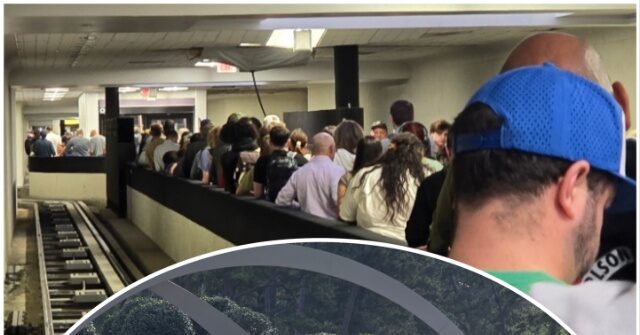
HOUSTON — Passengers traveling through George Bush Intercontinental Airport, Houston's busiest hub, experienced a noticeable improvement in security wait times this week as Immigration and Customs Enforcement officers stepped in to assist Transportation Security Administration screeners amid a federal government shutdown.
According to reports from the scene, lines that had ballooned to as long as four hours early Wednesday morning began to shorten dramatically once about a dozen ICE Enforcement and Removal Operations officers arrived for their shift around 6 a.m. Airport officials had indicated wait times of up to 240 minutes on the TSA's Houston Airport Security website at 5:30 a.m., but by mid-morning, those delays had dropped to under an hour.
The assistance comes at a critical time for travelers, as the partial government shutdown—now in its third week—has left thousands of TSA employees working without pay. The shutdown stems from a partisan standoff in Congress over funding for the Department of Homeland Security and other agencies, with Democrats accusing Republicans of using border security as leverage and Republicans blaming Democrats for blocking a comprehensive spending bill.
Bob Price, a reporter with Breitbart Texas who was on site at Terminal A, described the chaotic scene before the ICE officers' arrival. After checking luggage, passengers were funneled two floors below to an underground tunnel where the line extended a half to three-quarters of a mile. The queue then wound back up through baggage claim and the passenger pickup lobby before ascending to the main security checkpoint.
At the time of Price's arrival, only the South Concourse screening line was operational. As the line progressed, officials opened the North Concourse line, which helped alleviate the backlog. Price reported that his group cleared security in just under two hours total, a significant reduction from the projected four-hour wait.
ICE officers, who began their support role on Tuesday, told Price that the previous day's lines had stretched five to six hours. By 10 a.m. Wednesday, the impact was clear: wait times across Terminals A, D, and E had fallen to less than 60 minutes. The officers, numbering around 20 in total at the airport, were tasked with relocating TSA personnel from non-screening duties, such as crowd control, back to the checkpoints.
One ICE Enforcement and Removal Operations officer, speaking on condition of anonymity, expressed mixed feelings about the deployment. “We are happy to be helping to provide some relief to passengers and the TSA agents who are not currently being paid due to the Democrats withholding funding for the Department of Homeland Security,” the officer said. However, the officer added frustration over being pulled from their primary duties: “We would much rather be doing the job we are trained and paid to do.”
That primary role, according to ICE's mandate, involves enforcing immigration laws, including the removal of individuals in the country illegally, particularly those with criminal records. The officer noted that Houston and surrounding counties have seen an influx of such cases, and the diversion to airport support meant fewer resources for street-level operations.
Passengers who made it through the lines shared varied reactions. Some expressed sympathy for the unpaid TSA workers, who have been arriving for shifts despite the financial strain. “It's tough on them, working without a paycheck—especially with families to support,” said Maria Gonzalez, a traveler from Dallas heading to New York. Others were grateful for the ICE assistance. “I was dreading a four-hour wait with kids in tow, but it went way faster once more lines opened up,” added Robert Kline, a businessman from Austin.
The deployment of ICE officers is part of a broader federal response to the shutdown's ripple effects on air travel. Similar reports have emerged from other major airports, including Dallas-Fort Worth and Los Angeles International, where wait times have surged nationwide. The Transportation Security Administration has urged passengers to arrive three hours early for domestic flights and four hours for international ones, citing understaffing and fatigue among screeners.
Funding dynamics add another layer to the situation. While TSA operations fall under the Department of Homeland Security, which is affected by the lapse in appropriations, ICE officers remain fully paid thanks to provisions in the One Big Beautiful Bill Act, a continuing resolution passed by Congress late last year. That measure allocated specific funds for immigration enforcement, shielding ICE from the immediate impacts of the shutdown.
President Donald Trump took to social media Wednesday afternoon to praise the ICE personnel. In a post on X (formerly Twitter), he wrote, “Great job by the brave men and women of ICE who went straight to work to help the American people in this travel crisis created by Democrats’ refusal to fund DHS. Thank you!” The president's comments underscore the political divide, as White House officials have repeatedly tied the shutdown to Democratic opposition to stricter border measures.
Airport officials at George Bush Intercontinental, which handles over 45 million passengers annually, confirmed the ICE assistance but declined to provide specifics on staffing numbers or long-term plans. A spokesperson for Houston's Department of Aviation said in a statement, “We appreciate all federal partners working to maintain smooth operations during this challenging period.” The airport, a key Delta and United Airlines hub, has seen a 15% increase in delays this month compared to last, according to Federal Aviation Administration data.
Beyond the immediate relief at IAH, the episode highlights ongoing tensions in federal workforce management during shutdowns. The last major lapse, in 2018-2019, lasted 35 days and cost the economy an estimated $11 billion, per the Congressional Budget Office. TSA absenteeism has ticked up to 10% in recent days, officials said, exacerbating lines at peak travel periods like spring break.
Looking ahead, the fate of the shutdown rests with negotiations in Washington. House Speaker Mike Johnson has pushed for a bill including $20 billion for border wall construction, while Senate Democrats, led by Chuck Schumer, insist on restoring lapsed funding without additional immigration restrictions. As talks stall, travelers like those at IAH brace for continued disruptions.
For now, the ICE-TSA collaboration offers a temporary balm. Passengers emerging from security Wednesday morning grabbed coffee and settled into gates, a far cry from the underground queues of dawn. “It's a band-aid, but I'll take it,” Kline said, checking his boarding pass. As the sun rose over Houston, the airport hummed with a tentative normalcy, even as the broader crisis loomed.