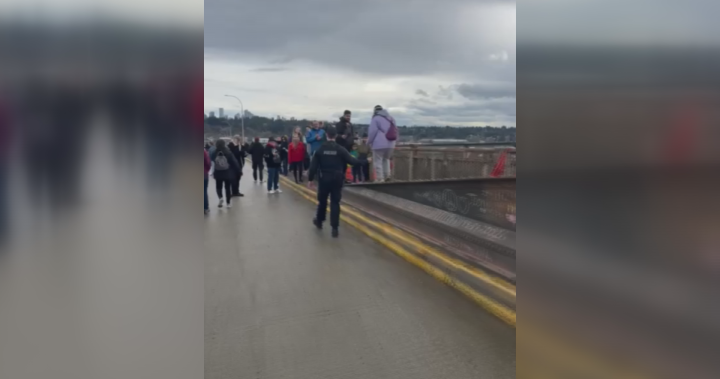
SURREY, British Columbia — The newly opened stal̕əw̓asəm Bridge, formerly known as the Pattullo Bridge, was forced to close early to all traffic over the weekend after crowds of pedestrians and cyclists began climbing its iconic arch structure, prompting safety concerns and police intervention.
The bridge, which spans the Fraser River connecting New Westminster and Surrey, had been designated car-free for the weekend to allow cyclists and pedestrians a unique opportunity to traverse the span without vehicles. The event was part of celebrations marking the bridge's recent replacement and reopening, honoring its new name bestowed by the Kwantlen First Nation and Musqueam Indian Band. However, what started as a festive outing turned chaotic when groups began scaling the bridge's arch, leading to an abrupt end to the pedestrian access several hours ahead of schedule.
According to witnesses, the climbing incidents began drawing crowds by late afternoon on Sunday. Derek Williams, who was on the bridge enjoying the car-free experience, described the scene to Global News. “There was a lineup forming, probably 20 people deep of people taking turns climbing up maybe 10 or 15 feet,” Williams said. “I think 15 feet is the highest I saw somebody do it.”
Williams noted that the climbers appeared to be treating the arch like an impromptu adventure spot, with participants taking turns to ascend short distances before descending. The activity quickly attracted a queue, turning a section of the bridge into an unauthorized spectacle. As the situation escalated, security personnel on site called for assistance from the Surrey Police Service around 5 p.m.
Officers arrived promptly to manage the growing crowd. Staff Sgt. Lindsey Houghton of the Surrey Police Service provided details on the response. “Police arrived and assisted security in dispersing the crowd that had queued up,” Houghton told Global News. He added that two individuals who had already begun climbing partway up the arch were safely negotiated down by officers, preventing any potential injuries.
The initial intervention appeared to calm the situation temporarily, but the B.C. government opted to close the bridge entirely shortly afterward. Officials cited poor weather conditions as the official reason for the early shutdown, though the climbing incidents were widely reported as the underlying trigger. The bridge had been scheduled to remain open for pedestrian and cyclist use until Tuesday morning, allowing for an extended weekend of access before resuming full vehicular traffic.
The stal̕əw̓asəm Bridge, which replaced the aging Pattullo Bridge in 2024, represents a significant infrastructure upgrade for the region. The original structure, built in 1937, had long been criticized for its narrow lanes and seismic vulnerabilities. The new bridge, with four wider lanes and improved pedestrian pathways, was designed to handle increased traffic volumes between the bustling cities of New Westminster and Surrey, both key hubs in Metro Vancouver's suburban network.
The naming ceremony earlier this year highlighted the bridge's cultural significance, with stal̕əw̓asəm meaning "bridge" in the Halq'eméyle language of the Stó:lō peoples, reflecting collaboration with local First Nations. The car-free weekend was intended to showcase these features, drawing hundreds of visitors eager to walk or bike across the 400-meter span with unobstructed views of the Fraser River and surrounding mountains.
Despite the successful negotiations on Sunday, the bridge's closure was not without further complications. On Monday evening, around 7 p.m., security reported another disturbance when a group pushed through barricades that had been set up to enforce the closure. Police were called back to the scene for a second time.
Houghton described the renewed confrontation as tense. “That’s when, unfortunately, these people got quite anti-police and verbally abusive with us and the security on scene,” he said. Fortunately, the situation de-escalated without arrests. “Thankfully, no one had to be arrested and everyone dispersed and cooler heads prevailed,” Houghton added.
Local authorities emphasized that the bridge's design prioritizes safety, with the arch serving as a structural element rather than a recreational climbing feature. Engineers involved in the project had incorporated barriers and signage to discourage such activities, but the weekend's events underscored the challenges of managing public enthusiasm for a new landmark.
Residents in New Westminster and Surrey expressed mixed reactions to the incidents. Some praised the car-free event for fostering community spirit, while others voiced frustration over the early closure, which disrupted planned outings. A spokesperson for the B.C. Ministry of Transportation and Infrastructure confirmed the weather rationale but declined to comment further on the climbing reports, stating only that public safety remains the top priority.
The episode highlights broader issues with managing temporary public access to infrastructure sites. Similar events, such as car-free days on other bridges like Vancouver's Burrard Street Bridge, have proceeded without major hitches, but the Pattullo's recent opening may have amplified curiosity. Transportation experts note that while pedestrian events boost public engagement, they require robust crowd control measures to prevent misuse of structural elements.
As of Tuesday morning, all four lanes of the stal̕əw̓asəm Bridge have reopened to vehicular traffic, restoring normal connectivity for commuters. The Ministry has not announced plans for additional car-free events in the immediate future, though officials indicated that lessons from the weekend will inform future programming. Surrey Police continue to monitor the area to ensure smooth operations.
In the wake of the closure, community leaders from the Kwantlen First Nation reiterated the bridge's importance as a symbol of reconciliation and progress. “This bridge connects not just communities, but histories,” said a representative in a statement released earlier this year. The incidents, while minor in the grand scheme, serve as a reminder of the responsibilities that come with sharing such a vital and symbolic piece of infrastructure.
Looking ahead, the stal̕əw̓asəm Bridge is expected to play a central role in alleviating congestion on Highway 1 and other regional routes. With Metro Vancouver's population projected to grow by hundreds of thousands in the coming decades, investments like this one are crucial for sustainable mobility. For now, the focus remains on ensuring that future celebrations honor the bridge's purpose without compromising safety.