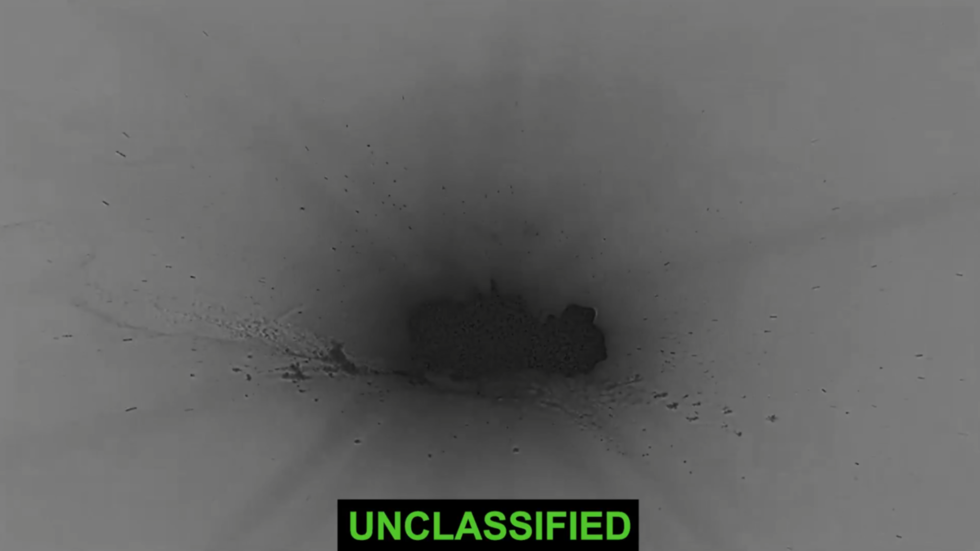
WASHINGTON — The Pentagon has declassified and released combat footage capturing a series of large-scale airstrikes by U.S. and Jordanian forces against suspected Islamic State targets in central Syria, marking a bold retaliatory operation following the killing of American personnel earlier this month.
The strikes, dubbed Operation Hawkeye Strike, involved more than 100 precision-guided munitions hitting over 70 targets described by U.S. officials as terrorist infrastructure and weapons sites linked to ISIS militants. According to a late Friday post on X by U.S. Central Command (CENTCOM), the operation unfolded with the coordination of American fighter jets, attack helicopters, artillery units, and Jordanian fighter aircraft, underscoring a joint effort to dismantle threats posed by the extremist group.
The footage, now publicly available, depicts dramatic scenes of airstrikes and explosions illuminating the night sky over multiple locations in central Syria. CENTCOM described the targets as positions used by ISIS to plan and execute attacks, emphasizing the precision of the munitions to minimize collateral damage while maximizing impact on militant capabilities.
"Tonight, U.S. and Jordanian forces struck 70+ ISIS targets in Syria with 100+ precision munitions. Peace through strength," read the CENTCOM statement accompanying the video clip, which has since garnered significant attention online.
This operation comes in direct response to an attack on December 13 that resulted in the deaths of U.S. and partner forces in the region, an incident CENTCOM attributes to ISIS operatives. Since that deadly assault, American and allied troops have conducted 10 separate counterterrorism operations across Syria and Iraq, leading to the killing or detention of 23 suspected ISIS members, according to the command's latest update.
Admiral Brad Cooper, the commander of CENTCOM, highlighted the strategic importance of the strikes in a statement released alongside the footage. "This operation is critical to preventing ISIS from inspiring terrorist plots and attacks against the US homeland," Cooper said. He added, "We will continue to relentlessly pursue terrorists who seek to harm Americans and our partners across the region."
The broader context of U.S. military involvement in Syria traces back to the height of the ISIS caliphate in 2014, when American-led coalitions began targeting the group to prevent its expansion and protect global security interests. Over the past six months alone, CENTCOM reports more than 80 counterterrorism operations in Syria, reflecting a sustained campaign against ISIS remnants even as the group's territorial control has diminished.
President Donald Trump, addressing the strikes during a White House briefing, noted the cooperation of the new Syrian government in the region. Trump stated that Damascus was fully aware of the operation and provided tacit support, framing it as a necessary step to stabilize the area and counter terrorism without escalating into full-scale conflict.
Secretary of War Pete Hegseth echoed this sentiment but used stronger language to describe the mission's intent. "This was a declaration of vengeance rather than a war," Hegseth said, stressing that the strikes were proportionate responses aimed at deterring future attacks on U.S. interests. His remarks, delivered from the Pentagon, underscore the administration's policy of decisive action against perceived threats.
While the Pentagon has praised the operation's success, details on the exact locations of the 70-plus targets remain limited to central Syria, with officials citing operational security. The released footage shows strikes on what appear to be remote desert outposts and storage facilities, but independent verification of the damage or casualties among militants is not yet available.
Jordan's involvement adds a layer of regional alliance to the effort, as the kingdom has long shared borders with Syria and faced its own ISIS-related threats. Jordanian officials have not issued separate statements on the strikes, but their participation aligns with ongoing bilateral military agreements with the United States, including joint training exercises and intelligence sharing.
The timing of the declassification, just days after the operation, is unusual for such sensitive combat footage, which typically undergoes review to protect sources and methods. Analysts suggest the release serves both to demonstrate U.S. resolve and to reassure allies of America's commitment to counterterrorism in the Middle East.
Critics of U.S. policy in Syria, including some international observers, have raised questions about the long-term efficacy of such strikes in eradicating ISIS ideology. However, CENTCOM maintains that these targeted actions, combined with ground operations, have significantly degraded the group's operational capacity since its peak in 2017.
Looking ahead, U.S. officials indicate that further operations are likely as intelligence on ISIS movements continues to develop. The strikes in Syria are part of a wider portfolio of activities under CENTCOM's purview, which spans from the Arabian Peninsula to South Asia, where American forces remain vigilant against evolving terrorist networks.
As the dust settles from Operation Hawkeye Strike, the episode reinforces the precarious security dynamics in Syria, where U.S. presence persists amid a shifting political landscape. With the new Syrian government's reported endorsement, the operation may signal a potential thaw in relations, though broader diplomatic challenges, including Russian and Iranian influences, loom large over the region's future stability.