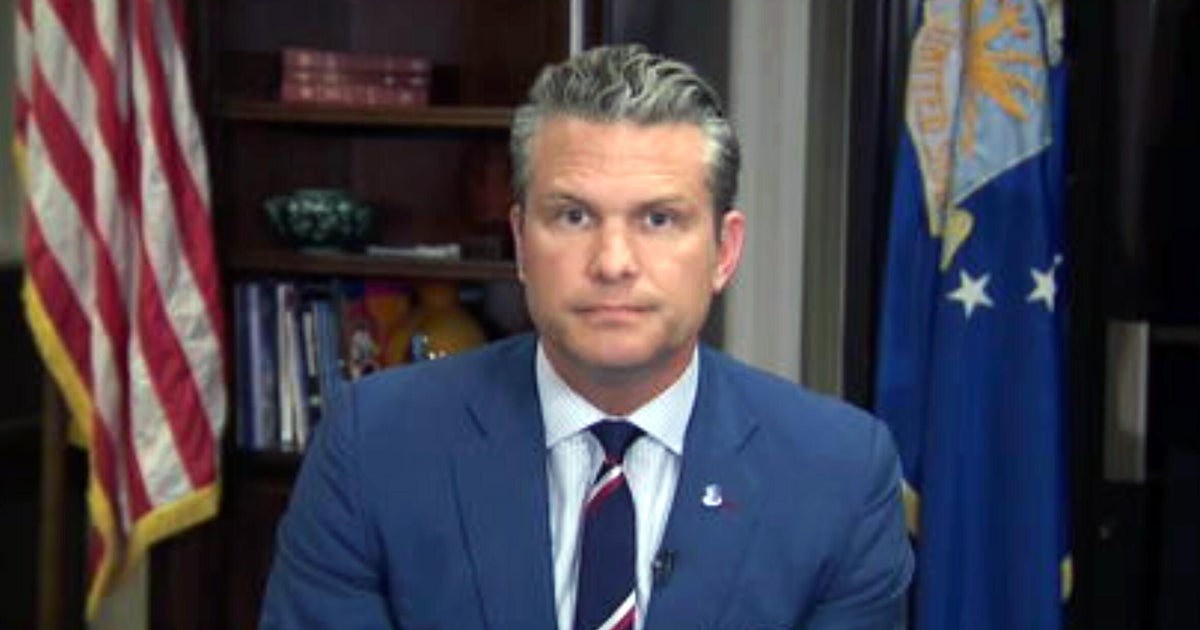
WASHINGTON — In a bold assertion of American influence, President Donald Trump has declared that the United States will oversee Venezuela's governance until a stable transition of power can be achieved, according to statements from top administration officials. The announcement follows a dramatic overnight U.S. military operation that resulted in the capture of Venezuelan President Nicolás Maduro, an event Defense Secretary Pete Hegseth described as "the most sophisticated, most complicated, most successful joint special operations raid of all time." Hegseth, speaking in an exclusive interview with CBS Evening News anchor Tony Dokoupil, emphasized that "President Trump sets the terms" for this interim administration, signaling a hands-on approach to stabilizing the crisis-ridden South American nation.
The operation, which unfolded in the early hours of Saturday, involved elite U.S. special forces units coordinating with regional allies, though specific details on troop movements or exact locations remain classified. Hegseth, a key architect of the mission alongside other senior Trump administration figures, highlighted its precision and success in apprehending Maduro without significant casualties. "It means we set the terms. President Trump sets the terms. And ultimately, he'll decide what the iterations are of that," Hegseth told Dokoupil, outlining the administration's vision for U.S. stewardship over Venezuela's immediate future.
Trump himself addressed the situation earlier that day from the White House podium, stating unequivocally, "we're going to run the country" until there is a "safe, proper and judicious transition" of power. The president's comments, delivered amid a flurry of international attention, provided scant specifics on the duration or scope of U.S. involvement, leaving observers to parse remarks from officials like Hegseth for clues. This intervention comes against the backdrop of Venezuela's long-standing political and economic turmoil, exacerbated by years of hyperinflation, widespread shortages, and allegations of authoritarian rule under Maduro's socialist regime.
Hegseth was clear about the administration's priorities in this new phase. "But, it means the drugs stop flowing, it means the oil that was taken from us is returned, ultimately, and that criminals are not sent to the United States," he said, pointing to longstanding grievances over Venezuela's role in regional drug trafficking and the nationalization of American oil assets. The U.S. has long accused Maduro's government of facilitating cocaine shipments to American shores, with estimates from the Drug Enforcement Administration suggesting that up to 90% of U.S.-bound cocaine passes through Venezuelan territory. Restoring access to Venezuela's vast oil reserves, which rank among the world's largest, is another cornerstone, as Hegseth noted the damage inflicted on U.S. energy companies.
The capture of Maduro marks a pivotal shift in a crisis that has gripped the Western Hemisphere for over a decade. Venezuela's descent began accelerating in 2013 following the death of Hugo Chávez, Maduro's mentor, leading to mass protests, a humanitarian exodus of more than 7 million refugees, and international sanctions aimed at pressuring the regime. The U.S. recognized opposition leader Juan Guaidó as interim president in 2019, but Maduro clung to power with support from allies like Russia, China, and Cuba. Saturday's raid, reportedly launched from bases in Colombia and U.S. naval assets in the Caribbean, effectively ended that standoff.
Questions about the legal and political framework for U.S. oversight quickly arose during Hegseth's interview. Dokoupil pressed the defense secretary on whether the administration would seek congressional approval for any extended military presence or full-scale intervention to stabilize the country. Hegseth framed the initial operation as a "law enforcement exercise," citing guidance from Secretary of State Marco Rubio that such actions do not require prior notification to Congress. "Rubio was clear there that this is not something you notify Congress about beforehand," Hegseth explained. However, he added a caveat: if the U.S. role extends beyond the immediate capture, "of course we will keep Congress involved."
This stance has already drawn scrutiny from lawmakers on both sides of the aisle. Democratic leaders, including Senate Foreign Relations Committee Chairman Bob Menendez, have called for immediate briefings, arguing that any prolonged U.S. administration in Venezuela could violate the War Powers Resolution of 1973, which mandates congressional authorization for sustained military engagements. Republicans, while generally supportive of Trump's aggressive foreign policy, have expressed concerns over the financial costs, with estimates for stabilizing Venezuela's oil infrastructure alone potentially exceeding $50 billion in the coming years.
Central to the administration's agenda is reclaiming Venezuela's oil sector, which has languished under mismanagement and sanctions. Hegseth referenced a blockade imposed by Trump last month, which has halted all oil imports and exports from Venezuelan ports. "No oil is going in or out of the country, and the U.S. military is still poised in the Caribbean," he said, underscoring the ongoing naval presence that includes carrier strike groups patrolling international waters off the coast. Under Maduro, Venezuela's state-owned PDVSA oil company saw production plummet from 3 million barrels per day in 2008 to under 500,000 barrels by 2023, operating refineries at just 20% capacity.
"What was done by Venezuela against American oil interests and oil companies is well understood and it never should have happened and President Trump is willing to recapture that," Hegseth asserted, alluding to expropriations dating back to the Chávez era that seized assets from firms like ExxonMobil and Chevron. Trump, in his podium remarks, vowed to reverse this trend: "[Mr. Trump] said it clearly at the podium today. We are going to get American companies in there. We are going to get investment in there. These oil depots have been operating at 20% capacity. That's going to change." Reviving the sector could not only bolster U.S. energy security but also generate revenue for Venezuela's reconstruction, according to administration projections.
Beyond economics, the U.S. intervention addresses broader security concerns for the hemisphere. Hegseth emphasized curbing the flow of migrants and criminals across the U.S. southern border, a issue Trump has repeatedly highlighted in his political rhetoric. Venezuela has been a major source of irregular migration, with over 500,000 Venezuelans apprehended at the U.S. border in fiscal year 2023 alone. By stabilizing the country, the administration aims to stem this tide and prevent further destabilization in neighboring nations like Colombia and Brazil, which have borne the brunt of the refugee crisis.
International reactions have been mixed. Allies such as the United Kingdom and Canada have welcomed Maduro's ouster, praising the operation's success in upholding democratic norms. However, voices from the Global South, including Brazil's President Luiz Inácio Lula da Silva, have cautioned against what they term "imperialist overreach," urging a multilateral approach through the United Nations. Russia, a key Maduro backer, condemned the raid as a violation of sovereignty, with Kremlin spokesman Dmitry Peskov stating that Moscow reserves the right to respond proportionally.
Within Venezuela, the mood is cautiously optimistic among opposition groups. Guaidó, now positioned as a potential transitional figure, issued a statement thanking the U.S. for its role and calling for free elections within six months. Yet, challenges abound: Maduro's loyalists in the military and security forces remain a wildcard, with reports of skirmishes in Caracas suburbs following the raid. Humanitarian organizations like the United Nations Refugee Agency warn that immediate aid is needed to address acute malnutrition affecting 30% of the population.
Hegseth struck an optimistic note on the potential upsides for all involved. "What happens next will be in the hands of Venezuelans to decide but ultimately America will benefit security wise, and with prosperity, we believe the Venezuelan people can as well," he told Dokoupil. This vision includes not just economic revival but also democratic reforms, though timelines remain fluid. As U.S. forces maintain a foothold— with an estimated 5,000 troops now on Venezuelan soil for security operations— the world watches to see if Trump's "America First" doctrine can translate into lasting stability.
Looking ahead, the administration faces a delicate balancing act. Extending U.S. control could invite accusations of neocolonialism, while a hasty withdrawal risks chaos and a power vacuum. Congressional hearings are slated to begin next week, where Hegseth and Rubio are expected to testify. For now, with Maduro in U.S. custody at an undisclosed location, the focus shifts to implementation: securing oil fields in the Orinoco Belt, dismantling drug networks in the Guayana Highlands, and fostering dialogue among Venezuelan factions. The stakes are high, as Venezuela's fate could reshape alliances across Latin America and influence global energy markets for years to come.