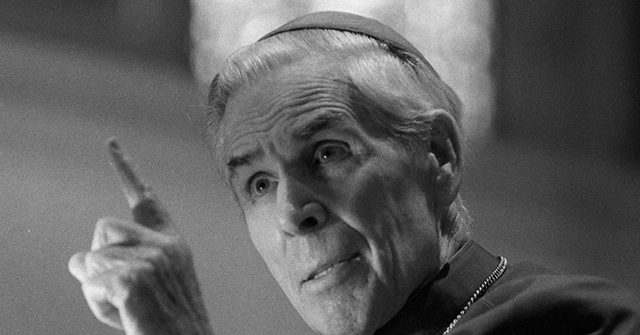
In a significant development for the Catholic Church, Archbishop Fulton J. Sheen, once one of America's most celebrated religious figures, is set to be beatified, marking him as blessed and just one step away from sainthood. The Vatican’s Dicastery of the Causes of the Saints is evaluating miracles attributed to Sheen, who died in 1979, according to reports from Breitbart News. This recognition comes nearly half a century after his passing and underscores his enduring influence as a communicator and anti-communist advocate during the Cold War era.
Sheen, born in 1895, rose to prominence in the mid-20th century as a prominent Catholic cleric, captivating audiences across radio, syndicated columns, and prime-time television. His show competed directly with entertainment giants like Milton Berle and Frank Sinatra, drawing an estimated 30 million viewers weekly. In 1956, a Gallup poll ranked him as the third-most admired American, highlighting his broad appeal beyond religious circles.
Even non-Catholics have found Sheen's legacy compelling, particularly for his role in bolstering American resolve against Soviet communism during the Cold War, which spanned from the 1940s to the 1990s. President Ronald Reagan famously dubbed the Soviet Union the “evil empire,” a sentiment Sheen echoed in his sermons and speeches. As detailed in Breitbart's coverage, Sheen viewed the ideological struggle as a battle between the Free World and communist forces, a fight that ultimately saw the good guys prevail, though Reagan cautioned that “there are no final victories.”
Sheen's early warnings about communism dated back to 1936, when he addressed Stalin's influence in Spain through a tutorial on the “United Front” tactics. In it, he wrote: “Q: Who was the first one in the history of Christianity to use the tactics of the United Front? A: Judas, by betraying our Lord with a kiss.” This analogy framed communism as a betrayal of Christian values, a theme that permeated his work. Sheen endorsed the centrist Catholic teachings of Pope Leo XIII, advocating gradual reform while firmly opposing leftist ideologies.
His articulate style, rich voice, expansive vocabulary, and striking resemblance to actor Tyrone Power helped propel him to national fame. A 1953 photo caption from his television series Life Is Worth Living described his approach: “Speaking in precise, never stagey tones, Bishop Sheen discusses a variety of subjects. His only prop is a blackboard on which he draws simple diagrams to help the audience grasp more easily the philosophical points he is making.” Sheen referred to his unseen stagehand who erased the board as his “angel,” and he balanced thoughtful discourse with occasional jokes and puns.
Biographer Thomas C. Reeves, in his 2001 book America’s Bishop: The Life and Times of Fulton J. Sheen, noted Sheen's provocative stances: “Frequently outspoken, Sheen stirred controversy with forceful statements on such topics as communism, socialism, the Spanish Civil War, World War II diplomacy, psychiatry, secularism, education, and the Left in general.” Sheen criticized the liberalism of the National Council of Churches, stating, “Satan’s last assault was an effort to make religion worldly.” Today, observers point out that the organization has evolved toward what some call “woke” positions.
The scale of communist atrocities in the 20th century, as documented in the Black Book of Communism, included the deaths of approximately 100 million people and the oppression of billions more across nations like Russia, China, Cambodia, and Cuba. In Eastern Europe, the Catholic Church served as a key resistance force against atheistic Bolshevism. In Poland alone, the communist regime executed or imprisoned thousands of priests and believers, according to historical accounts.
Sheen's efforts aligned with later triumphs, such as those led by Pope John Paul II, a Polish native, and Lech Walesa’s Gdansk dock workers in the Solidarity movement. Their push for freedom, including religious liberty, culminated in the fall of communism in 1989, paving the way for Poland's current prosperity. As a “legionary of Christ,” Sheen contributed to this broader victory through his public advocacy.
Despite his impact, Sheen's legacy has been somewhat overlooked by modern historians, as Reeves observed: “The celebration of religious certainty that characterized Sheen…has no doubt been responsible in part for the bishop’s neglect at the hands of more recent historians and journalists.” His staunch anti-communism, described by Reeves as a factor in his diminished appeal to “many modern intellectuals,” clashed with emerging narratives that downplayed communist threats.
Sheen did not mince words about the Soviet Union, calling it “the most anti-Christ nation on the face of the earth,” with its “central shrine” being “a rotted corpse, the body of Lenin—a perfect symbol of that to which all communism must lead us all, unto dust, unto dissolution, unto death.” During the early 1950s, amid the Korean War, he was a frequent speaker at American Legion conventions and patriotic events, reinforcing national defenses against communism.
At a 1949 rally attended by the U.S. vice president, New York City's mayor, and the local archbishop, Sheen declared that Marxism “is not the promise of a new era. It is the dying gasp of an old age. It is made up of all the cheap agnostic, atheistic philosophies of the 18th and 19th centuries.” This foresight anticipated the optimism of leaders like John Paul II, Reagan, and Walesa, who helped dismantle Soviet-style communism.
In the current era, Sheen's beatification process revives discussions about his relevance amid perceived new threats, including “democratic socialism” and internal “fifth columnists.” Breitbart's article references New York City Mayor Zohran Mamdani—though unconfirmed in other reports—as potentially fostering anarchy to seize private property, drawing parallels to Sheen's era. Sheen labeled communism a “diabolical system,” a view that contrasts with some progressive interpretations that portray anti-communists as overly alarmist.
Contemporary figures echo Sheen's voice. Bishop Robert Barron of Rochester, Minnesota, has confronted leftist ideologies, including those of Rep. Alexandria Ocasio-Cortez. Conservative commentator Chad Pecknold praised Barron, saying, “Among American Catholic bishops, one has to go back to Fulton Sheen to find such an articulate condemnation of Marxist materialism. It’s refreshing.” This endorsement highlights a continuity in Catholic resistance to materialism.
As the Dicastery reviews Sheen's miracles, his story serves as inspiration for ongoing cultural battles. Modern challenges, described in the Breitbart piece as including “woke-ism, anti-semitism, and omnicause third-worldism,” share with communism a hostility toward tradition and faith. The article suggests the need for new leaders—in the clergy, military, media, and beyond—to carry forward Sheen's mantle, especially as technologies like AI potentially amplify divisive forces.
Sheen's impending beatification not only honors his past contributions but also signals the Church's affirmation of his vision for a world rooted in faith and freedom. While his critics among secular intellectuals persist, admirers see in him a timeless warrior for civilization, much like the legendary King Arthur in T.H. White’s The Once and Future King. As evaluations proceed in the Vatican, the process could culminate in canonization, further cementing Sheen's place among the saints and offering guidance for contemporary struggles.