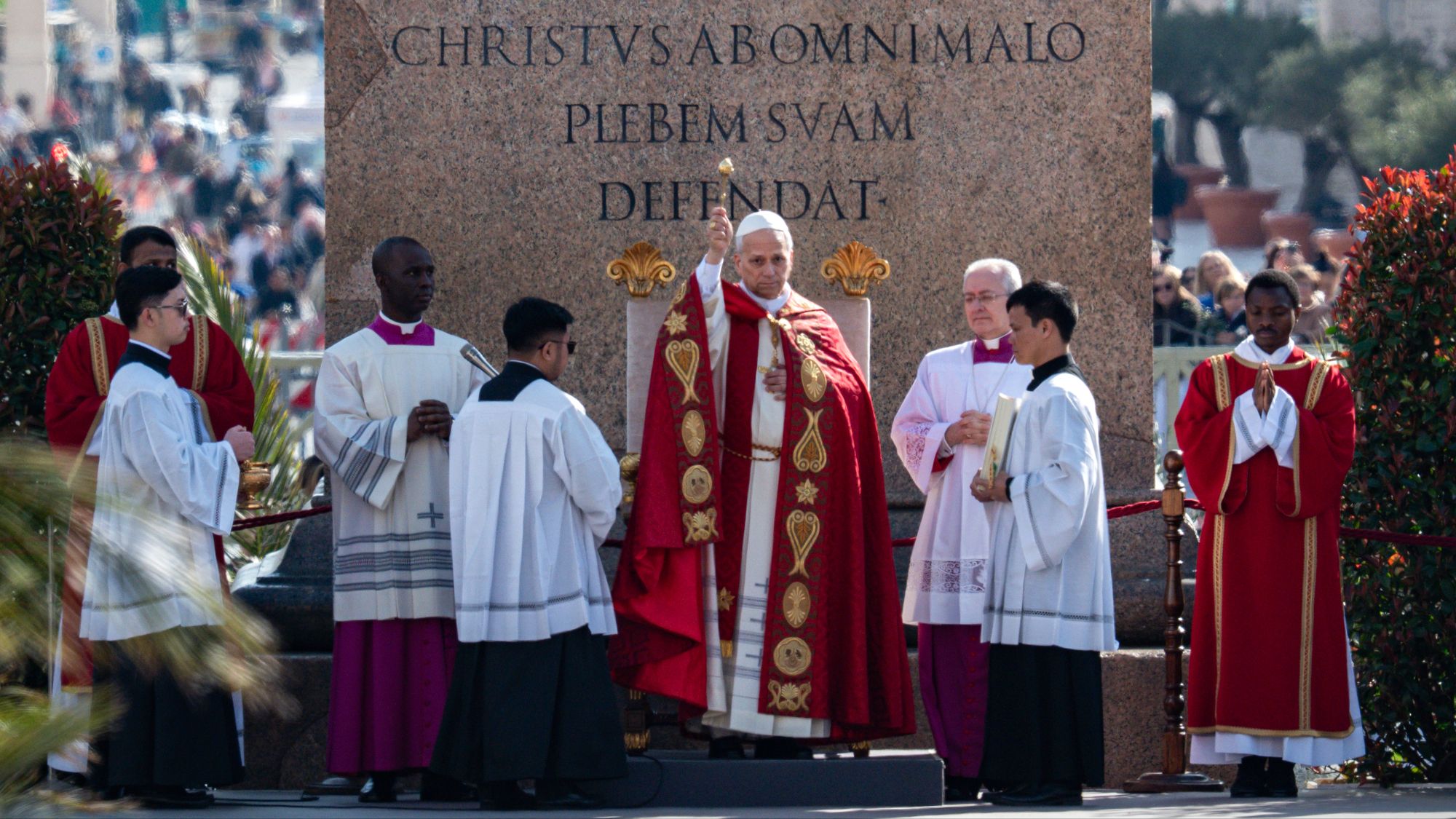
VATICAN CITY — Pope Leo XIV used his first Holy Week as pontiff to deliver a pointed rebuke against world leaders who invoke the name of Jesus to justify warfare, speaking out on Palm Sunday amid escalating tensions in the Middle East. Addressing tens of thousands of faithful gathered in St. Peter’s Square, the pope declared, “This is our God: Jesus, King of Peace.” He continued, quoting scripture, “He does not listen to the prayers of those who wage war, but rejects them, saying: ‘Even though you make many prayers, I will not listen: your hands are full of blood.’” The remarks, delivered during a solemn Mass marking the start of Holy Week, came just hours after Israeli authorities barred Jerusalem’s top Catholic cleric from celebrating services at one of Christianity’s holiest sites.
The pontiff’s words highlighted the plight of Christians in the Middle East, who he said are “suffering the consequences of an atrocious conflict,” preventing them from “live fully the rites of these holy days.” While Pope Leo did not name specific leaders or nations, his message appeared to target the ongoing war with Iran, which has drawn sharp criticism from the Vatican in recent weeks. According to Reuters, the pope is known for choosing his words carefully, but he has been ramping up his condemnation of the conflict, which has pitted the United States and its allies against Iran and its proxies.
The timing of the pope’s address was especially poignant, coinciding with reports of restrictions on Christian worship in Jerusalem. Early Sunday morning, Israeli police prevented Cardinal Pierbattista Pizzaballa, the Latin Patriarch of Jerusalem, from entering the Church of the Holy Sepulchre to lead Palm Sunday Mass. The basilica, revered by Christians as the site of Jesus’s crucifixion, burial, and resurrection, has been a focal point for pilgrims during Holy Week for centuries.
The Latin Patriarchate of Jerusalem issued a strongly worded statement condemning the incident as a “manifestly unreasonable” and “fundamentally flawed decision.” It marked, they said, the “first time in centuries” that Catholic prelates had been blocked from celebrating Palm Sunday at the church. The blockade drew immediate backlash from Western leaders and diplomats, who viewed it as an infringement on religious freedoms during a sensitive period.
Israeli authorities defended the action as a necessary security measure. According to officials, all religious buildings in Jerusalem’s Old City — a UNESCO World Heritage site encompassing sacred spaces for Christians, Muslims, and Jews — were closed due to threats of Iranian missile attacks. Police turned back Cardinal Pizzaballa “for his own safety,” they explained, emphasizing that the restrictions applied broadly amid heightened alert levels.
As criticism mounted from allies including the United States and European nations, Israeli Prime Minister Benjamin Netanyahu moved quickly to address the uproar. Late Sunday evening, Netanyahu announced that he had ordered police to grant the cardinal “full and immediate access” to the Church of the Holy Sepulchre, allowing him to “hold services as he wishes” throughout Holy Week. “We respect the religious freedoms of all faiths, especially during this holy time,” Netanyahu said in a statement reported by The Times of Israel.
The Jerusalem incident unfolded against the backdrop of the broader Iran war, which has intensified religious and geopolitical divides. The conflict, now in its second year, began with Iranian-backed militia attacks on U.S. forces in Iraq and has since expanded to include airstrikes, naval confrontations in the Persian Gulf, and proxy battles across the region. Casualty figures from the war remain disputed, but the United Nations reported last month that over 15,000 civilians have been displaced in affected areas, with Christian communities particularly vulnerable.
Pope Leo’s critique also seemed to reference rhetoric from U.S. Defense Secretary Pete Hegseth, whose public invocations of Christianity in military contexts have sparked controversy. The Associated Press noted that leaders on all sides of the Iran war have used religion to justify their actions, but “especially Defense Secretary Pete Hegseth.” Last week, during a Pentagon briefing, Hegseth led a prayer invoking the “mighty and powerful name of Jesus Christ” to call for “overwhelming violence of action against those who deserve no mercy.”
Hegseth’s approach has alarmed military, legal, and religious experts. The Washington Post reported that his “proselytizing Christian campaign” within the U.S. military has raised concerns about violations of church-state separation, particularly as the war with Muslim-majority Iran has made such statements more inflammatory. Critics, including the American Civil Liberties Union, have called for an investigation into whether Hegseth’s remarks constitute endorsement of a specific faith in official duties.
Supporters of Hegseth, however, argue that his expressions of faith are personal and motivational, drawing on a long tradition of chaplains in the armed forces. “In times of war, our service members draw strength from their beliefs, whatever they may be,” said a Pentagon spokesperson, who declined to comment directly on the secretary’s prayer. The controversy underscores deeper tensions in the U.S. military, where diversity training has clashed with individual expressions of religion since the war’s outset.
Back in the Vatican, Pope Leo’s Palm Sunday homily extended beyond the immediate conflict to a broader call for peace. He urged the faithful to reflect on Jesus’s entry into Jerusalem not as a conqueror, but as a servant of humility and nonviolence. “In a world torn by violence, let us choose the path of the Prince of Peace,” he said, drawing applause from the crowd waving olive branches and palm fronds.
The pope’s remarks resonated particularly with Middle Eastern Christian leaders, who have faced increasing marginalization amid the Iran war. In Syria and Lebanon, where Iranian influence is strong, churches have reported attacks and forced closures. The Vatican has dispatched humanitarian aid to the region, including $5 million announced last month for refugee support, but officials acknowledge the limitations of diplomacy in a polarized conflict.
Israeli officials, for their part, have maintained that security concerns justify the temporary closures in Jerusalem. While the Old City’s religious sites have been flashpoints before — notably during the 2021 Gaza conflict — this year’s restrictions are tied directly to Iranian threats. Intelligence reports, cited by Israeli media, warned of potential missile barrages targeting population centers, including the capital.
As Holy Week progresses, the Church of the Holy Sepulchre is expected to reopen for services, with Cardinal Pizzaballa planning to lead Easter Vigil on Saturday night. The incident has prompted calls for better coordination between Israeli authorities and religious leaders, with the Vatican expressing hope for “unhindered access” in the future. Meanwhile, the broader Iran war shows no signs of abating, with U.S. forces conducting airstrikes on Iranian positions in Iraq as recently as Friday.
Pope Leo’s intervention highlights the Catholic Church’s growing role in advocating for peace amid global strife. With Christianity’s holiest week underway, his message serves as a reminder of the faith’s pacifist roots, even as geopolitical realities test those ideals. Observers will watch closely to see if his words influence ongoing diplomatic efforts, including upcoming talks in Geneva aimed at de-escalating the Iran conflict.
In Appleton, local faith leaders echoed the pope’s sentiments during Sunday services. “Jesus taught us to love our enemies, not to bomb them in his name,” said Rev. Maria Gonzalez of St. Mary’s Cathedral, who organized a prayer vigil for Middle Eastern Christians. As the world grapples with war’s toll, such voices underscore the universal call for reconciliation during this sacred season.