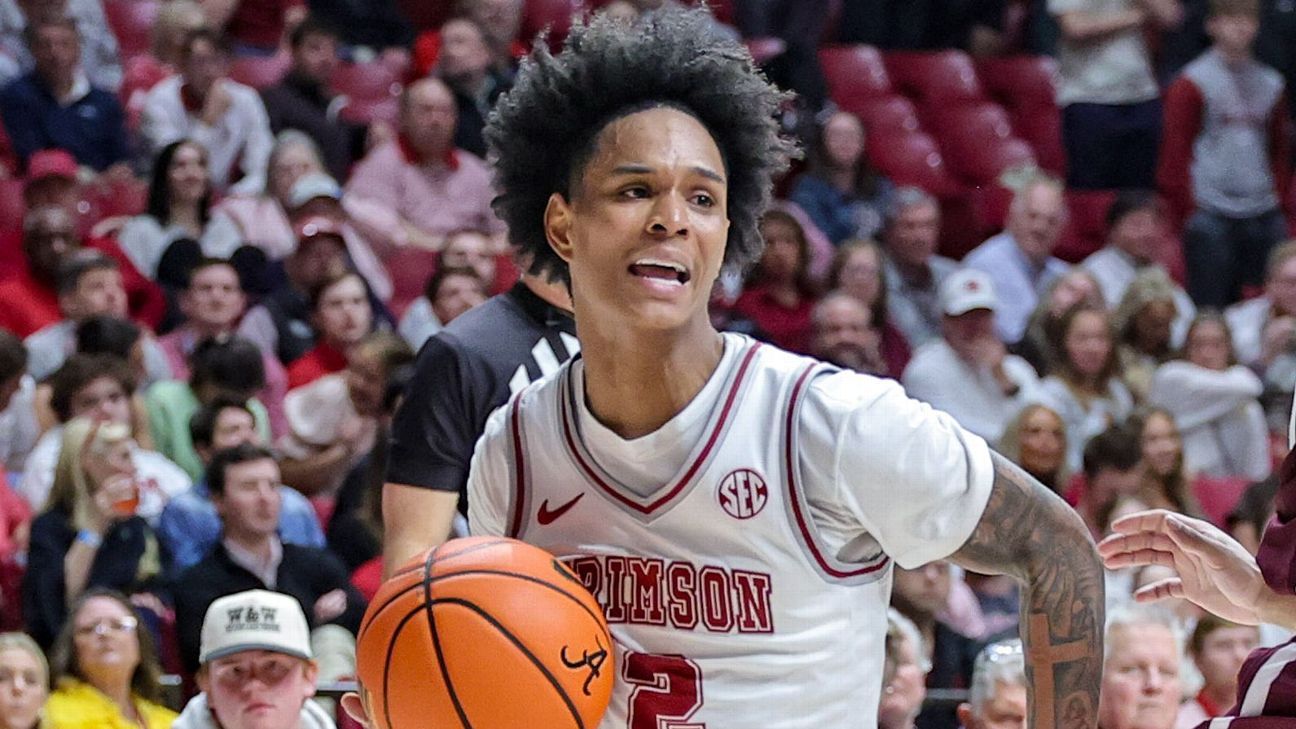
TUSCALOOSA, Ala. — Aden Holloway, the dynamic guard who has been a key contributor to the Alabama Crimson Tide men's basketball team, finds himself at the center of a serious legal controversy following his arrest on felony drug charges. Prosecutors have alleged that evidence of drug transactions was discovered on his phone, complicating what was shaping up to be a promising NCAA tournament run for the second-seeded Tide. The 20-year-old sophomore, who ranks as the team's second-leading scorer with an average of 13.7 points per game this season, was taken into custody on Monday, March 18, 2024, after authorities searched his off-campus apartment and uncovered 2.1 pounds of marijuana.
The arrest came swiftly after a routine investigation by the West Alabama Narcotics Task Force, which began with what police described as a 'trash pull' from outside Holloway's residence. According to court documents obtained by ESPN, officers sifted through garbage bags from the apartment complex on March 15 and found marijuana residue along with paraphernalia bearing Holloway's name. This discovery prompted a search warrant, leading to the raid that netted the substantial quantity of the substance, packaged in various ways including plastic bags, prepackaged portions, and vacuum-sealed containers.
During the search, officers also seized $400 in cash from a jacket inside the apartment, which Holloway reportedly claimed belonged to him. An officer examined Holloway's phone and, per the prosecutor's complaint, uncovered text messages indicating 'drug transactions.' The documents specify that individuals had texted Holloway about plans to 'get up with him after the season,' a period that would align with the conclusion of the college basketball campaign. Prosecutors noted the smaller denominations of the bills as 'indicative of narcotic sales,' further bolstering their case that the marijuana was not intended solely for personal use.
Holloway, however, has maintained his innocence regarding any intent to distribute, telling investigators that he uses marijuana only for personal reasons and that the supply was obtained from out of state. He posted $5,000 bail later that day and was released from the Tuscaloosa County Jail, but the fallout was immediate for his athletic career. University officials removed him from campus and separated him from the team, enforcing a ban that barred him from attending classes or practices. As a result, Holloway missed Alabama's first-round NCAA tournament victory over Hofstra on Friday, March 22, a 90-70 decision that advanced the Crimson Tide to the round of 32.
The charges against Holloway are severe: a Class C felony for possession of marijuana not for personal use and a separate felony count for failure to affix a tax stamp, as required under Alabama law for controlled substances. Each carries a maximum penalty of 10 years in prison and a $15,000 fine, underscoring the gravity of the allegations in a state where marijuana remains illegal for recreational purposes despite ongoing national debates on reform.
Holloway's attorney, Jason Neff, has sharply contested the validity of the police actions leading to the arrest. In an interview with ESPN, Neff argued that the initial trash pull violated his client's Fourth Amendment rights against unreasonable searches and seizures. 'In review of the probable cause [search warrant], once this case moves forward, we would challenge the basis of the search with a motion to suppress evidence for the violation of his Fourth Amendment rights,' Neff said. He emphasized that the evidence obtained from the apartment should not be admissible in court, potentially derailing the prosecution's case.
Neff also revealed plans to meet with Alabama officials next week, following the university's spring break, in an effort to lift the campus ban. Such a reversal could allow Holloway to return to classes and, if the Tide progresses deep into the tournament—facing Charleston in the second round on Sunday—potentially rejoin the team for games in the Sweet 16 or beyond. The attorney expressed optimism about resolving the academic restrictions, noting that Holloway's separation from campus was a precautionary measure rather than a final determination of guilt.
Alabama head coach Nate Oats, speaking to reporters before the Hofstra game, offered a message of support amid the uncertainty. While not committing to Holloway's immediate return, Oats drew from personal experience to underscore his commitment. 'I've got three daughters, they've made mistakes,' Oats said. 'You don't disappear on them when they need your help. I won't be disappearing on him. I talked to him yesterday morning on the phone, and the night before that. I've talked to him every day. I'm going to continue to talk to him, love him, help him through this and we'll see where it all takes him.'
Oats' comments reflect a broader tension within college athletics, where high-profile players like Holloway often navigate intense scrutiny. The guard transferred to Alabama from Auburn last offseason, bringing with him a reputation as a sharpshooting talent who averaged 16.6 points as a freshman for the Tigers. His scoring prowess had been instrumental in Alabama's 25-11 regular-season record and their berth as a No. 2 seed in the South Region. Yet, the timing of the arrest—mere days before the tournament—has cast a shadow over what was anticipated to be a marquee March Madness performance.
The investigation's origins trace back to unspecified 'complaints' reported to authorities, though the search warrant documents do not detail their nature. Whether these stemmed from neighbors, fellow students, or other sources remains unclear, but they were sufficient to initiate the surveillance that culminated in the trash pull. In Alabama, where marijuana possession laws are among the strictest in the South, such complaints can quickly escalate, particularly when involving public figures like student-athletes.
Prosecutors, for their part, appear confident in their evidence. The complaint filed on Friday, March 22, explicitly ties the phone messages and packaging methods to intent to sell, painting a picture of organized activity rather than casual possession. Holloway's claim of out-of-state sourcing adds another layer, potentially invoking interstate commerce questions if the case proceeds to trial. Legal experts not involved in the matter have noted that motions to suppress, like the one Neff plans to file, succeed in about 20-30% of cases involving warrant challenges, though outcomes vary widely based on specifics.
Beyond the courtroom, the incident raises questions about support systems for college athletes under pressure. Alabama, like many programs, has invested heavily in NIL (Name, Image, Likeness) deals and mental health resources, but drug-related scandals can jeopardize scholarships and future prospects. Holloway, a projected NBA draft prospect before the arrest, now faces an uncertain path. Scouts had praised his quick release and perimeter shooting, but off-court issues could impact his stock in the eyes of professional teams.
As the Crimson Tide prepare for their next matchup, the absence of Holloway—a player who started 24 of 36 games this season—has forced adjustments. Teammates like Mark Sears, who led Alabama with 19 points against Hofstra, have stepped up, but the emotional toll is evident. Oats mentioned post-game that the team discussed the situation in a team meeting, focusing on unity and performance despite the distraction.
Looking ahead, the coming weeks will be pivotal. If Neff's motion gains traction, it could lead to dismissed charges or a plea deal, allowing Holloway a shot at redemption on the court. School officials have not commented publicly on the potential for his return, citing privacy policies under federal education laws. Meanwhile, the NCAA tournament marches on, with Alabama favored to advance but now without one of its most electric players.
For Holloway, a young man thrust into the spotlight of Division I basketball, this episode serves as a stark reminder of the fine line athletes walk. As Coach Oats continues his daily check-ins, the hope is that guidance and legal resolution can steer him back toward the court—and away from the headlines of controversy.