By Michael Thompson, The Appleton Times
CAPE CANAVERAL, Fla. — With just days remaining until NASA's long-awaited Artemis II mission, the four astronauts set to become the first humans to fly around the moon in more than 50 years shared insights into their preparations during a video Q&A session from quarantine. The crew, isolated at the Kennedy Space Center since Friday, described a mix of excitement and reflection as they gear up for the Wednesday launch aboard the Orion spacecraft.
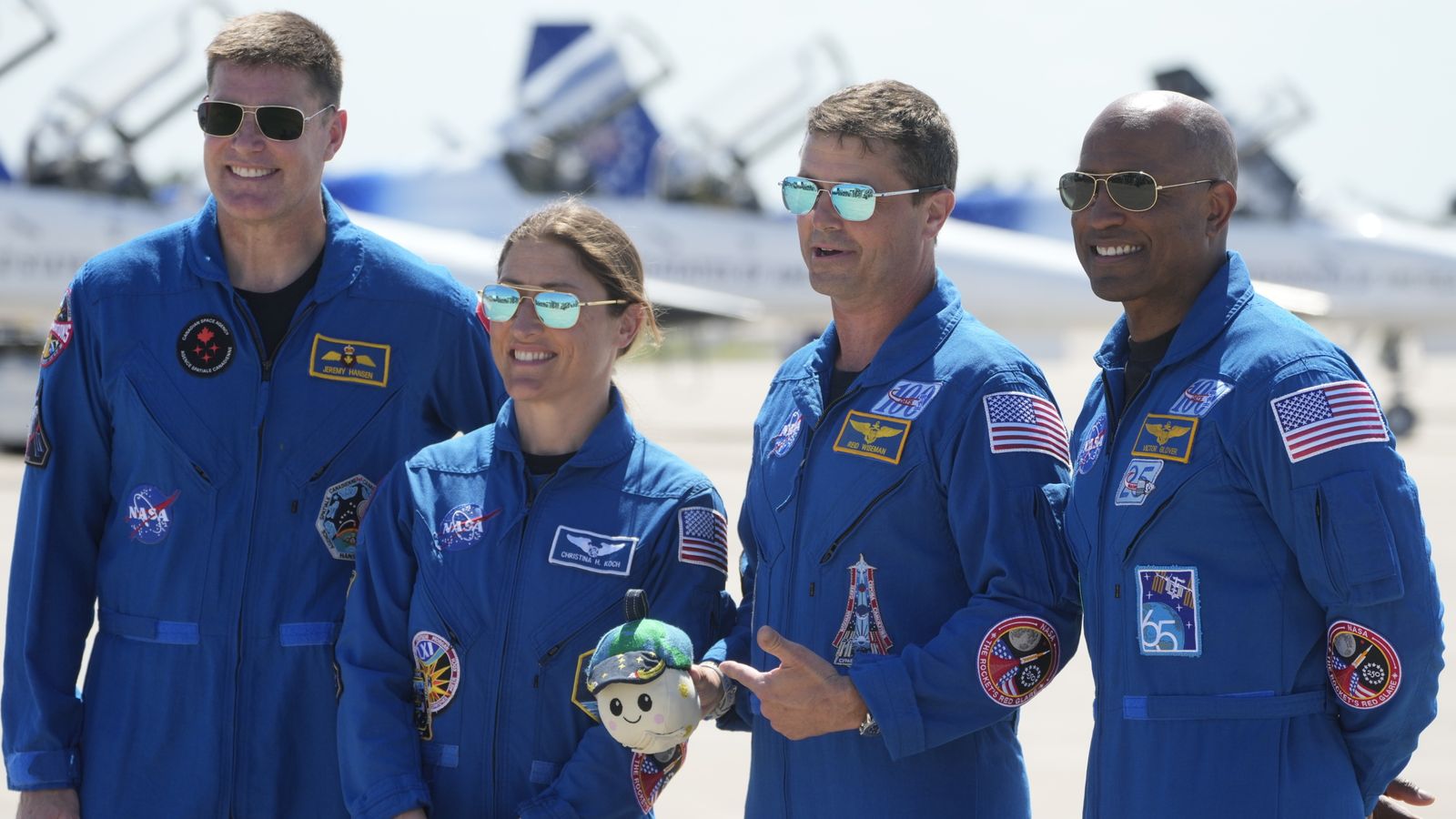
The Artemis II mission marks a pivotal step in NASA's program to return humans to the lunar surface, following the uncrewed Artemis I flight that successfully orbited the moon in November 2022. This crewed outing will send Commander Reid Wiseman, Pilot Victor Glover, Mission Specialist Christina Koch from NASA, and Mission Specialist Jeremy Hansen from the Canadian Space Agency on a 10-day journey that loops around the moon without landing. The flight path will test the Orion capsule's systems in deep space, paving the way for future missions, including the first woman and person of color on the lunar surface with Artemis III.
Launch is scheduled for Wednesday, April 1, at 2:00 p.m. EDT from Launch Complex 39B at the Kennedy Space Center. However, the date was pushed back from an original target of February 8 after a liquid hydrogen leak occurred during a dress rehearsal countdown in late January. NASA officials have emphasized that the delay was precautionary, ensuring the Space Launch System (SLS) rocket and Orion spacecraft meet stringent safety standards.
During Sunday's Q&A, conducted via video link to maintain quarantine protocols, the astronauts offered a glimpse into their daily routine at the historic crew quarters. "The folks who are cooking for us, their shirts are just covered in patches from other missions," Wiseman said, evoking the center's rich legacy. He continued, "When you walk down the halls, you see names in foreign languages, you can think about the places they were born, the lives they have lived and the legacy that we're a part of. It's a very, very special place. This is where humanity began reaching for the stars."
Wiseman's comments underscored the emotional weight of the moment, as the crew prepares to make history. The Artemis II flight will achieve several milestones: Glover will become the first Black astronaut to venture to the moon, Koch the first woman on such a mission, and Hansen the first Canadian. These "firsts," as the astronauts acknowledged, highlight progress in diversity within space exploration, though they expressed hope that such distinctions will soon become obsolete.
Glover addressed the significance of his role with a blend of pride and pragmatism. "I live in this dichotomy between happiness that a woman can look at Christina and physicalise her passion or her interest. And that young brown boys and girls can look at me and go, 'he's doing what?'" he explained. "But I also hope we're pushing in that other direction that one day, we don't have to talk about these firsts."
Koch built on Glover's sentiment, emphasizing the collaborative nature of the endeavor. "Something to add, is that although it is something to celebrate, a bunch of firsts, that doesn't necessarily tell the whole story. It's not about any one individual," she said. The crew's responses reflect a broader NASA ethos of teamwork, especially as international partners like the Canadian Space Agency contribute to the Artemis program.
Quarantine at the Kennedy Space Center is a standard procedure to protect the crew from illness before launch, involving restricted access and medical monitoring. The astronauts have been housed in dedicated facilities originally built for Apollo-era missions, now updated with modern amenities. Their isolation began last Friday, March 27, allowing time for final briefings, simulations, and rest amid the high-stakes preparations.
Behind the scenes, ground teams have been working tirelessly to ready the SLS rocket, standing nearly 400 feet tall and powered by four RS-25 engines and two solid rocket boosters. The mission's core stage, filled with cryogenic propellants, will propel Orion into Earth orbit before the upper stage sends it toward the moon. Artemis II's trajectory will include a close flyby of the lunar far side, providing opportunities for scientific observations and high-definition photography.
Weather remains a potential wildcard for the launch. Chris Cianciola, deputy manager of NASA's Space Launch System program, provided an update Sunday evening on the forecast. "We got our latest forecast and the thing we're watching is cumulus clouds, and also winds. Right now, we're forecast to be 80% go on Wednesday afternoon," Cianciola said. NASA typically requires favorable conditions to avoid risks from lightning or high winds, and backup dates are available later in the week if needed.
The Artemis program's broader timeline includes Artemis III, targeted for mid-2026, which will attempt the first lunar landing since Apollo 17 in 1972. That mission will utilize SpaceX's Starship as a lander, aiming for the moon's south pole to explore water ice resources. Further out, the SLS Block 1B configuration with an Exploration Upper Stage is slated for debut on Artemis IV in 2028, enhancing payload capacity for the Lunar Gateway station.
While the primary source of information comes from NASA's official channels and the crew's Q&A, some reports have noted minor discrepancies in launch window details. For instance, earlier projections from February suggested a possible slip to late spring, but current schedules align on April 1. Officials have stressed that all systems are nominal following extensive testing.
The international collaboration in Artemis II also extends to technology and science. Hansen, representing Canada, brings expertise from his previous stays on the International Space Station. The mission will carry experiments testing radiation shielding, spacesuit mobility, and communication relays, all crucial for sustaining human presence beyond low-Earth orbit.
As the world watches, the Artemis II crew embodies a new chapter in space exploration, one that builds on Apollo's triumphs while addressing modern challenges like climate monitoring from lunar vantage points and sustainable resource use. Public interest has surged, with viewing opportunities available along Florida's Space Coast and live streams worldwide. If successful, this mission will not only validate NASA's deep-space capabilities but also inspire a new generation to reach for the stars.
Looking ahead, NASA anticipates a series of lunar missions through the decade, culminating in plans for Mars exploration in the 2030s. For now, all eyes are on Wednesday's launch, where four astronauts will carry humanity's ambitions 240,000 miles from home.