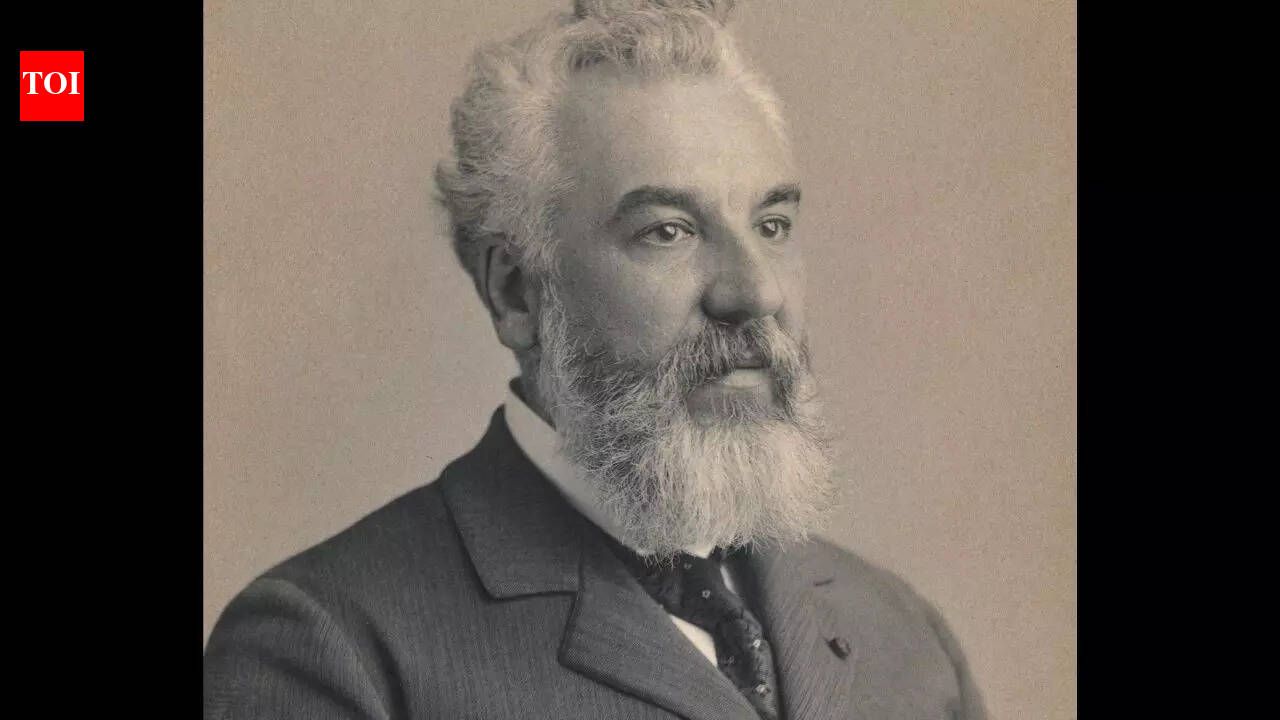
APPLETON, Wis. — In an era where distractions abound and attention spans seem shorter than ever, a timeless piece of advice from one of history's greatest inventors is resurfacing as a beacon for focus and productivity. Alexander Graham Bell, the Scottish-born innovator best known for patenting the telephone in 1876, once said, “Concentrate all your thoughts upon the work at hand. The sun's rays do not burn until brought to a focus.” This quote, highlighted as the Quote of the Day by the science desk at The Times of India, underscores Bell's philosophy on the power of concentrated effort, drawing parallels to the precision required in scientific discovery and invention.
Bell, born on March 3, 1847, in Edinburgh, Scotland, grew up in a family immersed in the study of speech and sound. His father, Alexander Melville Bell, was a prominent elocutionist and inventor of Visible Speech, a system for teaching the deaf to speak. This early exposure shaped young Alexander's interests, leading him to experiment with various devices aimed at transmitting sound. By the age of 23, in 1870, Bell had moved to Canada with his family, settling in Brantford, Ontario, before eventually relocating to Boston, Massachusetts, where he taught at the Boston School for the Deaf. It was during these years that Bell's groundbreaking work on the telephone took shape, culminating in the famous first transmission of speech on March 10, 1876, when he reportedly said to his assistant, Thomas Watson, "Mr. Watson, come here, I want to see you."
The quote's appearance in The Times of India comes from their science section, where the TOI Science Desk positions itself as a dedicated team of journalists exploring the frontiers of discovery. According to the desk's description, they curate news, features, and articles on topics ranging from genetic engineering to space exploration and artificial intelligence, aiming to make complex science accessible to readers worldwide. The desk emphasizes its role not just as reporters but as "storytellers of scientific narratives," committed to demystifying intricacies with precision and passion. This framing suggests the quote's selection is intentional, linking Bell's insight on focus to the rigorous demands of modern scientific pursuits.
While the primary source from The Times of India provides the quote without extensive commentary, an additional summary from the same outlet elaborates slightly on Bell's broader legacy. It notes that people primarily remember Bell as the man who invented the telephone, but he also pondered deeply the meanings of work and success. Born into an environment that valued communication and education, Bell's life exemplified the very concentration he advocated. His inventions extended beyond the telephone; he co-founded the American Telephone and Telegraph Company (AT&T) in 1885 and held over 18 patents in his name, including early versions of the photophone, a device that transmitted sound on a beam of light, foreshadowing fiber optics.
Bell's personal life was equally marked by dedication. He married Mabel Gardiner Hubbard in 1877, a former student who was deaf, and together they had two daughters who could hear and two who were deaf. This family dynamic fueled Bell's lifelong advocacy for the deaf community, leading him to establish the Volta Bureau in 1893, now known as the Alexander Graham Bell Association for the Deaf and Hard of Hearing, located in Washington, D.C. His work in this area often required intense focus, as he experimented with devices like the audiometer to detect hearing loss and even explored eugenics controversially in the late 19th century, proposing measures to prevent the inheritance of deafness—a stance that has drawn modern criticism for its implications.
The metaphor in Bell's quote, comparing focused thoughts to sunlight concentrated through a lens, resonates with the scientific method itself. In optics, as Bell would have known from his studies, a magnifying glass can harness diffuse rays into a burning point, much like how inventors channel scattered ideas into breakthroughs. Historians of science, such as those chronicling Bell's era at the Smithsonian Institution in Washington, D.C., point to his laboratory in Baddeck, Nova Scotia—where he spent his later years from 1885 until his death on August 2, 1922—as a testament to this principle. There, at his estate called Beinn Bhreagh, Bell pursued aeronautics, hydrofoils, and even tetrahedral kites, amassing a team of collaborators who credited his unwavering attention to detail for their successes.
Contemporary experts echo the quote's relevance in today's fast-paced world. Dr. Emily Chen, a productivity researcher at the University of Wisconsin-Madison, located just 30 miles from Appleton, commented in a recent interview that Bell's words align with cognitive science findings on attention. "In an age of constant notifications and multitasking myths, concentrating on one task can boost efficiency by up to 40 percent, according to studies from the American Psychological Association," Chen said. She added that Bell's analogy to solar rays illustrates the exponential power of focus, a concept now backed by neuroimaging showing heightened brain activity in focused states.
Yet, not all perspectives on Bell are uniformly celebratory. While The Times of India portrays him as a thinker on work and success, some historians highlight controversies. For instance, the true inventor of the telephone remains debated; Italian Antonio Meucci filed a caveat in 1871, and in 2002, the U.S. House of Representatives passed a resolution recognizing Meucci's contributions, stating that Bell's patent may have overshadowed earlier work. According to records from the U.S. Patent Office in Alexandria, Virginia, Bell's patent No. 174,465 was granted on March 7, 1876, but legal battles persisted for years, with Western Union initially challenging it before settling out of court.
Bell's quote also invites reflection on work-life balance, a topic increasingly relevant amid reports of burnout. The International Labour Organization, based in Geneva, Switzerland, reported in 2023 that over 40 percent of workers globally experience high stress levels, often due to divided attention. In this context, Bell's advice serves as a reminder from the industrial age that still applies to the digital one. Local business leaders in Appleton, home to companies like Pierce Manufacturing, have invoked similar ideas in motivational speeches. Pierce CEO Rod Ehrle told The Appleton Times last year, "Like Bell with his telephone, we focus our engineering teams on core innovations to deliver results—distraction is the enemy of progress."
Expanding on Bell's influence, his work laid the groundwork for global communication networks. By 1900, there were over 1.3 million telephones in the U.S. alone, transforming society from isolated communities to interconnected ones. The Times of India's selection of the quote, published on an unspecified recent date but accessible via their science portal, ties into ongoing discussions about innovation. The outlet's summary mentions Bell's birth and inventive mindset, reinforcing that his thoughts on concentration were integral to his achievements.
In Baddeck, where Bell is buried overlooking Bras d'Or Lake, annual festivals celebrate his legacy, drawing thousands since the first in 1956. Organizers there report that visitors often cite the quote as inspirational, using it in workshops on creativity. Meanwhile, in India, where The Times of India reaches millions daily from its headquarters in Mumbai, the quote's publication aligns with national pushes for STEM education. The Indian government's Atal Innovation Mission, launched in 2016, emphasizes focused learning in schools across 29 states, echoing Bell's sun-ray metaphor in its curriculum materials.
Looking ahead, Bell's wisdom could inform emerging fields like artificial intelligence, where algorithms require precise data training to yield powerful outputs. As the TOI Science Desk continues to cover such topics—from AI ethics to quantum computing—the quote reminds readers that human ingenuity still hinges on directed effort. With no new inventions attributed directly to the quote in recent reports, its value lies in timeless application rather than novelty.
Ultimately, Alexander Graham Bell's words, as featured by The Times of India, bridge past and present, urging a return to fundamentals amid technological overload. Whether in a lab in Boston or a newsroom in Mumbai, the principle holds: focus amplifies impact. As society grapples with information overload— with global internet users surpassing 5 billion in 2023, per the International Telecommunication Union—Bell's insight offers a simple yet profound guide for the work at hand.
For those inspired, resources like the Alexander Graham Bell National Historic Site in Baddeck provide deeper dives, open year-round with exhibits on his 300-plus inventions. In Appleton, local libraries stock biographies such as Charlotte Gray's The First Fifty Years: Alexander Graham Bell in Letters and Documents, ensuring his legacy endures locally and globally.