As the 2025 college football season draws to a close, the spotlight has shifted to an exhilarating College Football Playoff semifinal featuring three first-time participants and two potential inaugural national champions—none of whom have claimed a title in the past 24 years. Yet, amid this unexpected thrill, numerous teams have grappled with profound disappointments, from shattered national title aspirations to outright collapses that led to coaching changes and roster overhauls. According to an in-depth analysis by ESPN, the season's letdowns span a wide spectrum, with teams ranked loosely across eight categories based on unmet expectations, poor performances, and broader implications for their programs.
The most glaring disappointments came from preseason top-10 teams that either limped to seven or fewer wins or mounted late rallies that proved insufficient for playoff contention. ESPN ranked Clemson at the top of this list, describing a "systemwide collapse" that baffled observers. Despite returning NFL-caliber talent on defense, the Tigers improved only marginally from 29th to 24th in defensive SP+ rankings under coordinator Tom Allen. Quarterback Cade Klubnik's ineffectiveness persisted regardless of injuries to skill players and the offensive line, resulting in Clemson's worst season in 15 years. "I was openly skeptical of the Tigers' national title potential heading into the season, but I still expected them to play like a top-15 team," ESPN noted, highlighting the unexpected depth of the fall.
Following closely was Penn State, which placed too much emphasis on an early-season win over Oregon that never materialized. After that upset fell through, the Nittany Lions suffered a two-week implosion with losses as heavy favorites to UCLA and Northwestern, dropping to 18th in SP+ rankings. From there, they played like a middling team, nearly upsetting Indiana and Iowa on the road, challenging Ohio State for a half, and dominating lesser opponents. "They somehow emerge from the most disappointing season in ages with a few positive feelings," ESPN observed, pointing to a silver lining in their resilience.
LSU rounded out the top three in this category, undone by an offensive line that couldn't hold up and receivers plagued by drops. The Tigers overachieved projections only once, against FCS opponent Southeastern Louisiana, otherwise delivering a "cascade of awful performances" that wasted a strong defense and cost head coach Brian Kelly his job. ESPN's SP+ ratings struggled to capture the extent of LSU's offensive woes, underscoring how injuries and execution failures derailed a squad with high hopes.
Texas secured the fourth spot, relying heavily on freshman quarterback Arch Manning to mask deficiencies at receiver and on the offensive line. Manning didn't live up to preseason Heisman hype until late in the year, by which point defensive lapses had set in. A single devastating loss at Florida in early October proved pivotal; without it, Steve Sarkisian's Longhorns might have slipped into the playoff. ESPN emphasized that while the late surge was encouraging, the season's overall trajectory fell short of expectations for a top-10 program.
Beyond the elite preseason ranks, five teams slotted between 11th and 17th preseason failed to approach playoff contention. South Carolina, under Shane Beamer, continued a peculiar pattern of thriving only in even-numbered years, alternating strong and weak seasons in SP+ from 48th to 19th, then 51st, 14th, and back to 48th. Despite potential stars like quarterback LaNorris Sellers and defensive end Dylan Stewart, the Gamecocks retooled much of the roster and finished 4-8. New offensive coordinator Mike Shula departed after one year, and the pass defense faltered badly. "The bad performances were awful, and the excellent performances—they did nearly beat two playoff teams (Alabama and Texas A&M)—resulted in gut-wrenching losses," ESPN reported, noting optimism for the upcoming even-numbered 2026.
Florida was hamstrung from the outset by quarterback DJ Lagway's offseason injuries, leaving him rusty and inconsistent. A young, shuffled receiving corps exacerbated the issues, while the defense offered solidity but no dominance. Billy Napier's firing after a 3-4 start led to mounting losses under an interim coach, contrasting with Penn State's partial recovery. ESPN highlighted how these elements combined to doom the Gators' season.
In a surprising twist, Kansas State appeared cursed after its season-opening loss to Iowa State in Dublin, Ireland—a fate that befell Florida State in 2024 and Nebraska in 2022. The Wildcats briefly collapsed to 2-4 before stabilizing for a .500 finish, but an exhausted squad declined a bowl bid, prompting coach Chris Klieman's retirement. ESPN warned other Ireland participants, like TCU and North Carolina, of potential doom, framing Kansas State's arc as a cautionary tale.
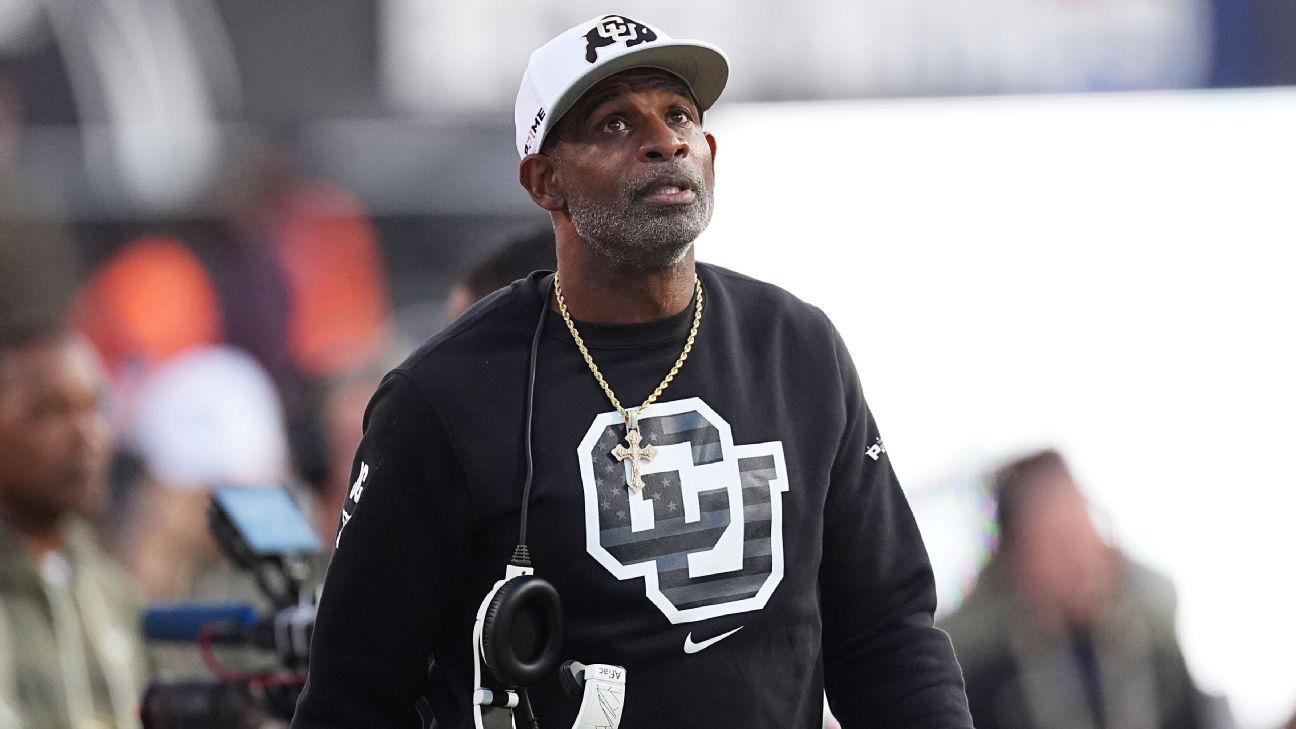
Honorable mentions in this tier went to Arizona State and Michigan, both of which underperformed relative to preseason projections. Shifting focus to 2024 playoff teams and late surging squads, Colorado epitomized the drop-off. After a nine-win 2024 campaign featuring Travis Hunter's Heisman win, the Buffaloes lost Hunter and quarterback Shedeur Sanders, leading to quarterback instability and a second demotion of the offensive coordinator in three years. A Week 7 upset of Iowa State was followed by five straight blowout losses averaging 40-15, ending at 3-9. Deion Sanders now faces another rebuild, with ESPN questioning the program's direction.
Boise State, without star Ashton Jeanty, was expected to lead Group of 5 but saw key players like Jayden Virgin-Morgan and Maddux Madsen stagnate or suffer injuries. New running backs fumbled excessively, and losses to three top-40 SP+ opponents totaled 100-24. Though they won the Mountain West, a fall from CFP contention to outside the top 60 in SP+ marked a significant regression.
Tennessee managed 8-5, but a disintegrating defense led to an 0-5 record against winning teams, squandering offensive gains post-Nico Iamaleava. SMU rebounded to nine wins after a 2-2 start but couldn't defend its ACC title, losing three close games by seven points total—enough, per ESPN, to potentially return them to playoff contention with better luck.
Teams without major hype but solid projections also faltered dramatically. Arkansas nearly achieved the improbable: a 2-10 record despite a top-50 SP+ ranking. A 56-13 thrashing that ousted Sam Pittman introduced interim Bobby Petrino, but an atrocious defense yielded losses even in games where the offense scored 30-plus. They went 0-6 in one-score finishes, which incoming coach Ryan Silverfield might spin positively for 2026.
Wisconsin's preseason 38th SP+ projection required massive offensive leaps, derailed when starting quarterback Billy Edwards Jr. was injured in Week 1. Four quarterbacks started, none exceeding 700 passing yards, leading to a 4-8 finish—the Badgers' worst in 35 years. Despite retaining Luke Fickell, late upsets over Washington and Illinois offered faint hope.
In the ACC, Virginia Tech mirrored Wisconsin's struggles at No. 42 preseason, needing new players and coordinators to gel. They didn't, prompting Brent Pry's firing after allowing 89 points to Vanderbilt and Old Dominion in the first three games. Losses mounted, finishing outside the top 100 in SP+ for the first time since 1978.
North Carolina, under Bill Belichick, was pegged for 6-6 but ended 4-8. ESPN quipped that the roster "screamed '6-6'" preseason, but offensive woes and a mockable quote from GM Michael Lombardi about being the "33rd NFL team" defined the year. Auburn repeated close-game misfortunes, going 0-6 in one-score finishes despite a plus-73 scoring margin, leading to Hugh Freeze's dismissal—echoing their 2024 struggles with a plus-77 margin.
Lower-expectation teams imploded even more spectacularly in the transfer-heavy era. Oklahoma State, after a poor 2024, imported 41 transfers under Mike Gundy, but they yielded little value. Losses averaged 48-13 in the first six power-conference games, firing Gundy after three. New hire Eric Morris inherits chaos with 45 players in the portal.
Georgia State lost 73 transfers over two years, leaving scant talent and a 1-11-like defense that allowed 27-plus points in nearly every FBS game. Coach Dell McGee struggled post-Shawn Elliott's awkward February 2024 exit. UCLA started with 78-20 home losses to Utah and New Mexico, firing DeShaun Foster early; a midseason rally including a Penn State upset dissolved into five blowouts averaging 42-12. Bob Chesney takes over at a low ebb.
Michigan State under Jonathan Smith stagnated at 9-15 over two years, ranking 83rd in SP+. The controversial Pat Fitzgerald hire follows, with a low bar for improvement. Oregon State reverted to 2-10 and 124th SP+ just two years after Smith's departure, burdened by realignment; Trent Bray had little chance, leaving JaMarcus Shephard to rebuild.
Rebound hopes for some teams evaporated quickly. Florida State improved on paper from 2-10 to 5-7 and 41st in SP+, starting 3-0 with a rout of Alabama and peaking at No. 7 in the AP poll. But tight losses and poor road play—including to Stanford—derailed them, feeling like regression given their recent 19-game streak.
Maryland, in Mike Locksley's seven seasons, boasts a 21-5 September record but 15-39 afterward; 2025's 4-0 to 0-8 split epitomized this. Retaining quarterback Malik Washington offers hope, though history suggests caution. Kansas, building under Lance Leipold, started 3-1 but again hit 5-7 with 1-5 in close games, mirroring 2024.
Finally, 2024 improvers like Syracuse collapsed after quarterback Steve Angeli's early injury, averaging 11 points per game thereafter. Desperation saw freshman lacrosse player Joseph Filardi start three times, hinting at deeper issues. Boston College devolved from 7-6, with the defense yielding 36-plus points seven times and the offense scoring 13 or fewer often.
Honorable mentions for broader letdowns include Baylor, Liberty, Louisiana, Rutgers, and others that combined for far fewer wins than projected. As programs lick their wounds—many with new coaches like Ryan Silverfield at Arkansas or Eric Morris at Oklahoma State—the 2026 offseason looms large. Transfer portal activity, recruiting, and schematic overhauls will be crucial, especially with the playoff's expansion amplifying the stakes. For these disappointed teams, putting 2025 behind them can't come soon enough, setting the stage for potential redemptions or further turmoil in a landscape where expectations can shift dramatically year to year.