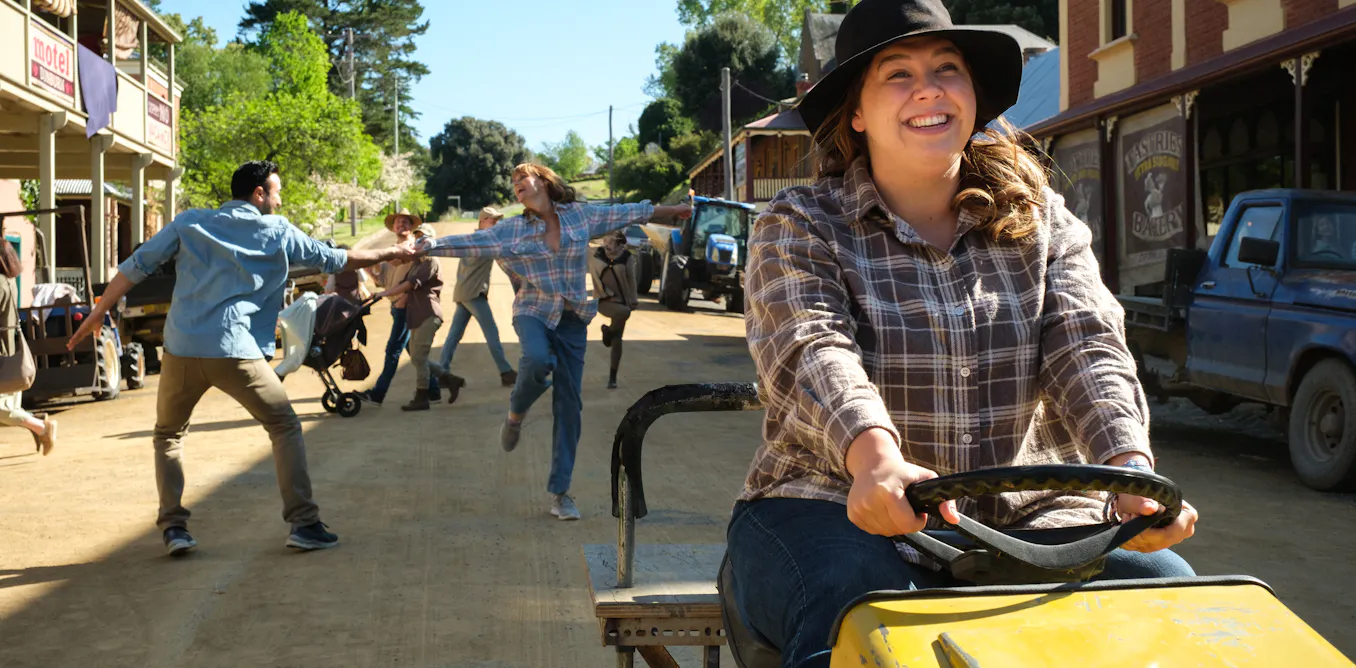
SYDNEY, Australia — After a series of legal hurdles and production delays, Rebel Wilson's directorial debut, The Deb, has finally arrived in cinemas, bringing a fresh Australian comedy to audiences with a focus on young women and regional life. The film, which adapts a 2022 stage musical, centers on two contrasting teenage girls navigating traditions and personal growth in a drought-stricken outback town. Released this week, it marks Wilson's first time behind the camera, following her success as an actor in films like Pitch Perfect and Bridesmaids.
The story unfolds in the fictional town of Dunburn, where city sophistication clashes with rural simplicity. Maeve, played by Charlotte MacInnes, is a confident Sydney private school student expelled for protesting the 'tyranny of the top shirt button' — a nod to school uniform strictures. Sent to stay with her cousin Taylor Simpkins, portrayed by Natalie Abbott, Maeve arrives just as preparations for the local debutante ball intensify. Taylor, an earnest farm girl struggling with unpopularity, desperately seeks a date for the event, highlighting the film's exploration of social and political divides.
According to a review published by The Conversation, the film originated as a stage production in 2022, the inaugural project from Wilson's scholarship program for young, female-identifying comedy writers. Written by Australian comedy writer Hannah Reilly and musician Meg Washington, the musical was staged by the Australian Theatre for Young People (ATYP) and quickly caught Wilson's attention. 'Almost immediately, Wilson flagged her intent to adapt the stage show for film,' the review notes, emphasizing the project's roots in empowering emerging female talent.
Wilson, who also stars as Janette, a colorful hairdresser boasting about waxing Hugh Jackman's 'back, sack and crack,' infuses the movie with her signature crude humor. Her involvement was reportedly a condition set by the film's funders, ensuring her broad comedic appeal. MacInnes reprises her stage role as Maeve, bringing self-assured energy to the character, while Abbott delivers a heartfelt performance as the sweet but overlooked Taylor. The review praises their chemistry, stating, 'both MacInnes and Abbott deliver in spades,' underscoring the film's alignment with what it calls the 'female turn' in Australian musical theatre.
Supporting roles add depth to the ensemble. Shane Jacobsen plays Rick, Taylor's father and the town's mayor, embodying the 'salt-of-the-earth' archetype. Costa D’Angelo appears as Dusty, Maeve's romantic interest, though male characters remain on the periphery. Young actors Stevie Jean, as the mean-girl Annabelle, and Scarlett Crabtree, as the comic Kid Koala, stand out for their talents. Jean's vocal prowess is highlighted as 'one of the best voices in the cast,' while Crabtree provides laugh-out-loud moments.
The narrative draws loosely from the fable of the town mouse and country mouse, with Maeve initially recoiling at the debutante ball's patriarchal undertones. Her 'woke politics' create humorous friction with Dunburn's residents, but the film softens this into a message about the value of traditions. As the review observes, 'one of the film’s strengths is that it manages to make the clash between Maeve’s woke politics and the sensibilities of Dunburn’s residents for the most part funny, rather than painfully didactic.' By the end, Maeve appreciates how such rituals foster community bonds.
Production challenges have shadowed The Deb since its inception. Unresolved legal troubles and repeated delays pushed back its release, testing the patience of Wilson and her team. Despite these setbacks, the film emerges as an enjoyable comedy targeted at a young, female audience, complete with quintessentially Australian humor. The Conversation review describes it as 'an enjoyable Australian comedy with characteristically crude humour, but aimed squarely at a young, female audience.'
However, not all elements hit the mark. While the comedy shines, the musical aspects falter, according to critics. The score, comprising individual catchy songs, lacks cohesion and fails to integrate seamlessly with the story. Influences from successful Australian works like Fangirls and Muriel’s Wedding: The Musical are evident, but the review argues that The Deb misses the 'sophisticated dramaturgical underpinnings' that tied those productions together. 'The strong performances are not enough to override the film’s central problem: that, devastatingly for a musical, the music is the weakest link,' it states.
Songs in The Deb often serve as background rather than advancing the plot, leading to a notable songless sequence during key dramatic moments. This stretch, where 'all the important things happen without music,' suggests to reviewers that the music functions more as a soundtrack than an essential storytelling tool. The film struggles to establish a sonic or choreographic style that complements its Australian setting, humor, and landscape.
Audience reactions vary, reflecting the film's niche appeal. The reviewer watched it with family members from a similar country town, including her mother-in-law and sister-in-law, both debutante ball alumni. They 'found many pleasurable, laugh-out-loud moments of quintessentially Australian humour,' while the reviewer's husband left after the first song, reinforcing the perception of its targeted demographic. This personal anecdote illustrates the film's warmth toward regional Australia amid ongoing urban-rural divides, as seen in recent One Nation polling.
Beyond entertainment, The Deb contributes to a growing trend in Australian theatre and film that prioritizes female perspectives. The 'female turn' acknowledges that musical theatre audiences skew young and female, and the movie leans into this with its all-women focus. Wilson's scholarship program, which birthed the original musical, continues to support new voices, potentially paving the way for more such projects.
As The Deb rolls out in cinemas across Australia, it arrives at a time when discussions about cultural representation in media are prominent. The film's affectionate portrayal of drought-ravaged towns like Dunburn offers a counterpoint to stereotypes, celebrating community resilience. Yet, its musical shortcomings may limit its staying power compared to Wilson's past hits.
Looking ahead, Wilson has expressed interest in further directing ventures, building on this experience. For now, The Deb stands as a testament to her commitment to Australian stories and female-led narratives. Whether it gains a cult following or fades into niche appeal remains to be seen, but its release ends a long wait for fans eager to see Wilson's vision on screen.
The film's cinematography captures the stark beauty of the outback, enhancing the cultural clash at its core. Sets in Dunburn evoke real Australian regional life, from dusty farms to community halls buzzing with ball preparations. No specific release dates beyond 'in cinemas now' were detailed, but early screenings have drawn positive buzz for its humor and heart.
In summary, The Deb delivers laughs and warmth but stumbles as a musical, per expert analysis. As Australia grapples with its city-country tensions, films like this bridge divides through shared stories, even if imperfectly. Viewers are encouraged to catch it soon, joining the conversation on what makes Australian cinema uniquely vibrant.