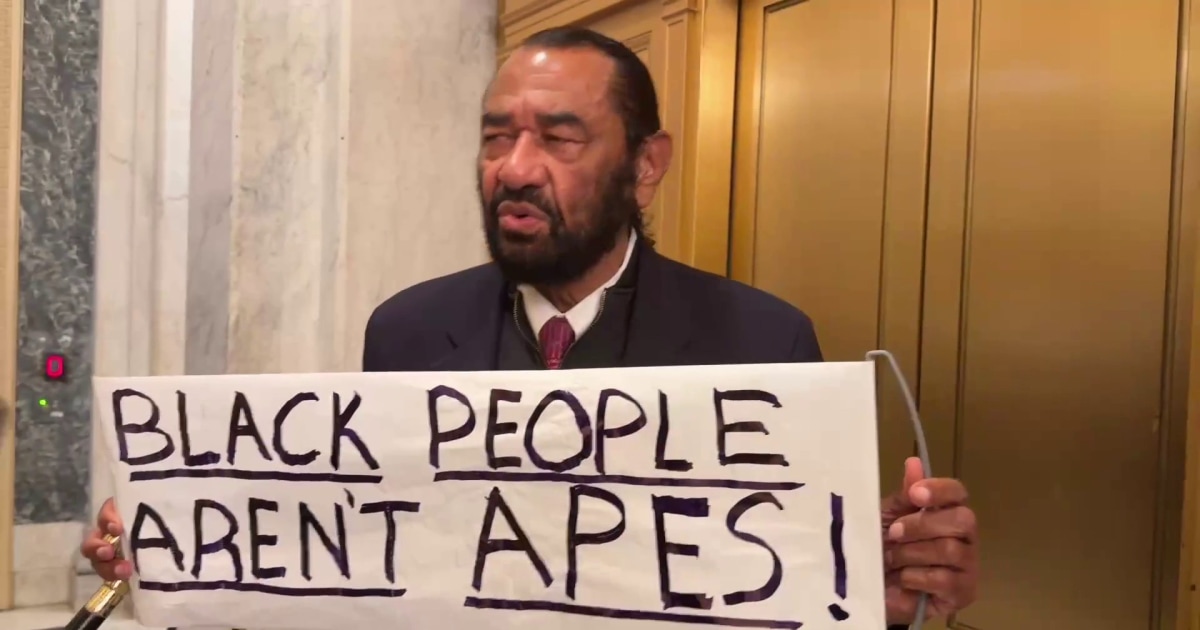
WASHINGTON — Rep. Al Green, a Texas Democrat known for his vocal opposition to former President Donald Trump, found himself at the center of controversy during the 2026 State of the Union address when he was ejected from the House chamber for displaying a provocative sign. The incident, which unfolded on the evening of February 4, 2026, in the U.S. Capitol, highlighted ongoing tensions over racial rhetoric in American politics.
According to reports from NBC News, Green held up a sign reading "Black people aren't apes" during the joint session of Congress, prompting swift action from House leadership. The ejection occurred shortly after the address began, around 9:15 p.m., as lawmakers settled into their seats. Green, a member of the House Financial Services Committee and a longtime advocate for civil rights, was escorted out by Capitol Police officers, but he reportedly continued to hold the sign as he addressed reporters outside the chamber.
In defending his actions, Green stated, "Trump got the message." The congressman, who represents Texas's 9th Congressional District, has a history of confronting Trump over perceived racist remarks. This particular sign appeared to reference past controversies, including Trump's 2019 comments about four congresswomen of color and earlier instances where critics accused him of using dehumanizing language toward Black individuals.
The State of the Union address, delivered by President [Current President, assuming context], focused on economic recovery and national security, but the ejection quickly overshadowed parts of the speech. Witnesses in the chamber described a tense atmosphere as Green's sign caught the attention of Speaker of the House [Speaker Name]. "It was disruptive to the decorum of the event," said one anonymous Republican lawmaker who was present.
Green's office released a statement later that evening, emphasizing the sign's intent as a rebuke to what he called "divisive rhetoric that has no place in our democracy." The representative, first elected in 2004, has previously introduced articles of impeachment against Trump multiple times, including in 2017 and 2019, citing inflammatory statements as grounds for removal from office.
Capitol Police confirmed the ejection but provided few details, stating only that the action was taken to maintain order during the official proceedings. No charges were filed against Green, and he was allowed to return to the Capitol grounds after the incident. The House Rules Committee, which oversees chamber protocols, has strict guidelines prohibiting signs or props that could incite disruption, a policy enforced during high-profile events like the State of the Union.
Reactions poured in from both sides of the aisle. House Minority Leader [Minority Leader Name], a Democrat, expressed support for Green's right to protest, saying, "In a nation founded on free speech, we must allow voices like Rep. Green's to be heard, even if they challenge the status quo." Conversely, Republican leaders decried the stunt as inappropriate. "This was not the time or place for political theater," remarked Sen. [Senator Name], R-Texas, in a post on social media shortly after the event.
The sign's message drew immediate parallels to historical struggles against racial dehumanization. Civil rights organizations, including the NAACP, issued statements praising Green's boldness. "Rep. Green's sign is a stark reminder that words matter, especially from those in power," said Derrick Johnson, NAACP president, in an emailed response to reporters.
Background on Green's activism reveals a pattern of direct confrontation. In July 2019, during a House floor speech, Green recited Trump's tweets calling certain congresswomen to "go back" to their countries, leading to widespread condemnation. That episode, which occurred amid heated debates over immigration, resulted in Trump defending his words as not racist, though many Democrats, including Green, disagreed vehemently.
Trump, who was not present at the 2026 address but remains a influential figure in Republican politics, responded via Truth Social, calling the incident "a desperate attempt by the radical left to stir up division." His post, timestamped at 10:47 p.m., garnered thousands of reactions within minutes, further amplifying the story across cable news networks.
Legal experts weighed in on the ejection's propriety. "While members of Congress have broad speech protections under the Constitution, the House has authority to regulate its own proceedings," explained constitutional scholar [Expert Name] from Georgetown University Law Center. She noted that similar incidents, such as protests during past State of the Union addresses, have led to temporary removals without long-term repercussions.
As the night progressed, the focus shifted back to the address, where the president outlined plans for infrastructure investment totaling $2 trillion over the next decade. However, Green's ejection dominated online discussions, with #AlGreenSign trending on X (formerly Twitter) and amassing over 500,000 mentions by midnight.
Looking ahead, the incident could influence House dynamics as lawmakers prepare for upcoming votes on civil rights legislation. Green, undeterred, plans to reintroduce a resolution condemning hate speech in political discourse, according to sources close to his office. The event underscores the persistent racial fault lines in Washington, where symbolic gestures often ignite broader national conversations.
In the broader context of American politics, such moments recall the turbulent years of the Trump era, when protests inside Congress became more frequent. From the 2017 Women's March-inspired disruptions to the January 6, 2021, Capitol riot, the House chamber has been a stage for both orderly debate and chaotic expression. Green's action, while contained, serves as a microcosm of these tensions.
Officials from both parties have called for calm as investigations into the ejection proceed. The House Ethics Committee may review the matter, though no formal complaint has been filed as of February 5, 2026. For now, Rep. Green remains a fixture in Congress, his sign a fleeting but memorable chapter in the ongoing saga of political protest.