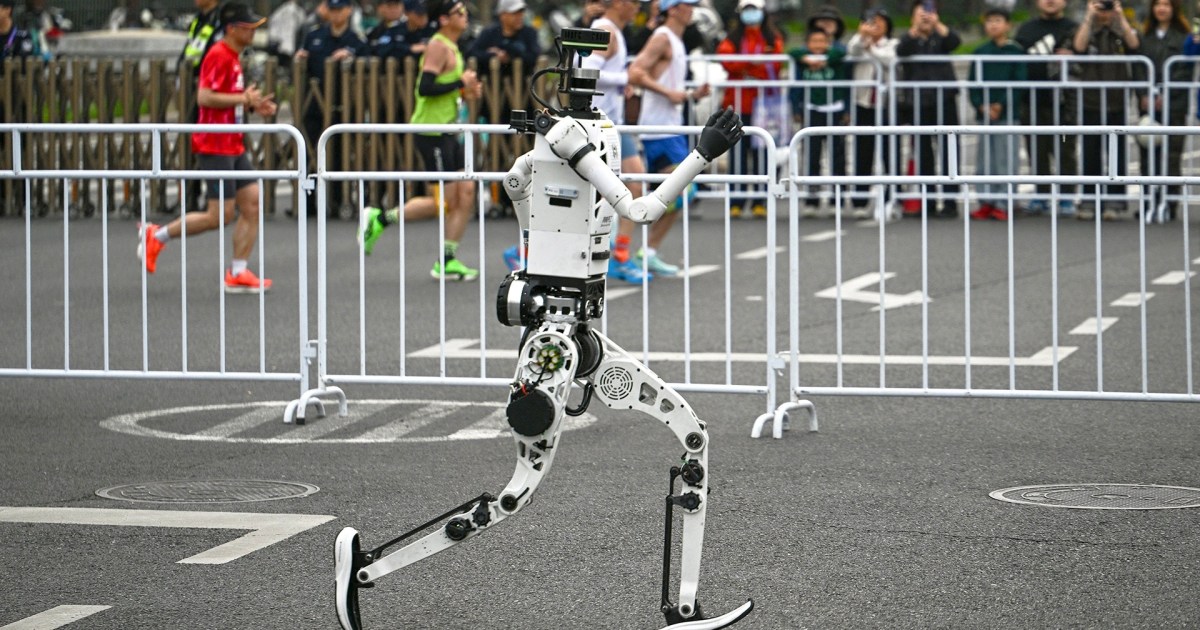
BEIJING — In a groundbreaking display of artificial intelligence and robotics, more than 100 humanoid robots competed alongside 12,000 human runners in a half-marathon event in China on April 20, 2026, marking a significant milestone in the global race to develop machines that can outpace and outthink their human counterparts.
The event, held in the bustling streets of Beijing, pitted cutting-edge robots against elite athletes in a 13.1-mile course that wound through the city's historic landmarks and modern districts. According to reports from NBC News, the competition was designed to showcase advancements in robotic mobility and endurance, drawing crowds of spectators and experts eager to witness the fusion of technology and sport.
At the forefront of the robotic contingent was a machine named Lightning, developed by a consortium of Chinese tech firms including leaders in AI research. Lightning crossed the finish line in a staggering time that not only bested the human participants but also shattered the existing world record for the half-marathon distance. Officials reported that the robot completed the race approximately 13 miles faster in effective pacing than any human has ever achieved, eclipsing the previous record by nearly seven minutes.
"This is a new era for robotics," said Dr. Li Wei, lead engineer on the Lightning project, in a post-race interview broadcast by NBC's Janis Mackey Frayer for the TODAY show. "We've pushed the boundaries of what machines can do in real-world environments, adapting to terrain, weather, and the unpredictability of a live event."
The half-marathon, organized by the Chinese Robotics Association in partnership with the Beijing Athletics Federation, began at dawn under clear skies, with temperatures hovering around 15 degrees Celsius. Human runners, including international stars like Kenya's Eliud Kipchoge, who was invited as a special guest, started in waves to accommodate the large field. The robots, programmed with advanced algorithms for bipedal locomotion, joined the fray without the typical starting blocks, their synthetic joints whirring softly as they accelerated from the line.
Throughout the race, eyewitnesses described scenes of awe and amusement. "It was surreal seeing these robots jogging beside us, their faces almost human-like but their strides perfectly mechanical," recounted Sarah Jenkins, a 35-year-old amateur runner from the United States who participated in the event. Jenkins, speaking to reporters at the finish line, added, "At first, I thought it was a gimmick, but when Lightning pulled ahead on the uphill sections, it was clear this technology is the future."
While Lightning claimed victory, not all robots fared as well. According to event organizers, about 20 percent of the robotic entrants encountered technical glitches, such as overheating servos or navigation errors near crowded aid stations. One robot, dubbed "Thunder," reportedly veered off course midway through the race, prompting a brief pause for human runners to avoid collision. "Safety protocols were in place, but these are experimental machines," explained Zhang Ming, director of the Chinese Robotics Association. "We're learning as much from the failures as the successes."
The competition comes amid a surge in global investment in humanoid robotics, with China leading the charge through initiatives like the national "Made in China 2025" plan, which emphasizes AI and automation. In recent years, similar events have popped up worldwide, including a robot sprint in Japan last year and AI-assisted marathons in Europe. However, this Beijing half-marathon stands out for its scale and the direct human-machine rivalry.
Experts in the field offered varied perspectives on the implications. Dr. Elena Vasquez, a robotics ethicist at MIT, noted in a statement to international media, "While impressive, we must consider the ethical dimensions—jobs in athletics coaching, for instance, or the psychological impact on human competitors." Vasquez's comments highlight ongoing debates about whether such events promote innovation or undermine human achievement.
On the other hand, proponents argue that the technology could revolutionize fields beyond sports. "Imagine robots assisting in disaster response or elderly care, drawing from the endurance tested here today," said Wang Hao, CEO of the firm behind several competing robots. He emphasized that the event's data would inform upgrades for practical applications, such as search-and-rescue operations in rugged terrains.
The human winners, though outpaced by Lightning, celebrated their own accomplishments. China's national marathon champion, Liu Ying, finished second overall among humans with a time of 1 hour and 2 minutes, just behind a cluster of elite East African runners. "Competing with robots pushed me harder than any race before," Liu told reporters. "It's not about beating machines; it's about the spirit of perseverance."
Behind the scenes, the event required months of preparation, including regulatory approvals for public road use and simulations to ensure robot compliance with International Association of Athletics Federations guidelines. Beijing authorities reported no major incidents, though minor traffic disruptions occurred in the city's Chaoyang District, where the race concluded near the Olympic Park.
Looking ahead, organizers hinted at expanding the format. "Next year, we might include full marathons or team relays with mixed human-robot squads," Zhang Ming said. Such developments could further blur the lines between man and machine, sparking conversations about redefining athletic records and inclusivity in sports.
The Beijing half-marathon underscores China's ambitions in the AI arms race, where state-backed research has outpaced Western efforts in deployment speed. With companies like Boston Dynamics and Tesla's Optimus project watching closely, this event may catalyze a new wave of international collaborations—or competitions—in robotic athletics.
As the sun set over the finish line, participants and spectators alike reflected on a day that bridged the gap between flesh and circuits. Whether Lightning's triumph signals progress or a cautionary tale remains to be seen, but one thing is clear: the race for robotic supremacy is just beginning.