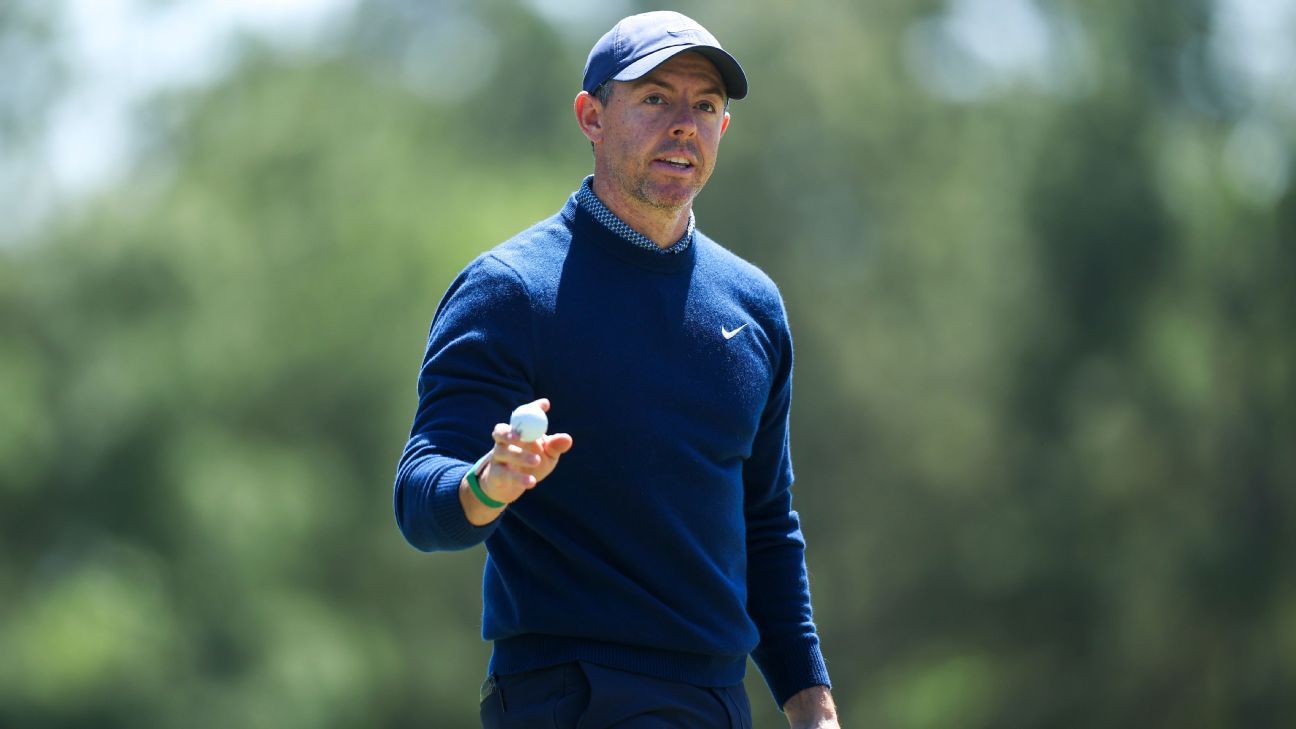
AUGUSTA, Ga. -- The 90th Masters Tournament kicked off Thursday at Augusta National Golf Club under ideal conditions, with a firm and fast course setting the stage for a grueling test of golf. Rory McIlroy, fresh off completing his career grand slam with last year's victory, fired a 5-under 67 to share the first-round lead with a group of top contenders. The leaderboard featured five of the top 10 finishers from 2025 inside the top 10 again, including four of the top five players in the world according to Data Golf rankings.
McIlroy's round was particularly notable given his struggles off the tee, hitting only five of 14 fairways. Despite what he called an almost undeserved score -- estimating he should have been at 2-under -- the Northern Irishman showcased the confidence gained from his recent major success. "I said this when I came in on Tuesday: I think winning a Masters makes it easier to win your second one. I do," McIlroy said after his round. "I think it's easier for me to make those swings and not worry about where it goes when I know that I can go to the Champions Locker Room and put my green jacket on and have a Coke Zero at the end of the day."
McIlroy's performance has positioned him well for a potential defense of his title, something not achieved since Tiger Woods in 2001. Fred Couples, a two-time Masters champion, was optimistic about McIlroy's chances, telling his caddie on the 12th hole, "By the way, Rory may never lose this thing again after last year." McIlroy relishes the shot-shaping and spin control demanded by Augusta National, especially as the course is expected to harden over the weekend.
Scottie Scheffler, the world No. 1, managed a 2-under 70 despite describing it as his "C game." The 2025 runner-up knows the demands of the layout intimately. Justin Rose, who finished second last year, posted a steady 70, drawing on his near-miss experience. Patrick Reed, the 2018 champion, opened with a 3-under 69 after two DP World Tour wins this year and a top-10 finish in 2025. "When I won in '18, it was the first year I actually fully bought into just taking it day by day and shot by shot," Reed said. "I think that's what my recipe is, because when you get to the first major, you're always going to put too much pressure on yourself, you're always going to grind a little harder."
Xander Schauffele, a two-time major winner, quietly carded a 70, marking his fifth top-10 in eight Masters starts. After a subpar 2025, Schauffele has three top-10s in 2026. "Kind of just got to hang in there," he said. "Anything can happen on this property, especially the way it's playing." With 18 players under par after the first round, the leaderboard remains stacked, but the forecast -- mid-80s temperatures and 20-30% humidity by the weekend -- promises drier, crustier conditions.
The course played firm and fast Thursday, with signs of its evolving difficulty evident early. Jason Day, in his 15th Masters, noticed a "tinge of purple" on the No. 1 fairway, indicating the fairways' firmness. Debutant Chris Gotterup averaged 363 yards off the tee, benefiting from the ball's roll on the hard surfaces. Patrick Reed broke a tee while repairing a ball mark on the 17th green, underscoring the turf's condition.
Shane Lowry, who shot 2-under 70, predicted challenges ahead. "You look at the forecast," Lowry said. "They can do whatever they want with the golf course this weekend. I think over the last few years, we've had a day every year where it's been raining or it's been heavy rains. It's kind of helped us a little bit, but I think before the week is out, it's going to get very, very crusty around here." Reed echoed the sentiment: "You already know it's going to get crusty. You know it's going to get fast, and it's going to take a lot of patience. You're going to have to hit the ball solid and put the ball in the right spots. When you do, be patient and try to minimize errors."
Day, who also shot 69, noted Augusta National's control over the setup. "If they want [single] digits to win, it'll be baked out and fast, and guys will be kind of spewing on themselves out there," he said. "Be really difficult." Lowry called it potentially "the toughest Masters we've played in a while." The lack of significant wind this week will keep focus on the course's firmness, making distance control and strategic misses crucial.
An illustrative moment came on the par-5 13th. McIlroy laid up and faced a 60-yard pitch from a downslope, generating enough spin to hold the green and birdie, sparking three straight birdies. Later, Scheffler and Gary Woodland encountered firmer greens; Scheffler's 62-yard shot and Woodland's 39-yard pitch both rolled off the back, turning a birdie opportunity into a par save. "When the greens get that firm, you really have to think about where the best miss is, and distance control is very important, but also, like, different -- missing it left, missing it right," McIlroy explained. "So when the greens do get firm like this, it makes it a much more tactical test, and you really have to think about things."
Not all rounds were stellar. Jon Rahm, riding momentum from a LIV Golf win and five top-5s in five starts this year, faltered with a 6-over 78, 11 strokes back. The 2023 champion spoke positively Tuesday about his iron play, but Thursday saw him lose over a stroke with irons and 3.62 strokes putting, including four three-putts -- the third-worst in the field. Rahm's recent major struggles have fueled debate about his LIV move, though he attributed his 2023 win to wetter conditions favoring survival over precision.
Bryson DeChambeau, after back-to-back LIV wins and consecutive top-10s at Augusta, including fifth last year, shot 4-over 76. His round unraveled on the 11th par-4 with a triple-bogey 7 after hitting into the right greenside bunker and taking three shots to escape. DeChambeau said he hit his second shot 12 yards farther than intended and found the bunker softer than expected. He hit eight of 18 greens and nine of 14 fairways, his worst Masters opener since a 78 at the 2025 Open, where he rebounded to tie for 10th. "Just going to give what the golf course gives me," DeChambeau said. "I have to try to hit my irons better. I drove it left numerous occasions. You know, everybody has an ability for weird things to happen, and today I just did not have my irons under control, which is weird. It's been good coming into it [the week]."
Several notables face a fight to make the cut, projected at 4-over or better by Data Golf, with a 38.4% chance for some. Bubba Watson, a two-time winner, Sungjae Im, Nicolai Højgaard, and DeChambeau sit at 4-over. Patrick Cantlay, Harry Hall, and Maverick McNealy are at 5-over, while Min Woo Lee, Fred Couples, and Rahm are at 6-over. Brian Harman, the 2023 Open champion, is 7-over, and Robert MacIntyre is 8-over.
Harry Hall, after a 37-40 first round, plans equipment changes. "I'm going to change my driver," he said. "I'm going to put two drivers in play tomorrow, different ones. I'm putting a new putter in play and going to figure [it] out on the range. I don't think I spin my irons enough either. I went into a spinnier ball this week, but I still can't stop it on a dime like I need to. So, I probably need to add to my irons or do something to compete in these majors."
As the second round unfolds Friday, the focus will be on who can navigate the increasingly demanding Augusta National. With leaders like McIlroy and Scheffler experienced in contention here, and the course poised to reward precision, the tournament could produce one of its most memorable finishes. Players like Reed and Schauffele, with strong histories at the venue, add depth to the chase. Meanwhile, those like Rahm and DeChambeau must mount comebacks, reminiscent of DeChambeau's 2025 Open recovery. The dry forecast suggests scores may tighten, potentially leading to a winning total in single digits if the club superintendents adjust accordingly.
Augusta National's history of adapting to weather -- softer in rainy years, firmer in dry ones -- underscores its reputation as a thinking player's major. This year's setup, without the usual rain assistance, could elevate the test, separating the field's elite from the rest over the remaining 54 holes.