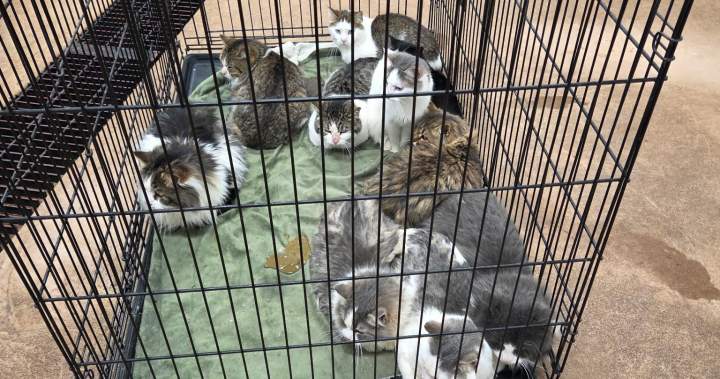
In the small town of Wynyard, Saskatchewan, a routine wellness check by the Royal Canadian Mounted Police last Friday uncovered a heartbreaking scene: a neglected home filled with debris and garbage, where one person was found deceased and another was rushed to medical care. Amid the chaos, dozens of cats were discovered in dire conditions, prompting a swift response from three animal rescue organizations across the province. By Tuesday evening, volunteers had saved at least 37 felines, many suffering from wounds and infections, in what rescuers described as a desperate but coordinated effort to prevent further tragedy.
The incident began when Saskatchewan RCMP officers arrived at the residence in Wynyard, located in east-central Saskatchewan, to perform the welfare check. According to a statement from the police to Global News, the officers not only attended to the human occupants but also identified several cats in need of immediate assistance. They quickly reached out to a local animal sanctuary to secure the animals' safety, setting off a chain of events that mobilized rescuers from as far as Saskatoon.
Veronica Hermiston, founder and director of Mozart Sympawthy Animal Sanctuary in the nearby town of Mozart, Saskatchewan, received the initial call from the RCMP. "I said to the RCMP officer, ‘I’ll get back to you, I just have to think this through and how we can do this,'" Hermiston recounted. Her sanctuary was already operating near capacity, and she was preparing to leave for another rescue operation, which made her hesitate. Despite the challenges, the urgency of the situation demanded action.
Late Friday evening, SOS Prairie Rescue, a volunteer-run cat rescue based in Saskatoon, took the lead. Ashlyn Weninger, the organization's president, explained how they rallied support overnight. “Overnight we were able to generate a response from other local rescues like SCAT and be able to mobilize in under 12 hours to head out onto the scene and start removing animals,” Weninger said. The team, including volunteers from SCAT—a cat rescue group—and Mozart Sympawthy, embarked on a two-hour drive early Saturday morning to reach the site.
Upon arrival, the volunteers faced conditions far worse than anticipated. The home was cluttered with debris and waste, creating a labyrinth of hiding spots for the frightened cats. “Cats were going up into the ceiling, they’re going into the rafter in the basement. There’s places to hide under the debris,” Weninger described, highlighting the painstaking search required. To protect themselves from potential hazards and the overwhelming odor, rescuers donned personal protective equipment and masks before entering.
The operation was methodical but grueling. Volunteers worked tirelessly over the weekend, coaxing and capturing the elusive animals one by one. By the end of the effort, 37 cats had been extracted, though rescuers believe more remain inside. Many of the saved cats exhibited minor injuries, such as cuts, abscesses, and skin issues, while a few suffered more severe conditions, including one with a ruptured eyeball. “Overall, considering everything they went through, they’re in pretty good shape,” Weninger noted optimistically.
The rescued cats are now receiving veterinary care and temporary fostering. According to Weninger, they will undergo a quarantine period of at least two weeks—potentially longer for those with serious injuries—before being prepared for adoption. The organizations plan to announce adoption availability on their social media channels in the coming weeks, giving the felines a chance at new beginnings. Hermiston emphasized that the RCMP's permission will dictate how long they can continue searching the property. “We’ll continue as long as we’re allowed by the RCMP,” she said.
This rescue highlights a broader issue in rural Saskatchewan, where animal welfare often intersects with human hardship. Rescuers pointed out that attempts to assist the residents and their pets had been ongoing for some time, but resources were scarce until the emergency escalated. “Unfortunately, in this case, it seems like people had been trying to help both the people and the animals living in this situation for quite some time and there just hadn’t been the help or resources or response available until it was a really emergency situation,” said one involved party, as reported by Global News.
The organizations involved—SOS Prairie Rescue, Mozart Sympawthy, and SCAT—agree that such neglect cases are not unique to Wynyard. Weninger, drawing from her group's frequent encounters, likened the plight of the animals to a warning sign for community suffering. “Our rescue deals with this all the time,” she said. “I think it’s important to recognize that when we see animals suffering in our communities, it’s kind of like the canary in the coal mine. There’s people that are suffering just as bad.”
In response to these recurring challenges, the rescue groups are advocating for systemic changes. They are calling on provincial and federal governments to implement proactive measures, including affordable veterinary services and widespread spay-and-neuter programs, to support pet owners and curb overpopulation. Weninger expressed frustration over the lack of engagement from authorities. “I think every group you will talk to is dismissed on every level from the smallest town council to the federal government. We are not asked to come to the table. We are continually dismissed. And something has got to change,” she urged.
The RCMP's role in this story underscores their occasional involvement in animal welfare during human crises. While their primary focus was the wellness check that led to the discovery of the deceased individual and the medical transport of the surviving resident, the police facilitated the rescue without delay. Details about the humans involved remain limited, as investigations into the death are ongoing, but officials have not released further information pending autopsy results.
Wynyard, a community of about 1,800 residents in the Quill Lakes area, is no stranger to rural hardships that can exacerbate situations like this. Economic pressures in agricultural regions often strain access to social services, including mental health support and animal care. The collaborative effort among the rescues demonstrates the strength of grassroots networks in filling these gaps, even as they push for more institutional backing.
As the search for additional cats continues this week, the rescued animals' progress offers a glimmer of hope. Veterinarians are treating infections and injuries, and foster homes are providing the nurturing environment these cats desperately need. The organizations' social media updates will keep the public informed, potentially leading to adoptions that not only save lives but also raise awareness about preventive care.
This event serves as a stark reminder of the interconnectedness of human and animal well-being in underserved areas. While the immediate crisis in Wynyard has been partially addressed, the rescuers' calls for policy reform echo a larger conversation across Canada about supporting vulnerable populations—both two-legged and four-legged. As Weninger put it, addressing animal suffering could be the key to uncovering and alleviating deeper community issues.
With more cats still unaccounted for, the teams remain committed to the site, weather and permissions permitting. The story from Wynyard may fade from headlines, but its lessons on compassion, collaboration, and the need for better resources linger, urging action before the next emergency arises.