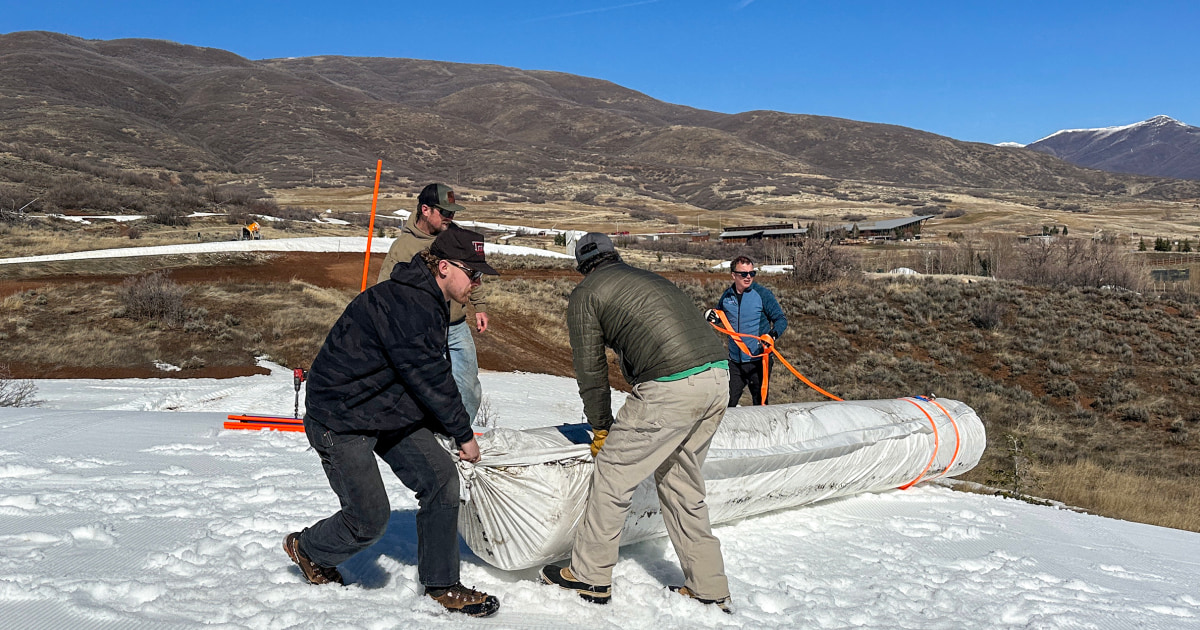
In the face of the West's most severe snow drought in modern history, ski resorts in states like Idaho, Utah, and Wisconsin are turning to an innovative technique called snow farming to safeguard their futures. This method involves producing artificial snow during optimal cold, dry conditions, stacking it into massive piles up to three stories high, and insulating it under specialized mats to preserve it through the summer for use in the next ski season. As natural snowfall becomes increasingly unreliable due to warmer winters, these efforts highlight the ski industry's desperate adaptations to climate change.
At Bogus Basin ski resort near Boise, Idaho, snow farming is entering its second season, offering a glimmer of hope for smaller operations on the brink. Nate Shake, the director of mountain operations at Bogus Basin, explained the process's potential: “It’s going to extend the viability of skiing, especially for some of the resorts that are going to be on the margin as we have warmer winters and we get less snow.” Last year, the resort piloted the system from Finnish company Snow Secure, one of only three in North America to do so. Crews made snow in frigid weather, piled it high, and covered it with white polystyrene mats that fold like accordions and provide weatherproof insulation similar to that used in homes.
The mats, about 2½ inches thick, can be installed in a day and are designed to encase snow piles roughly the length of a football field. Antti Lauslahti, CEO of Snow Secure, described the technology as akin to a battery for cold storage: “It’s a little bit like a battery. The more snow you can put under that insulated system, the longer it’ll hold that cold in.” According to Lauslahti, the stored snow typically loses only about 20% of its mass over the summer, allowing resorts to produce higher-quality snow more efficiently than in warmer conditions.
Snowmaking itself isn't new—it dates back to the 1970s—but it's far less effective in marginal temperatures at the start or end of seasons. Lauslahti noted that producing snow in warmer weather, around 27 or 28 degrees Fahrenheit, can require 70% to 80% more energy and yield shallow piles, perhaps just 2 feet deep overnight. In contrast, single-digit temperatures allow the same snow guns to build piles up to 8 feet deep quickly. “The snow quality is better when you make it in cold weather,” Lauslahti said. “You make it really fast, you make a really good quality and you use less energy.”
Bogus Basin's experience last summer validated the approach despite extreme heat. Monitoring systems recorded exterior temperatures reaching 119 degrees Fahrenheit on the mats, yet the snow inside averaged 37 degrees. When crews removed the coverings in October, about 80% of the snow remained intact. Even with the resort's warmest November on record, Shake said they opened on schedule: “We opened on the snow that we saved,” he added, noting that without it, “we wouldn’t have had a Thanksgiving opening at all.”
Further south, Soldier Hollow Nordic Center near Salt Lake City is testing snow farming for the first time, a move driven by its role in the upcoming 2034 Winter Olympics. Built for the 2002 Games at about 5,600 feet elevation—relatively low for Utah skiing—the venue is particularly vulnerable to warming trends. Luke Bodensteiner, the general manager and a two-time Olympic competitor in 1992 and 1994, called this winter's snowpack the worst in his memory. “It’s contingency planning for a bad winter in 2034,” Bodensteiner said of the experiment.
Soldier Hollow invested roughly $300,000 in the Snow Secure system to cover a snow pile from top to bottom. The center already relies heavily on artificial snow, with about half its season depending on man-made coverage produced by 20 movable fan guns and 40 robotic stationary units. Bodensteiner described the challenges of this year's conditions: “If it’s 27, 28 degrees and you leave a snow gun on overnight, you might have a pile under that gun that’s maybe 2 feet deep. If it’s single digits outside, and you turn on that same snow gun, you’ll end up with a pile that’s 8 feet deep.” Holding cross-country events there “would have been a challenge if this were an Olympic year,” he added.
The broader context is a devastating winter across the Western United States. By mid-March, every major basin from the Rockies to the Sierra Nevada had recorded its warmest or second-warmest winter on record, coupled with significant snow deficits, according to the U.S. Drought Monitor. A record-breaking heat wave in late March melted much of what remained, heightening wildfire risks and prompting water restrictions in cities like Denver. States including Colorado and Utah reported their lowest snowpacks ever, forcing many resorts to limit operations, close early before April, or not open at all.
“Everybody in the industry is cognizant of the fact that winters are getting shorter and warmer,” Bodensteiner said. While snow farming is more established in Europe, its adoption in the U.S. signals a shift toward labor-intensive solutions for marginal resorts. Small areas in Wisconsin and Idaho are also experimenting, though details on their programs remain limited. Lauslahti addressed concerns about American summers being too hot: so far, the systems have proven effective, even in scorching conditions.
For Soldier Hollow, success could mean being the first Nordic venue to open next fall. The facility plans upgrades to its snowmaking equipment and, if the pilot works, expansion to three or four snow piles by summer 2033. “If we get the results that we think … in the summer of 2033, we’ll probably have three to four of these piles going around the venue,” Bodensteiner said. This preparation is crucial, as the 2034 Olympics will again feature Soldier Hollow for cross-country skiing, and unreliable snow could jeopardize the events.
The snow drought's impacts extend beyond skiing, affecting water supplies, agriculture, and ecosystems dependent on spring melt. In Colorado, for instance, officials have imposed restrictions amid fears of summer shortages. While some resorts with higher elevations or advanced infrastructure have fared better, lower-lying areas like Soldier Hollow are at the forefront of adaptation needs. Shake emphasized snow farming's role in preserving access to the sport: it allows production in ideal conditions, reducing energy waste and improving snow density for better skiing.
As climate projections predict even milder winters ahead, the ski industry faces tough choices. Some larger resorts are diversifying into summer activities, but for Nordic centers and smaller operations, innovations like snow farming may be essential for survival. Bodensteiner, reflecting on his Olympic past, underscored the urgency: maintaining reliable conditions isn't just about business—it's about preserving a legacy sport in changing times.
Looking forward, the outcomes of these pilots could influence wider adoption across North America. If Bogus Basin and Soldier Hollow achieve consistent results, more resorts might invest in similar systems, potentially reshaping how the industry battles seasonal unpredictability. For now, as the West thaws into another dry spring, these snow farmers are betting on stored winter to bridge the gap to cooler days.