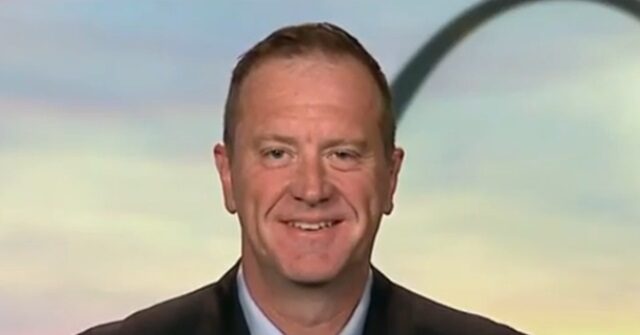
In a recent appearance on Fox News, Missouri Senator Eric Schmitt advocated for a full decoupling from China in U.S. economic policy, emphasizing the need to prioritize American workers and open agricultural markets. Speaking on Tuesday's edition of "Ingraham Angle," hosted by Brian Kilmeade, Schmitt expressed strong support for President Donald Trump's approach to trade negotiations with Chinese President Xi Jinping. The discussion highlighted ongoing tensions in U.S.-China relations, particularly around trade imbalances and job losses in manufacturing sectors.
Schmitt's comments come amid renewed focus on economic strategies toward China as the Trump administration prepares for potential high-level talks. The senator, a Republican from Missouri—a state heavily reliant on agriculture—stressed that decoupling, rather than merely de-risking supply chains, is essential to protect American interests. De-risking, a term popularized in recent policy debates, involves reducing vulnerabilities without fully severing ties, while decoupling implies a more complete separation of economic dependencies.
"So, Eric, should the focus be on decoupling or de-risking?" Kilmeade asked during the broadcast. Schmitt responded unequivocally, "For me, decoupling. I think that we’ve had the indignity in this country, working-class families, of having their jobs shipped overseas, especially to China, which has undermined the working class in this country." He pointed to decades of offshoring that have hollowed out communities in the Midwest and beyond, a narrative that resonates deeply in rust-belt and agricultural states like his own.
Missouri, with its vast farmlands producing soybeans, corn, and livestock, has long been at the forefront of trade disputes with China. During Trump's first term, tariffs imposed on Chinese goods led to retaliatory measures that slashed U.S. agricultural exports to China, costing farmers billions. According to the U.S. Department of Agriculture, soybean exports to China dropped by more than 50% in 2018 following the trade war escalation, though a Phase One trade deal in January 2020 aimed to restore some access by committing China to purchase $200 billion in additional U.S. goods over two years, including $80 billion in agricultural products.
Schmitt praised Trump's historical role in confronting these issues. "But I trust President Trump, he’s the — honestly, the most important President on this issue we’ve ever had in American history," Schmitt said. "He identified how China has been ripping us off. He didn’t go by way of the party line, both Republicans and Democrats, to sort of cede to these ridiculous trade deals that existed." This reflects Schmitt's view that previous administrations, from both parties, failed to address unfair trade practices like intellectual property theft and forced technology transfers, which the U.S. Trade Representative has estimated cost the American economy up to $600 billion annually.
The senator's optimism centers on upcoming negotiations. He expressed hope that talks between Trump and Xi could yield tangible benefits for U.S. farmers. "My hope is that he’ll open up markets for agriculture. That would be a good thing," Schmitt stated. Opening markets could mean reducing non-tariff barriers in China, such as stringent regulatory approvals for genetically modified crops, which have historically limited American exports. In 2023, U.S. agricultural exports to China reached about $40 billion, but industry groups like the American Farm Bureau Federation argue that full market access could double that figure.
Schmitt's stance aligns with a growing chorus among conservative lawmakers who favor aggressive decoupling measures. For instance, bills like the CHIPS and Science Act of 2022 have already directed billions toward domestic semiconductor production to reduce reliance on Chinese manufacturing. However, not all experts agree on the pace or extent of decoupling. Economists at the Peterson Institute for International Economics have warned that rapid separation could disrupt global supply chains, potentially raising costs for U.S. consumers by 1-2% on imported goods and slowing GDP growth by 0.5% annually.
De-risking, championed by figures in the Biden administration before Trump's return, focuses on targeted diversification. According to a 2023 report from the Brookings Institution, this approach involves friend-shoring—shifting production to allies like Mexico or Vietnam—rather than outright bans. Schmitt's preference for decoupling, however, underscores a more protectionist bent, echoing Trump's "America First" doctrine that prioritizes national security over global integration.
The timing of Schmitt's remarks is notable, occurring just weeks after the U.S. imposed new restrictions on Chinese technology firms in April 2026. These measures, including export controls on advanced AI chips, aim to curb China's military advancements but have sparked retaliatory threats from Beijing. Chinese state media reported that such actions could lead to "serious consequences" for bilateral trade, potentially affecting $500 billion in annual U.S.-China commerce.
In Missouri, the agricultural sector employs over 400,000 people and contributes $88 billion to the state's economy, per a 2024 University of Missouri study. Schmitt, who was elected to the Senate in 2022 after serving as Missouri's attorney general, has made support for farmers a cornerstone of his platform. His push for market openings aligns with efforts by the National Corn Growers Association, which in a recent statement urged negotiators to secure "predictable and profitable access" to China, the world's largest importer of U.S. feed grains.
Beyond agriculture, decoupling has broader implications for industries like steel and automobiles, where Missouri also has stakes. The state hosts major plants for companies such as Boeing and General Motors, both of which have faced supply chain disruptions from U.S.-China tensions. A 2025 Commerce Department analysis found that decoupling could create 2 million U.S. jobs in manufacturing over the next decade but at the cost of higher prices for electronics and vehicles.
Critics of full decoupling, including some business leaders, argue it overlooks the interconnected nature of modern economies. The U.S. Chamber of Commerce has advocated for a balanced approach, stating in a policy paper that "complete separation is neither feasible nor desirable" given that China supplies 80% of U.S. rare earth minerals essential for tech and defense. Schmitt's comments, however, suggest little patience for such nuances, framing the issue as a moral imperative for American workers.
As Trump prepares for his meeting with Xi, expected later this summer in an undisclosed location, the outcomes could reshape global trade dynamics. Analysts at the Council on Foreign Relations predict that successful talks might include commitments to intellectual property protections and reduced subsidies for Chinese state-owned enterprises, potentially boosting U.S. exports by $100 billion over five years. Failure, on the other hand, could escalate tariffs and further strain relations already frayed by issues like Taiwan and human rights in Xinjiang.
Schmitt's appearance on "Ingraham Angle" was part of a broader media push by Republicans to highlight Trump's trade credentials ahead of midterm elections. The senator's district, encompassing rural areas hit hard by past trade policies, stands to gain from any agricultural wins. Yet, with China signaling willingness to negotiate but demanding reciprocity on issues like currency manipulation, the path forward remains uncertain.
Ultimately, Schmitt's call for decoupling underscores a pivotal moment in U.S. foreign policy, where economic security intersects with national identity. As negotiations unfold, farmers in states like Missouri watch closely, hoping for deals that restore prosperity without the pitfalls of past agreements. Whether Trump's deal-making prowess can deliver on these hopes will be a defining test for his administration's China strategy.