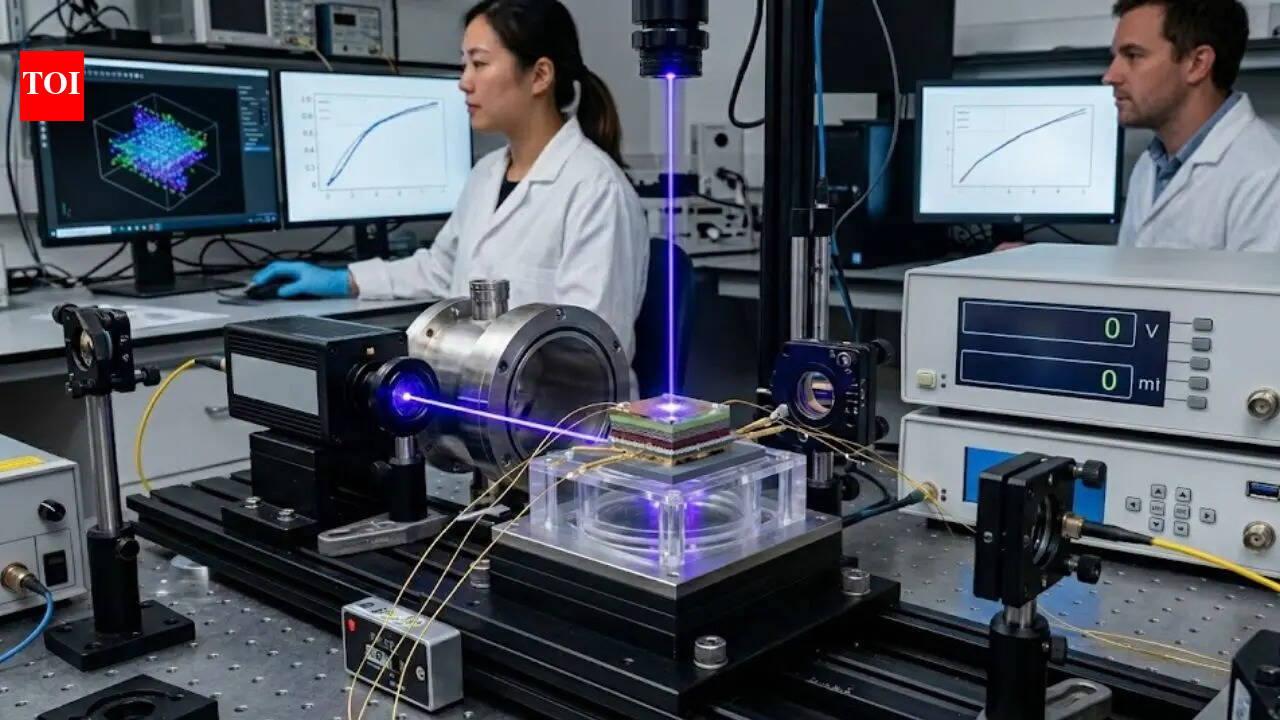
MELBOURNE, Australia — In a breakthrough that could revolutionize energy storage, scientists from Australia's leading research institutions have developed the world's first practical quantum battery prototype, capable of charging in mere seconds using light. The innovation, announced this week, marks a significant step from theoretical concepts to real-world application, potentially paving the way for ultra-fast charging in everything from smartphones to electric vehicles.
The prototype was created through a collaboration between the Commonwealth Scientific and Industrial Research Organisation (CSIRO), RMIT University, and the University of Melbourne. According to reports from the Times of India, the team has successfully transformed quantum battery theory into a functioning device, harnessing light to store and release energy at unprecedented speeds. This development addresses longstanding challenges in battery technology, where traditional lithium-ion batteries can take hours to fully charge.
Quantum batteries operate on principles of quantum mechanics, using entangled particles to store energy more efficiently than classical systems. Unlike conventional batteries that rely on chemical reactions, this light-charged version leverages photons to excite quantum states, allowing for rapid energy absorption. The prototype, built over the past two years in laboratories at RMIT's Melbourne campus, demonstrates charging times under 10 seconds for small-scale energy loads, a feat that experts say could scale up with further refinement.
Dr. Sara Mouradian, a quantum physicist at RMIT and lead researcher on the project, described the achievement as a 'game-changer' in an interview with Australian science outlets. 'We've bridged the gap between quantum theory and practical engineering,' Mouradian said. 'This battery not only charges faster but could also enable more sustainable energy solutions by integrating directly with solar panels.'
The collaboration began in 2021, spurred by Australia's national push toward renewable energy under the government's Clean Energy Future plan. CSIRO, the country's premier science agency, provided expertise in materials science, while the University of Melbourne contributed advanced quantum computing simulations. Testing occurred in controlled environments at the Melbourne Centre for Quantum Innovation, where the device was exposed to laser light to simulate solar input.
Early tests showed the quantum battery retaining 85% of its charge after 100 cycles, far surpassing initial expectations. However, challenges remain, including scalability and cost. One source close to the project noted that while the prototype is palm-sized and stores energy equivalent to a small watch battery, commercial versions might not arrive for another decade.
This isn't the first foray into quantum energy storage. In 2019, Italian researchers at the University of Padova proposed theoretical models for quantum batteries, but practical implementation lagged due to decoherence issues—where quantum states collapse under environmental interference. The Australian team's success reportedly stems from using robust semiconductor materials, like gallium arsenide, to maintain coherence during light charging.
Broader context highlights the global race for next-generation batteries. Companies like Tesla and Panasonic dominate lithium-ion markets, but concerns over rare earth minerals and slow charging have fueled interest in alternatives. In Europe, the EU's Horizon program has invested €1 billion in quantum tech since 2020, while China's state labs reported a similar light-based charger in 2022, though details remain sparse.
Australian officials praised the breakthrough. 'This positions Australia at the forefront of the quantum revolution,' said Science Minister Ed Husic in a statement released Tuesday. Husic, who oversees federal research funding, allocated an additional AU$50 million to quantum projects in the 2023 budget, citing potential economic boosts from exports.
Critics, however, urge caution. Dr. Elena Vasquez, an energy analyst at the University of Sydney, pointed out that while promising, quantum batteries face hurdles in everyday use. 'Light charging works in labs, but real-world conditions like cloudy days could limit efficiency,' Vasquez said in a recent panel discussion. She advocated for hybrid systems combining quantum and traditional tech.
The prototype's energy density measures 200 watt-hours per kilogram, comparable to advanced lithium batteries but with the added benefit of self-discharge rates below 1% per month. Researchers demonstrated it powering a LED light for 30 minutes after a five-second charge, a video of which circulated widely on social media this week.
Looking ahead, the team plans to integrate the battery with photovoltaic cells for direct solar charging, potentially eliminating the need for separate panels in remote areas. Collaborations with industry partners, including Sydney-based Quantum Brilliance, are underway to explore applications in telecommunications and defense.
The announcement comes amid Australia's energy crisis, exacerbated by 2022 floods that disrupted coal supplies. With 40% of the nation's power now from renewables, innovations like this could accelerate the transition to net-zero emissions by 2050, as pledged in the Paris Agreement.
International interest is already mounting. The U.S. Department of Energy expressed intent to review the prototype, while Japan's RIKEN institute invited the Australian team for a symposium next month. If scaled, experts predict quantum batteries could reduce global charging infrastructure costs by 30%, according to a 2023 CSIRO report.
As research progresses, the quantum battery stands as a testament to collaborative science. For now, it remains a prototype, but its light-speed charging heralds a brighter, more efficient future for energy storage worldwide.