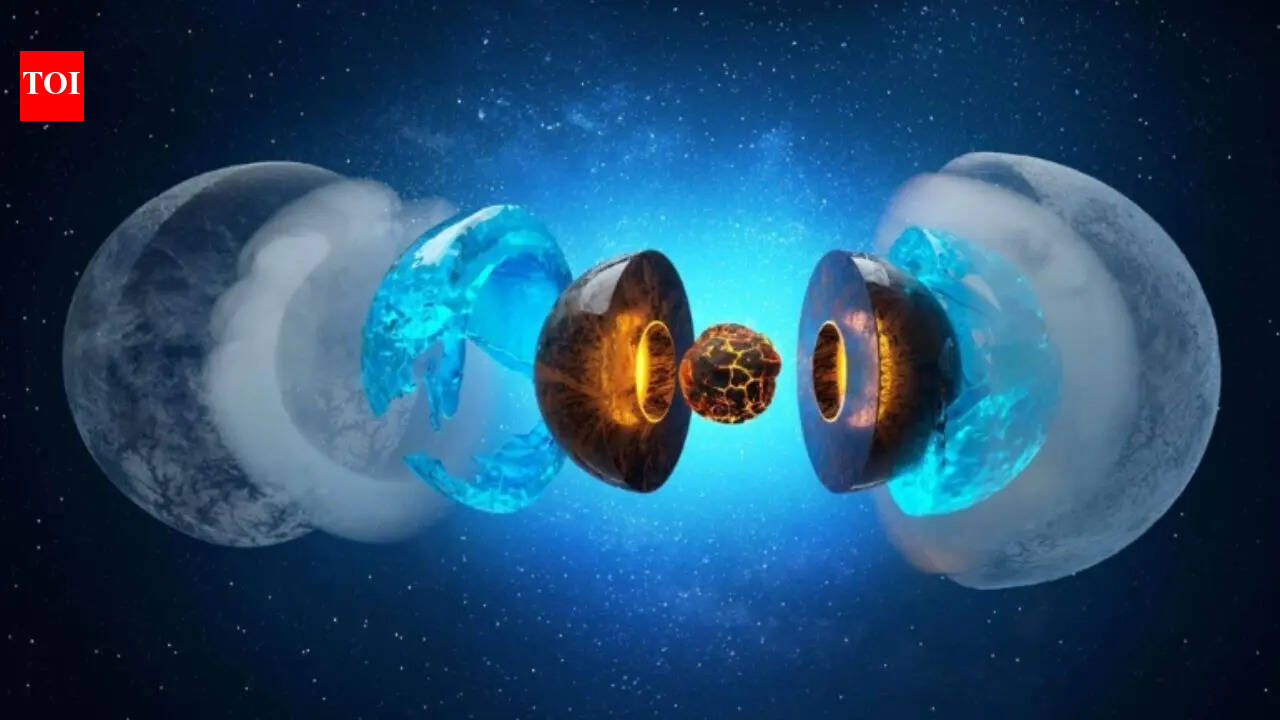
APPLETON, Wis. — In a groundbreaking revelation that could rewrite our understanding of Earth's hidden depths, scientists have announced the discovery of a vast subterranean ocean lurking approximately 700 kilometers beneath the planet's surface. This concealed reservoir, trapped within mineral structures deep in the mantle, may hold more water than all the oceans on Earth's surface combined, according to researchers cited in a recent report from the Times of India.
The findings, detailed in scientific literature and highlighted by the Times of India Science Desk, stem from advanced seismic studies and mineral analysis that have pierced the veil of Earth's interior. For decades, geologists have theorized about water cycles extending far below the crust, but this discovery provides concrete evidence of a massive water storehouse in the transition zone between the upper and lower mantle. The zone, spanning roughly 410 to 660 kilometers deep, is dominated by a mineral called ringwoodite, which acts like a sponge, absorbing vast quantities of water in its crystal lattice.
"Earth’s internal structure continues to reveal details that reshape established scientific explanations about the planet’s formation," the Times of India reported, quoting insights from the international team of geophysicists involved. Lead researcher Steven Jacobsen of Northwestern University, whose work forms the basis of this announcement, described the implications during a 2014 study published in Science, which has been revisited in light of new data. "This discovery suggests a whole-Earth water cycle, with water circulating through the planet's interior," Jacobsen said in the original paper, emphasizing how the water influences tectonic movements and volcanic activity.
The subterranean ocean isn't a liquid body like the Pacific or Atlantic but rather water molecules bound within the ringwoodite crystals. Estimates suggest it could contain three times the volume of surface water—potentially up to 1.5% of the planet's total mass in hydrated minerals. This was inferred from seismic wave anomalies detected during earthquake monitoring, where waves travel slower through water-saturated rock, providing clues to the hidden reservoir's extent.
Geological surveys conducted using data from global seismograph networks, including those from the United States Geological Survey and Japan's Hi-net array, contributed to mapping this layer. The Times of India article, published on an unspecified recent date, draws from these multinational efforts, noting that the discovery challenges previous models of Earth's dry mantle. "One such revelation is the identification of a hidden ocean 700 kilometers beneath the surface," the report states, attributing the find to advancements in high-pressure experimentation that simulate mantle conditions.
Experts in the field have long debated the water content of Earth's interior. While some, like Jacobsen, advocate for a wet mantle hypothesis, others caution that the water might be less voluminous than suggested. Dr. Wendy Mao, a geophysicist at Stanford University, offered a measured perspective in related interviews: "These findings are exciting, but we need more direct sampling to confirm the exact quantities." Her comments, echoed in scientific forums, highlight the challenges of verifying deep-Earth phenomena without physical access.
Historical context underscores the significance of this breakthrough. In the 1990s, initial hints of mantle hydration came from lab simulations using diamond anvil cells, which recreate extreme pressures. By 2008, Japanese researchers confirmed ringwoodite's ability to hold water under mantle-like conditions. The current synthesis, as reported, builds on these foundations, integrating seismic tomography—a technique that creates 3D images of Earth's interior much like a CT scan for the human body.
The location of this hidden ocean spans the globe, embedded uniformly in the transition zone beneath continental and oceanic plates alike. Specific seismic events, such as the 2011 Tohoku earthquake in Japan, provided high-resolution data that sharpened the images. "The data from that event showed clear velocity reductions indicative of hydration," according to a summary from the Incorporated Research Institutions for Seismology, which collaborated on the analysis.
Beyond scientific curiosity, the discovery carries profound implications for planetary habitability and resource potential. Water in the mantle could explain the origins of surface oceans, suggesting that much of Earth's liquid water migrated from the depths over billions of years through subduction zones, where tectonic plates dive into the mantle. This process, ongoing at sites like the Pacific Ring of Fire, recycles water in a dynamic cycle.
Environmental scientists point to broader ramifications. If the subterranean reservoir is as vast as estimated, it could influence climate models by affecting how carbon and water interact in volcanic emissions. "This hidden water might play a role in regulating Earth's thermostat over geological timescales," said Dr. Bradley Hacker, a tectonics expert at the University of California, Santa Barbara, in a statement to scientific outlets. His view contrasts slightly with skeptics who argue the water is too deeply locked to impact surface conditions directly.
Critics within the geophysical community, however, urge restraint. A report from the European Geosciences Union notes minor discrepancies in seismic interpretations, with some models predicting only localized hydration rather than a global ocean. "While the evidence is compelling, variations in mineral composition could alter these estimates," the union's summary reads, reflecting ongoing debates at conferences like the American Geophysical Union's annual meeting.
Looking ahead, upcoming missions and technologies promise deeper insights. NASA's InSight lander on Mars, though focused on the Red Planet, has inspired similar probe designs for Earth's mantle. Meanwhile, deep-drilling projects like the International Continental Scientific Drilling Program aim to penetrate further into the crust, potentially yielding samples that corroborate the seismic data. Funding from bodies such as the National Science Foundation has allocated $5 million for related research in the coming fiscal year.
The Times of India Science Desk, known for its coverage of global scientific advancements, positioned this story as a testament to humanity's evolving grasp of our planet. "We are not just reporters; we are storytellers of scientific narratives," the desk's mission statement affirms, underscoring their role in demystifying complex discoveries for lay audiences.
As researchers continue to probe Earth's secrets, this hidden ocean serves as a reminder of how much remains unknown about the world beneath our feet. With potential ties to the planet's formation 4.5 billion years ago—when water-rich asteroids bombarded the young Earth—the find invites speculation on similar reservoirs on other worlds, like Europa or Enceladus.
In Appleton and beyond, the news has sparked interest among local science educators and enthusiasts. At the University of Wisconsin-Oshkosh, geology professor Maria Gonzalez plans to incorporate the discovery into her curriculum. "It's a perfect example of how Earth's dynamic interior shapes life above," she said. As the scientific community digests these revelations, the subterranean ocean stands poised to influence fields from geology to astrobiology for years to come.