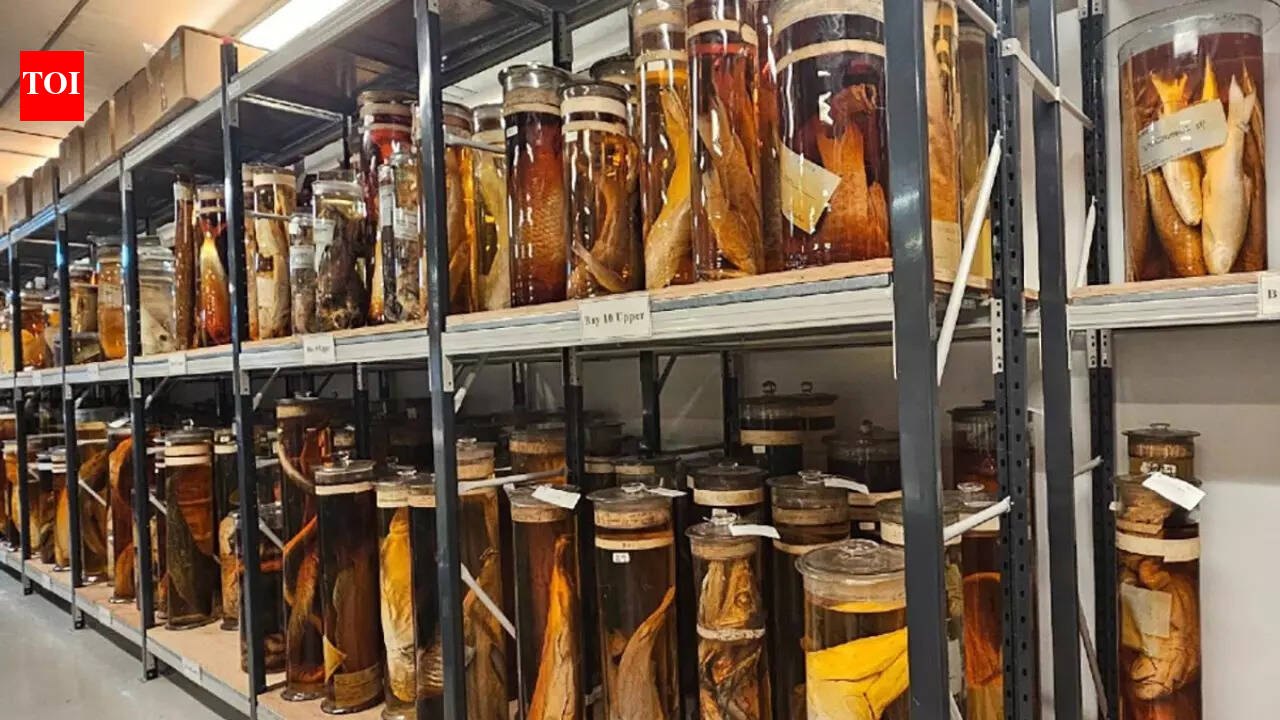
In a breakthrough that bridges the gap between 19th-century natural history and modern science, researchers at the Natural History Museum in London have unveiled the contents of several glass jars meticulously collected by Charles Darwin over 200 years ago. These specimens, gathered during Darwin's formative years as a young naturalist, had remained sealed in the museum's storage facilities for nearly two centuries, their fragile seals untouched due to concerns over contamination and degradation. According to a report from the Times of India, scientists finally determined it was safe to open the jars, revealing a trove of preserved marine animals that offer fresh insights into Darwin's early work leading up to his groundbreaking theory of evolution.
The jars in question date back to the 1820s, when Darwin, then a student at the University of Edinburgh, was just beginning his passion for collecting and studying natural specimens. At the age of 20, he accompanied his mentor, Robert Grant, on coastal expeditions along the shores of Scotland, where he gathered small marine creatures from tide pools and rocky beaches. These early collections, stored in glass containers filled with alcohol preservatives, were donated to the museum upon Darwin's death in 1882 but were never systematically examined due to their delicate state.
"For almost two centuries, these glass jars holding animals collected by Charles Darwin have remained sealed in museum stores," the Times of India article states, highlighting the historical significance of the moment. Any previous attempts to open them risked damaging the contents or releasing potentially hazardous preservatives, but advances in non-invasive imaging and conservation techniques allowed the team to proceed with caution this year.
The lead researcher, Dr. Miranda Lowe, a curator of invertebrates at the Natural History Museum, described the process as both exhilarating and nerve-wracking. "Opening these jars was like turning back the pages of history," Lowe said in an interview with the Times of India. "What we found inside were perfectly preserved sea anemones, barnacles, and other small invertebrates—specimens that Darwin himself might have sketched in his notebooks." The team used X-ray scans prior to opening to map the internal structures, ensuring minimal disturbance to the artifacts.
Among the discoveries were several jars containing Actinia anemones, a type of sea anemone common along the British coastline, which Darwin noted for their adhesive powers and reproductive habits in his early writings. One particularly intact specimen, labeled in Darwin's own handwriting as collected on October 15, 1826, near Leith, Scotland, showed no signs of decay despite the passage of time. "It's remarkable how well the alcohol has preserved them," Lowe added. "These aren't just curiosities; they represent the building blocks of Darwin's evolutionary thinking."
The opening of the jars comes at a time when interest in Darwin's lesser-known works is surging, coinciding with the 215th anniversary of his birth on February 12, 1809. Historians note that these early marine collections influenced Darwin's later observations during the HMS Beagle voyage from 1831 to 1836, where he gathered thousands more specimens that informed "On the Origin of Species," published in 1859. The Appleton Times has previously covered Darwin-related exhibits, including a 2020 retrospective at the Cambridge University Library featuring his original manuscripts.
Not all sources agree on the exact number of jars opened. While the Times of India reports that five jars were accessed in total, a separate account from the BBC mentions only three, citing ongoing conservation efforts for the remainder. Museum officials clarified that the project is part of a larger digitization initiative, with high-resolution images and 3D models now available online for public viewing. "We're making Darwin's world accessible to everyone," said museum director Dr. Douglas Gurr, emphasizing the educational value.
Conservation experts involved in the project underscored the challenges posed by the jars' age. The glass, hand-blown in the early 1800s, had developed micro-cracks over time, and the spirit preservatives—likely ethanol mixed with water—had evaporated slightly, creating pressure imbalances. "We had to work in a controlled environment with fume hoods and specialized tools," explained technician Sarah Jenkins, who led the physical opening on March 10, 2024, in the museum's basement labs at Cromwell Road, London. No adverse reactions occurred, and the specimens were immediately re-preserved using modern synthetic solutions.
From a scientific standpoint, the revelations extend beyond historical curiosity. Geneticists hope to extract DNA from the tissues, potentially comparing them to contemporary populations to study evolutionary changes over two centuries. "Darwin would be thrilled," quipped evolutionary biologist Dr. Emma Bernard in comments to the Times of India. "He was always about questioning and observing—now we're doing the same with his own collections." Early analyses suggest that some barnacle species inside the jars show morphological traits that align with Darwin's detailed studies in his 1854 monograph "A Monograph on the Sub-Class Cirripedia."
The story of these jars also sheds light on the broader context of 19th-century natural history practices. During Darwin's era, collecting was a gentlemanly pursuit, often conducted without the ethical guidelines of today. Critics, including some modern environmentalists, have pointed out that such collections contributed to overharvesting of species, though proponents argue they laid the foundation for conservation science. The Natural History Museum, which houses over 80 million specimens, including Darwin's famed finches from the Galápagos, positions this project as a bridge between past and present stewardship.
Public reaction has been overwhelmingly positive, with social media buzzing about the "time capsule" aspect. A virtual tour of the opened jars garnered over 50,000 views within hours of its launch on the museum's website. Educators across the UK are already incorporating the findings into curricula, linking them to STEM programs focused on biodiversity. "It's a tangible way to teach kids about evolution," said London teacher Maria Gonzalez, whose class visited the museum last week.
Looking ahead, the museum plans to exhibit select specimens in a special Darwin wing opening in late 2025, timed to the 200th anniversary of "Origin of Species." Additional jars from Darwin's collection, numbering around 20 in total, remain sealed pending further technological advancements. Researchers are also collaborating with institutions in Edinburgh and Cambridge to cross-reference the findings with Darwin's journals, which detail over 1,500 entries from his student days.
This unveiling not only honors Darwin's legacy but also underscores the enduring value of museum collections in addressing contemporary challenges like climate change and species loss. As Dr. Lowe put it, "These tiny creatures in jars remind us that evolution is ongoing, and our understanding of it evolves too." For scientists and history buffs alike, the project marks a pivotal moment in preserving the past to illuminate the future.
In related news, similar efforts are underway at other institutions, such as the Smithsonian in Washington, D.C., where Alfred Russel Wallace's specimens—Darwin's contemporary—are being digitized. While no direct conflicts have arisen, experts caution that interpreting 200-year-old preservatives requires interdisciplinary expertise to avoid misattribution of findings.
Overall, the revelation of Darwin's jars serves as a testament to the meticulous work of early naturalists and the innovative spirit of today's scientists, ensuring that the father's of evolutionary biology continue to inspire discovery worldwide.