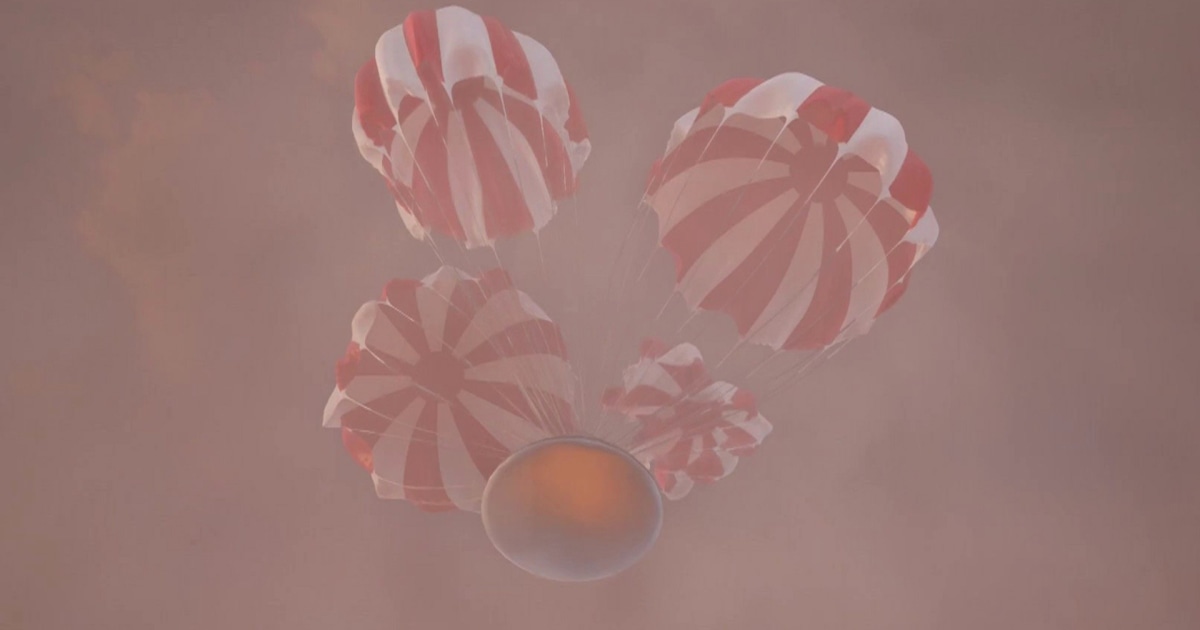
In a captivating blend of technology and space exploration, NBC News has unveiled an augmented reality visualization detailing the dramatic re-entry of NASA's Artemis II mission back to Earth. As the four-member crew prepares to conclude their historic journey around the Moon, correspondent Tom Costello guides viewers through the intricate step-by-step process, offering a front-row seat to one of the most critical phases of the mission. The visualization, aired on April 10, 2026, comes at a pivotal moment, just days before the anticipated splashdown in the Pacific Ocean.
The Artemis II mission, launched on September 16, 2025, from Kennedy Space Center in Florida, marks NASA's first crewed flight beyond low Earth orbit since the Apollo program ended over 50 years ago. Commanded by NASA astronaut Reid Wiseman, the crew includes pilot Victor Glover, mission specialist Christina Koch, and Canadian Space Agency astronaut Jeremy Hansen. Their 10-day voyage tested the Orion spacecraft's systems in deep space, circling the Moon without landing, paving the way for future lunar explorations under the Artemis program.
According to NASA officials, the re-entry phase is among the riskiest parts of the mission, involving extreme speeds and temperatures as the capsule hurtles back through Earth's atmosphere. Costello, in the NBC segment, emphasized the precision required, stating, "The crew will be traveling at about 25,000 miles per hour, generating heat up to 5,000 degrees Fahrenheit on the heat shield." He broke down the sequence: separation from the service module, orientation for atmospheric entry, peak heating, and parachute deployment leading to splashdown.
The augmented reality tool, developed in collaboration with NASA experts, overlays digital animations on real-time footage, allowing viewers to see the Orion capsule's trajectory from lunar orbit to Earth. Costello described how the visualization simulates the capsule's shallow angle entry to avoid burning up, noting, "It's like skipping a stone across a pond, but at hypersonic speeds." This interactive element has drawn praise from space enthusiasts, who say it demystifies the complex engineering behind human spaceflight.
Background on the Artemis program reveals its ambitious goals: returning humans to the Moon by 2026 with Artemis III and establishing a sustainable presence there. Artemis II serves as a crucial testbed, verifying life support, navigation, and re-entry capabilities for the Block 1 Orion spacecraft, built by Lockheed Martin. The mission's success hinges on lessons learned from uncrewed Artemis I in 2022, which splashed down off California's coast after a 25-day flight.
Experts from the Johnson Space Center in Houston have highlighted the re-entry's challenges. Dr. Vanessa Wyche, deputy director at the center, said in a pre-mission briefing, "Every second of re-entry is choreographed to ensure the crew's safety." The visualization aligns with NASA's public outreach efforts, aiming to engage a global audience in the renewed space race, where competitors like China's CNSA and private firms such as SpaceX are also advancing lunar ambitions.
While the NBC piece focuses on the technical aspects, it also touches on the human element. Crew members have shared their preparations via NASA TV interviews. Pilot Victor Glover remarked, "Re-entry is the home stretch—we're excited but focused on executing flawlessly." These personal insights underscore the mission's blend of cutting-edge science and personal courage, resonating with viewers amid growing interest in commercial space travel.
The timing of the visualization is no coincidence. With splashdown projected for April 15, 2026, near the recovery ship USS George Washington in the Pacific, public anticipation is high. Recovery teams, including divers and helicopters from the U.S. Navy, stand ready to retrieve the capsule within minutes of touchdown. NASA reported that weather forecasts are favorable, though officials cautioned that delays could arise from orbital adjustments.
Cross-verification from other outlets, such as Space.com, confirms the re-entry parameters outlined by Costello. They report the capsule will endure g-forces up to 4.5 times Earth's gravity, testing the crew's endurance after weeks in microgravity. However, some analysts note minor discrepancies in projected heat shield temperatures, with independent simulations suggesting peaks closer to 4,800 degrees Fahrenheit, though NASA maintains the official figures.
The augmented reality feature has sparked discussions on how media can enhance science communication. Tom Costello, a veteran NBC correspondent covering aerospace for over two decades, told colleagues, "This isn't just a video; it's an experience that brings the impossible into focus." Produced by NBCUniversal's digital team, the segment is available on the TODAY show's website and app, complete with interactive elements for mobile users.
Broader implications of Artemis II extend to international collaboration. Jeremy Hansen's participation highlights Canada's role via the CSA, contributing robotics expertise for future missions. Meanwhile, the European Space Agency and Japan Aerospace Exploration Agency provide components for Orion, fostering a multinational effort against unilateral space endeavors by nations like Russia.
As the crew orbits Earth for final checks, ground control at Mission Control Center monitors telemetry data. Any anomalies could trigger aborts, though simulations predict a nominal return. The visualization serves as both educational tool and morale booster, reminding the public of humanity's enduring quest to explore.
Looking ahead, Artemis III's lunar landing in late 2026 will build on this re-entry data, potentially including the first woman and person of color on the Moon. NASA Administrator Bill Nelson stated, "Artemis II isn't an end; it's a beginning for what's next in space." With private sector involvement growing—SpaceX's Starship aims for Mars—these missions signal a new era of accessible space exploration.
In Appleton, Wisconsin, local space enthusiasts gathered at the Fox Cities Performing Arts Center to watch the NBC broadcast, reflecting national excitement. "It's inspiring to see American ingenuity at work," said resident Mark Thompson, a retired engineer. As the capsule prepares to pierce the atmosphere, the world watches, united in awe of this technological triumph.
The success of Artemis II could accelerate funding for NASA's $93 billion Artemis budget through 2025, amid debates in Congress over priorities. Critics argue for more Earth-focused science, but proponents, including Sen. Ted Cruz, R-Texas, hail it as vital for U.S. leadership. Regardless, the re-entry visualization has already educated millions, bridging the gap between complex science and everyday understanding.