In a historic milestone for space exploration, NASA's Artemis II mission has delivered the first human-obtained close-up photographs of the moon's far side, captivating scientists and the public alike. On Monday, astronauts Reid Wiseman, Victor Glover, Christina Koch, and Canadian Space Agency astronaut Jeremy Hansen completed a daring flyby of the moon aboard the Orion spacecraft, marking the first crewed lunar mission since the Apollo era. The crew's images, beginning to trickle in after the event, reveal stunning details of the lunar surface that have long been hidden from Earth-based observers.
The mission, launched earlier this month from Kennedy Space Center in Florida, represents a crucial step in NASA's Artemis program aimed at returning humans to the moon and eventually establishing a sustainable presence there. During the approximately seven-hour flyby, the astronauts orbited the moon at a distance of about 50 miles, allowing them unprecedented views of the entire far side—a region perpetually turned away from Earth due to the moon's synchronous rotation. According to NASA officials, this was the first time humans have laid eyes on the complete far side in real time, surpassing even the limited glimpses captured during the Apollo missions of the late 1960s and early 1970s.
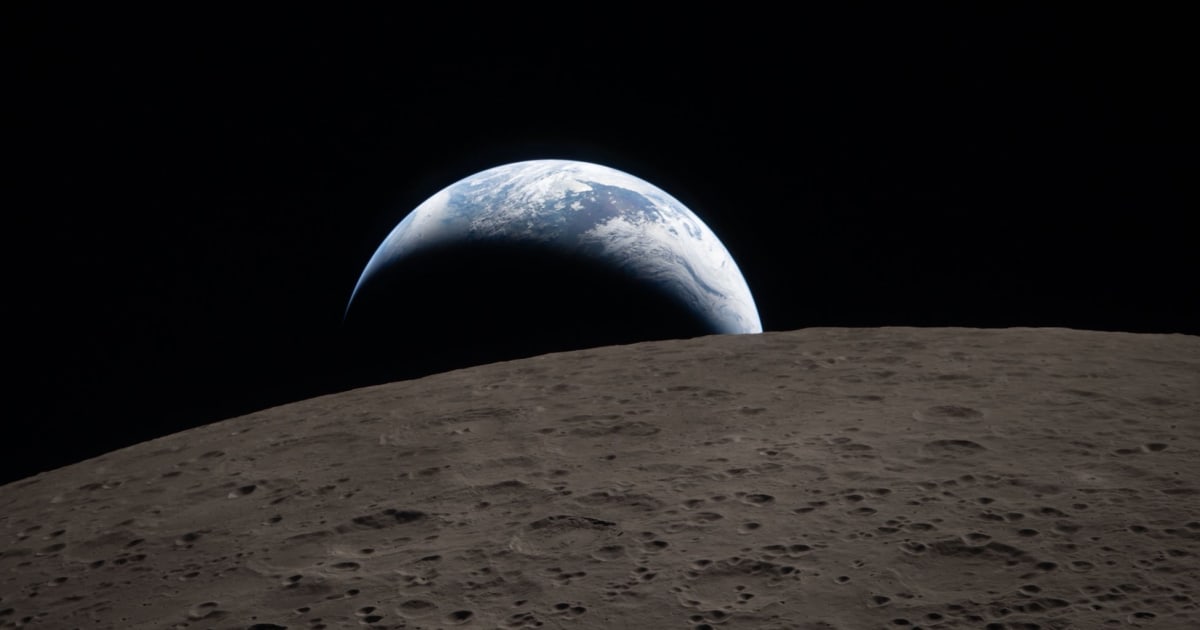
The White House shared the inaugural photo from the mission on Tuesday morning via its X account, depicting a dramatic "Earthset" as the home planet slipped behind the moon's horizon from the far side perspective. This image echoes the famous "Earthrise" photograph taken by Apollo 8 astronaut Bill Anders in 1968, though in reverse: while Apollo 8 captured Earth emerging into view, Artemis II's shot shows it vanishing, underscoring the poetic symmetry of human exploration across decades. NASA described the photo as a modern recreation, highlighting the technological and experiential evolution since the Apollo days.
Another standout image released by the White House captures a solar eclipse viewed from the lunar vantage point, an event that unfolded Monday evening as the mission neared its conclusion. The astronauts witnessed the sun dipping behind the moon, creating a silhouette framed by the sun's glowing corona—the outermost layer of its atmosphere. As the first humans to observe a solar eclipse from the moon, Wiseman, Glover, Koch, and Hansen provided real-time commentary that mission control in Houston eagerly received. "The corona is just breathtaking," one astronaut reportedly radioed, according to NASA transcripts.
Throughout the flyby, the crew documented a wealth of lunar features, from rugged terrain and expansive impact craters to vast dark plains known as maria. Victor Glover, the mission's pilot, was particularly struck by the moon's terminator—the boundary between the illuminated and shadowed hemispheres. In a radio transmission to Mission Control, Glover exclaimed, “Boy, I am loving the terminator. There’s just so much magic in the terminator — the islands of light, the valleys that look like black holes. You’d fall straight to the center of the moon if you stepped in some of those. It’s just so visually captivating.” His words elicited cheers from the lunar science team monitoring the event from Earth.
Christina Koch, the mission's flight engineer, reflected on the emotional impact of the views during a conversation with controllers. “When we have that perspective and we compare it to our home of Earth, it just reminds us how much we have in common,” she said. “Everything we need, Earth provides. And that is somewhat of a miracle and one that you can’t truly know until you’ve had the perspective of the other.” Her observations underscore the philosophical dimensions of space travel, blending scientific inquiry with profound human insight.
The astronauts also noted subtle color variations on the moon's near side, reporting hues of brown and green amid the more familiar grays. They highlighted the striking brightness of fresh craters, likely formed by recent meteorite strikes, which stood out against the ancient, weathered landscape. Reid Wiseman, the mission commander, and Jeremy Hansen, the mission specialist, contributed detailed notes on ridges, ancient lava flows, and other geological formations. These descriptions, relayed in vivid real-time broadcasts, have already sparked excitement among planetary scientists who anticipate using the data to refine models of the moon's formation and the early solar system.
NASA has emphasized the scientific value of these observations. The Artemis II images could provide fresh insights into the moon's volcanic history and bombardment by asteroids, helping researchers piece together the 4.5-billion-year story of our nearest celestial neighbor. Unlike robotic missions such as China's Chang'e-4, which landed on the far side in 2019, the human perspective offers immediate, contextual analysis that machines cannot replicate. However, due to bandwidth constraints during the deep-space downlink, the full archive of photographs won't be available until after the crew's return, expected via splashdown in the Pacific Ocean off San Diego on Friday.
The flyby also etched a new chapter in human spaceflight records. As the Orion spacecraft swung around the moon's far side, it reached a peak distance of 252,756 miles from Earth—surpassing the Apollo 13 crew's 1970 emergency trajectory by more than 4,100 miles. This achievement, while not involving a landing like future Artemis missions, validates the SLS rocket and Orion capsule systems critical for deeper explorations, including the planned Artemis III lunar landing in 2026.
Background on the Artemis program reveals its ambitious scope: building on the successes and lessons of Apollo, NASA aims to foster international partnerships, with contributions from agencies like the Canadian Space Agency, evident in Hansen's participation. The mission's path was meticulously planned to maximize scientific return without risking a landing, given the untested nature of the hardware. Previous uncrewed tests, like Artemis I in 2022, paved the way, but Artemis II's human element introduces variables that only live observers can address.
Reactions from the ground have been overwhelmingly positive. At NASA's Johnson Space Center in Houston, the lunar science team celebrated the crew's safe passage and the influx of data. "These views are going to rewrite some chapters in lunar geology," one unnamed scientist told reporters post-flyby, according to mission updates. Meanwhile, the White House's prompt sharing of images signals strong political support for NASA's endeavors, with President Biden's administration touting Artemis as a beacon of American innovation and global collaboration.
Yet, not all perspectives are without caution. Some space policy experts have noted the mission's cost—estimated at over $4 billion for Artemis II alone—and questioned the balance between exploration and earthly priorities like climate research. According to reports from space advocacy groups, while the scientific payoff is immense, funding debates in Congress could influence future missions. NASA counters that the program's dual-use technologies, from advanced propulsion to life support, benefit broader society.
As the astronauts hurtle back toward Earth, traversing the roughly 240,000-mile journey home, anticipation builds for the complete photo release. Processing the images will involve high-resolution analysis to map features down to the meter scale, potentially revealing sites for future bases. The far side's relative radio silence—free from Earth's interference—also positions it as ideal for radio astronomy, a prospect Artemis scientists are eager to explore further.
Looking ahead, Artemis II sets the stage for more audacious goals. With crew safely en route and splashdown slated for Friday morning local time, NASA prepares to debrief the astronauts on their experiences. Their firsthand accounts, combined with the visual bounty, will inform not just science but public engagement, reminding the world of humanity's enduring quest to understand our cosmic neighborhood. In an era of rapid technological change, these lunar glimpses reaffirm the timeless allure of the moon, just 239,000 miles away yet worlds apart in wonder.
The mission's success also highlights international teamwork, with Hansen's involvement strengthening U.S.-Canada ties in space. As the Orion capsule prepares for re-entry, burning through the atmosphere at 25,000 miles per hour, the world watches, much as it did during Apollo. For now, the photos serve as tantalizing previews, promising revelations that could reshape our view of the moon for generations.