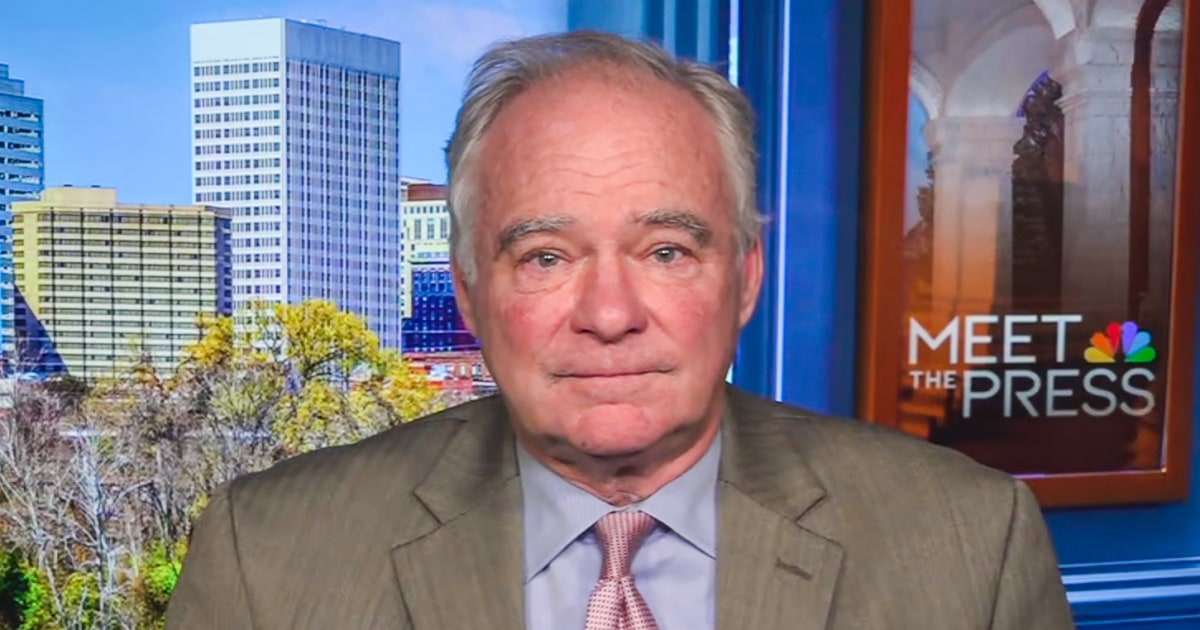
WASHINGTON — Senator Tim Kaine, a Democrat from Virginia and a key member of the Senate Armed Services Committee, voiced significant doubts on Sunday about the Trump administration's proposed $1.5 trillion military budget for fiscal year 2027, calling it a figure that Congress will have a "hard time" justifying. The request represents a 44% increase over the current year's appropriations for the Department of Defense, a jump that Kaine described as unwarranted amid concerns over leadership instability at the Pentagon.
Speaking on NBC News' "Meet the Press," Kaine highlighted his reservations during an interview with moderator Kristen Welker. "I have a hard time seeing that size of an increase as being justified," he said, emphasizing that he and his colleagues on the committee plan to scrutinize the proposal closely in the coming weeks. The senator's comments come as the administration pushes for enhanced defense spending, citing ongoing global threats, including what Kaine referred to as an "illegal and unwise" war involving Iran.
Kaine's skepticism is partly rooted in recent turmoil within the military's top ranks. Last week, Defense Secretary Pete Hegseth, a Trump appointee known for his outspoken views on military reform, abruptly removed several high-profile Army leaders. Among those ousted were Army Chief of Staff General Randy George, Chief of Chaplains Major General William Green, and Commanding General of Army Transformation and Training Command David Hodne. These dismissals, occurring in the midst of active combat operations, have drawn bipartisan criticism for their timing and rationale.
"Here's a question we have to ask, which is, it's not just about the dollars, it's about the Pentagon managing the money," Kaine told Welker. He pointed to the firings as evidence of deeper management issues, noting that the leaders in question were "respected... on both sides of the aisle in both houses." The Virginia Democrat argued that such instability raises fundamental questions about the administration's ability to steward a budget of this magnitude effectively.
Expanding on his concerns, Kaine stated, "I don't think Congress is going to be in a mood to write a blank check to a leadership team, a civilian leadership team that seems so inept these days." While he stopped short of outright rejecting the budget request, Kaine stressed the need for thorough review. "Needless to say, we have a lot of questions to ask, and the administration has a whole lot of explaining to do," he added, referencing upcoming hearings before the Armed Services Committee where details of the proposal will be dissected.
The proposed budget arrives against a backdrop of escalating tensions in the Middle East, where U.S. forces have been engaged in operations related to Iran since early last year. According to administration officials, the surge in funding is intended to bolster readiness, modernize equipment, and support allies in the region. However, critics like Kaine have called for greater congressional oversight, particularly regarding the legal basis for the conflict. He urged lawmakers to vote on a formal declaration of war, a step that has not been taken since World War II.
Not all reactions on Capitol Hill echo Kaine's tone of outright caution. Representative Mike Lawler, a Republican from New York, appeared later on the same program and expressed a more measured skepticism toward the full budget request. "The administration released its budget. That is not going to be the final budget or appropriations numbers," Lawler said, assuring that Congress would work to provide the necessary resources for military operations without necessarily approving every dollar requested.
Lawler, who serves on the House Armed Services Committee, focused his comments on the practicalities of the ongoing Iran conflict. He questioned the potential deployment of U.S. troops on the ground, suggesting that any such move should be limited in scope. "I think the question moving forward with respect to any troops on the ground would be for what purpose? And I think the only purpose that I could see would be to get the enriched uranium," he told Welker, referring to Iran's nuclear program as a core national security concern.
The New York congressman advocated for classified briefings to address sensitive aspects of the strategy. "I think that is something that does need to be discussed with Congress in a classified setting, and I think Congress would need to be briefed on that particular matter," Lawler said. His remarks underscore a bipartisan interest in transparency, though from a perspective that prioritizes operational flexibility for the executive branch.
Lawler sharply rebutted Kaine's characterization of the war as "illegal," accusing the senator and other Democrats of misleading the public. "I want to push back on something Senator Kaine said: This is not an illegal military operation," he asserted. Citing the War Powers Resolution of 1973, Lawler explained that the president has authority to initiate actions for up to 60 to 90 days, with Congress required to be notified within 48 hours. "The president is fully within his authority to conduct this military operation... and Congress was lawfully notified within 48 hours of the initial incursions," he added.
This exchange highlights a persistent divide in Washington over the balance of power in foreign policy. The War Powers Resolution, enacted in the wake of the Vietnam War, aims to prevent unchecked executive warmaking, but its application remains contentious. Presidents from both parties have invoked it to justify interventions, often leading to debates like the one between Kaine and Lawler. In this case, the administration notified Congress promptly after initial strikes on Iranian targets in late 2023, according to official records.
Broader context on the budget request reveals a pattern in Trump-era defense priorities. During his first term, from 2017 to 2021, military spending rose steadily, reaching about $740 billion annually by 2020. The current proposal, if enacted, would dwarf those figures, reflecting heightened rhetoric around threats from Iran, China, and Russia. Supporters argue that the increase is essential for deterrence, while opponents warn of fiscal strain amid domestic needs like infrastructure and healthcare.
The firings at the Pentagon have fueled additional scrutiny. General Randy George, who assumed the role of Army Chief of Staff in 2022, was praised for his handling of recruitment challenges and modernization efforts. Major General William Green, overseeing spiritual support for troops, and General David Hodne, focused on training innovations, were similarly regarded as steady hands. Hegseth, a former Fox News contributor and combat veteran, has defended the moves as necessary to align leadership with the administration's vision, though details on the specific reasons remain sparse.
As Congress gears up for budget deliberations, the Armed Services Committees in both chambers will hold a series of hearings starting next month. Witnesses are expected to include Hegseth and other top officials, providing a platform for lawmakers to probe the rationale behind both the spending hike and the recent personnel changes. Kaine indicated that these sessions will be pivotal in shaping the final appropriations bill, which must pass by October 2026 to avoid a government shutdown.
The implications of this budget battle extend beyond dollars and cents. With U.S. forces actively engaged in the Middle East—where over 40,000 troops are deployed across bases in Iraq, Syria, and allied nations—the debate touches on America's global role. Lawler's call for focused briefings suggests that while funding may be adjusted, support for countering Iran's nuclear ambitions enjoys cross-party backing. Yet Kaine's push for a war declaration could force a reckoning on congressional war powers, potentially reshaping future interventions.
For now, the administration maintains that the $1.5 trillion request is a starting point for negotiations. White House spokespeople have not yet responded directly to Kaine's criticisms, but sources close to the process say Trump views robust defense outlays as central to his legacy. As lawmakers from both parties weigh in, the coming months promise intense scrutiny, with the outcome likely to influence not just military readiness but the broader trajectory of U.S. foreign policy in a volatile world.