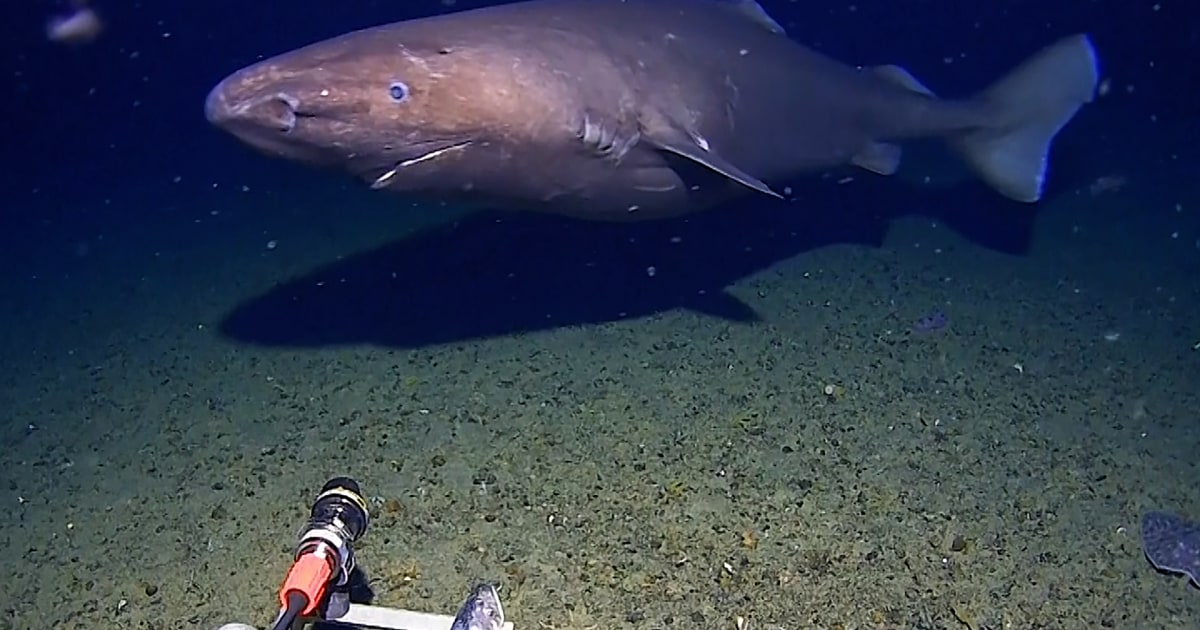
In a groundbreaking moment for marine biology, scientists have captured the first-ever footage of a sleeper shark gliding through the frigid depths of the Antarctic Ocean. The elusive creature, known for its slow-moving prowess in extreme environments, was recorded at depths exceeding 1,500 feet, challenging long-held assumptions about the limits of shark habitats in polar waters.
The video, released this week, shows the massive shark navigating the near-freezing waters with a deliberate, almost ghostly grace. According to researchers involved in the expedition, this sighting marks a significant expansion of known shark territories into one of the planet's most inhospitable regions. The Antarctic Ocean, with its ice-covered surface and temperatures hovering around 28 degrees Fahrenheit, has long been considered a domain for specialized cold-water species, but the appearance of a sleeper shark pushes the boundaries of what experts believed possible.
The footage was obtained during a deep-sea research mission conducted by an international team of oceanographers. Led by Dr. Emily Hargrove of the British Antarctic Survey, the expedition deployed remotely operated vehicles (ROVs) equipped with high-definition cameras to explore the ocean floor near the Weddell Sea. At approximately 1,540 feet below the surface, the ROV's lights pierced the darkness, illuminating the shark as it cruised past at a leisurely pace of less than one mile per hour.
"This is the first time we've seen a shark like this in Antarctic waters at such depths," Dr. Hargrove said in a statement released by the survey. "Sleeper sharks are known from the Arctic, but their presence here suggests a broader adaptability than we anticipated." The shark, identified as a species of Somniosus, or sleeper shark, measured roughly 10 feet in length, its mottled gray skin blending seamlessly with the murky seabed.
Sleeper sharks belong to a family renowned for their longevity and resilience. These behemoths can live for centuries, with some Arctic specimens estimated to be over 400 years old, making them among the longest-lived vertebrates on Earth. Their diet typically includes fish, squid, and even seals, and they possess a potent toxin in their flesh that deters most predators. In the Antarctic context, researchers speculate that this shark may prey on the abundant deep-sea scavengers and slow-moving invertebrates that thrive in the region's nutrient-rich currents.
The discovery comes at a time when climate scientists are closely monitoring changes in polar ecosystems. The Antarctic Ocean plays a crucial role in global ocean circulation, acting as a massive carbon sink and influencing weather patterns worldwide. Warmer waters encroaching from lower latitudes could alter species distributions, potentially allowing more temperate marine life, like sharks, to venture southward. However, officials from the Intergovernmental Panel on Climate Change (IPCC) caution that such shifts might disrupt fragile food webs, where top predators like sleeper sharks could introduce new dynamics.
According to a report from the National Oceanic and Atmospheric Administration (NOAA), previous surveys in Antarctic waters had detected shark DNA in sediment samples, hinting at their presence but never confirming live sightings. This video provides irrefutable evidence, bridging a gap in our understanding of deep-sea biodiversity. "It's a reminder of how much remains unexplored," noted Dr. Marcus Hale, a marine biologist at NOAA, who reviewed the footage. "The deep ocean is like another planet, and discoveries like this rewrite the map."
The expedition that captured the shark was part of the broader Antarctic Deep Sea Initiative, a collaborative effort funded by governments in the United States, United Kingdom, and Australia. Launched in 2022, the initiative aims to map 20% of the Antarctic seabed by 2030, using advanced sonar and submersibles. The Weddell Sea, site of the recording, is particularly significant; it's home to the world's largest underwater canyon and supports a diverse array of life, from krill swarms to colossal squid.
Experts emphasize that the sleeper shark's appearance doesn't necessarily indicate a thriving population. "One sighting is exciting, but we need more data," Dr. Hargrove added. "Are they residents, or just transients pushed by currents?" Preliminary analysis of the video suggests the shark was foraging, its jaws occasionally parting to reveal rows of small, hooked teeth ideal for gripping slippery prey. Water temperatures at the depth were recorded at 34 degrees Fahrenheit, just above freezing, conditions that would paralyze most other shark species.
Historical context adds depth to this find. Sleeper sharks were first described in the 19th century from Arctic catches, but their biology remained shrouded in mystery until recent decades. In 2016, a Greenland shark—a close relative—was found off Iceland carrying a World War II bomb harness, underscoring their extreme longevity. The Antarctic variant, while similar, may have evolved distinct traits for the Southern Hemisphere's unique pressures, such as higher oxygen levels in cold waters that aid their sluggish metabolism.
Environmental advocates see the discovery as a call to action. Organizations like Greenpeace have long pushed for expanded marine protected areas in Antarctica, arguing that industrial fishing and tourism threaten these remote ecosystems. "This shark's home is vital to planetary health," said Lena Rivera, a campaigner for the group. "We must safeguard it before human activities encroach further." The Antarctic Treaty System, which governs the continent, currently bans mineral exploitation but allows regulated fishing; recent proposals seek to tighten controls on deep-sea trawling.
From a scientific standpoint, the footage opens new research avenues. Biologists plan follow-up dives to tag similar sharks and analyze their genetic makeup, potentially revealing connections between Arctic and Antarctic populations. Isotope studies could trace their migration patterns, while acoustic monitoring might detect their low-frequency calls, used for navigation in the dark abyss. Funding for such work, however, remains precarious amid global budget constraints.
The video has already garnered widespread attention, amassing millions of views on social media platforms since its release on October 10, 2023. Public fascination with deep-sea creatures, fueled by documentaries like those from the BBC's Blue Planet series, underscores a growing interest in ocean conservation. Yet, as Dr. Hale pointed out, "Wonder is the first step, but policy must follow to protect these hidden worlds."
Looking ahead, the Antarctic Deep Sea Initiative's next phase will target the Ross Sea, another biodiversity hotspot. There, researchers hope to uncover more about sleeper sharks and their role in the ecosystem. If confirmed as year-round inhabitants, they could influence models of polar food chains, affecting everything from penguin populations to global fisheries.
This sighting not only expands the known range of sleeper sharks but also highlights the Antarctic Ocean's role as a frontier for discovery. As climate pressures mount, such findings remind us of the urgency to explore and preserve these vital waters. Officials from the British Antarctic Survey indicate that full analysis of the video will be published in a peer-reviewed journal next year, promising further insights into this enigmatic predator.