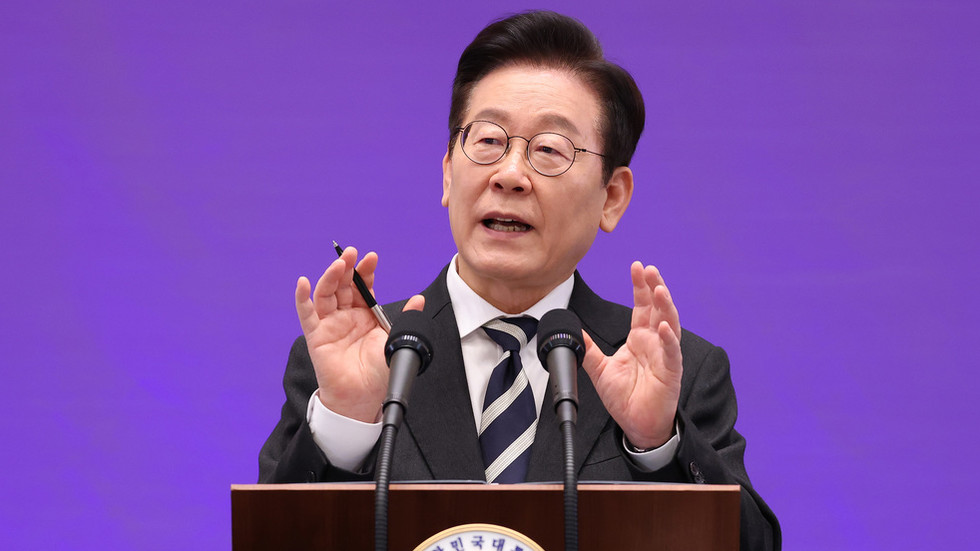
SEOUL, South Korea — In a rare gesture amid longstanding tensions on the Korean Peninsula, South Korean President Lee Jae Myung has issued an apology to North Korea over unauthorized drone incursions that heightened military friction between the two nations.
The apology came during a cabinet meeting on Monday, where Lee addressed a series of drone flights into North Korean airspace that occurred between September 2025 and January 2026. According to South Korean prosecutors, three individuals—an employee of the National Intelligence Service, a South Korean military officer, and a graduate student—were indicted last week for their roles in sending unmanned aerial vehicles, or UAVs, across the border. Seoul has maintained that these actions were carried out by civilians without any official government involvement.
"Although this was not an act by our government, I express regret to the North Korean side over the unnecessary military tension caused by such reckless behavior," Lee said, as reported by his office. He emphasized that the incidents were the work of individuals acting on their own, describing their conduct as "unacceptable" and "irresponsible."
Lee further remarked, "Individuals carried out such provocative acts... on their own," and urged a deeper reflection on the matter, stating, "We need to carefully consider who such actions are really meant to benefit." In response to the episode, the president directed relevant government agencies to revise regulations aimed at preventing future drone incursions, signaling a commitment to de-escalating cross-border provocations.
The drone incidents first drew international attention in early January when North Korea announced it had downed a UAV equipped with surveillance equipment over its territory. Pyongyang released photographs of the wreckage, which appeared to show the remnants of a small aircraft scattered across a rural area. North Korean state media warned that any further violations of its airspace would provoke a "terrible response," escalating rhetoric that has long characterized inter-Korean relations.
North Korean leader Kim Jong Un has been vocal in his condemnation of the South, labeling it the "most hostile state" in a speech last month. He vowed that Seoul would "pay the price" for its provocations and reaffirmed North Korea's refusal to abandon its nuclear weapons program, which he described as essential deterrence against what he called U.S. "state terror and aggression" on a global scale.
Kim's statements also targeted the military alliance between South Korea and the United States, criticizing the deployment of American nuclear-capable assets in the region as a direct threat to North Korean sovereignty. "We will thoroughly reject and disregard it," he said of the South, underscoring Pyongyang's deep-seated animosity toward joint U.S.-South Korean military exercises and defense pacts.
Officials in President Lee's office responded sharply to Kim's remarks, asserting that they undermine ongoing efforts toward peaceful coexistence on the Korean Peninsula. The two Koreas technically remain at war, as the 1950-1953 Korean War concluded with an armistice agreement rather than a formal peace treaty, leaving a fragile truce that has been tested by periodic flare-ups.
The backdrop to these latest developments is a history of mutual suspicion and sporadic incidents along the heavily fortified Demilitarized Zone, or DMZ, that separates the North and South. Drone technology has emerged as a new flashpoint in recent years, with both sides accusing the other of espionage and surveillance flights. In 2022, similar allegations surfaced when South Korean activists sent propaganda-laden balloons and drones northward, prompting North Korean artillery drills in retaliation.
South Korea's denial of state involvement in the recent UAV flights aligns with its broader policy of deterrence through alliance with Washington, while avoiding direct provocations that could spiral into conflict. The indictments of the three individuals suggest an internal crackdown to maintain plausible deniability and prevent escalation. The National Intelligence Service employee and military officer face charges that could imply lapses in oversight, though details of the investigation remain limited.
From North Korea's perspective, the incursions represent a pattern of aggression backed by U.S. influence. Pyongyang has frequently cited such events to justify its nuclear advancements and missile tests, which have drawn international sanctions and condemnation. Last year's series of hypersonic missile launches, for instance, were framed by Kim as countermeasures to perceived threats from the South and its allies.
Experts on Korean affairs note that Lee's apology, while conditional, is unusual for a South Korean leader, who typically respond to North Korean threats with firm resolve rather than regret. "This move could be an attempt to lower temperatures before any potential spring military exercises," said one analyst familiar with the region, speaking on condition of anonymity due to the sensitivity of the topic. However, it remains unclear whether Pyongyang will accept the gesture or view it as insufficient.
The timing of the apology coincides with broader geopolitical shifts, including ongoing U.S. elections and uncertainties in global alliances. South Korea, a key U.S. partner in Asia, has been bolstering its defense capabilities amid North Korea's advancing arsenal, which now includes solid-fuel missiles capable of reaching the U.S. mainland. Lee's administration has prioritized dialogue where possible, but tensions persist over issues like North Korea's alleged cyber activities and arms exports to Russia.
Looking ahead, the revised drone regulations ordered by Lee could include stricter licensing for civilian UAV operators and enhanced border surveillance technologies. South Korean defense officials have indicated that joint exercises with the U.S. will proceed as planned, potentially drawing a stern reaction from the North. Meanwhile, international observers, including the United Nations, continue to monitor the situation for signs of de-escalation or further provocation.
As the Korean Peninsula navigates this delicate balance, the drone apology highlights the fragile nature of peace efforts. With no formal treaty ending the war, even minor incursions carry the risk of broader conflict. Both sides have much to lose, yet the cycle of accusations and countermeasures shows little sign of abating, leaving the region on edge for what comes next.