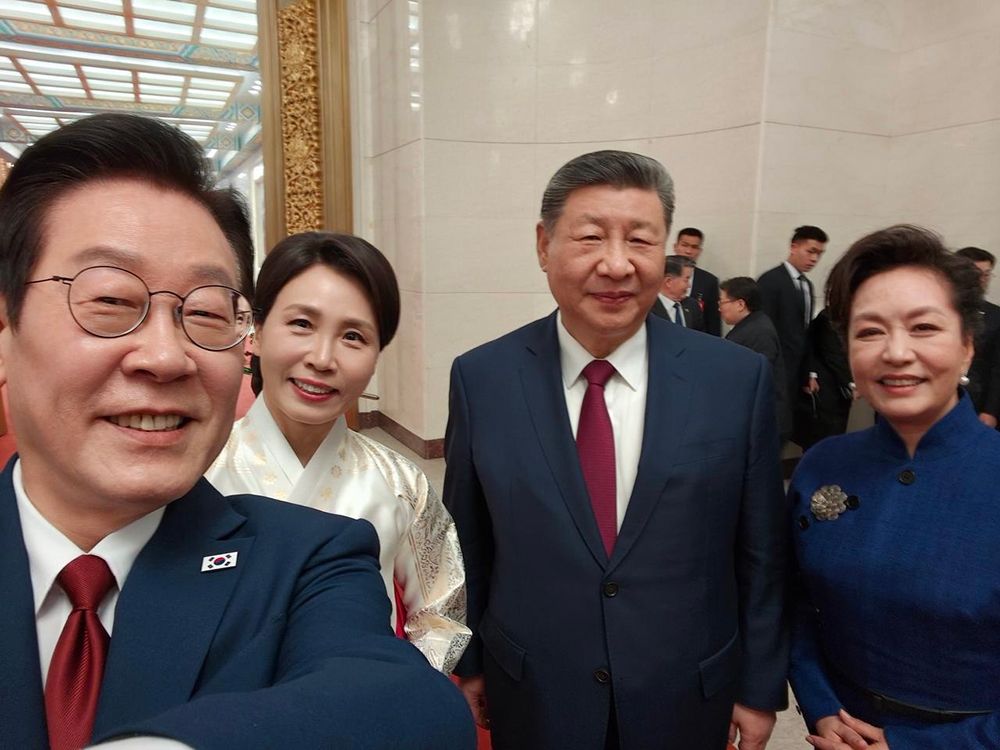
BEIJING — South Korean President Lee Jae-myung captured a lighthearted moment during his state visit to China on Monday, snapping a selfie with Chinese President Xi Jinping and their spouses using a smartphone that Xi himself had previously joked might contain spying capabilities.
The photo, posted by Lee on the social media platform X, shows the four leaders smiling together against a backdrop that appears to be an official setting in Beijing. In the caption, Lee wrote, “A selfie with President Xi Jinping and his wife, taken with the Xiaomi I received as a gift in Gyeongju.” He added, “Thanks to them, I got the shot of a lifetime,” and expressed optimism for future relations, stating, “I will communicate more frequently and collaborate more closely going forward.”
Lee's office shared a short YouTube video of the selfie-taking scene, in which Xi can be heard complimenting the South Korean president's photography skills. The device in question is a Xiaomi smartphone, a Chinese-made handset that Xi gifted to Lee during their meeting on the sidelines of the Asia-Pacific Economic Cooperation (APEC) summit in Gyeongju, South Korea, last November.
During that earlier encounter, as Lee inquired about the security of the phone's communication features, Xi responded with uncharacteristic humor, urging him to “check if there is a backdoor” — a reference to potential pre-installed software that could enable third-party monitoring or espionage. Lee later described Xi as “unexpectedly quite good at making jokes,” highlighting the rare display of levity from the typically reserved Chinese leader.
The selfie quickly gained traction online, amassing more than 3,400 shares in its first few hours on X. Social media users reacted with a mix of amusement and commentary, including one quip that read, “Sir, Do you know Nicolas Maduro used the same phone?” The remark alluded to recent geopolitical tensions, though no evidence supports Maduro using a similar device.
Monday's selfie came amid a 90-minute summit between Lee and Xi, where the Chinese president called on his South Korean counterpart to join Beijing in navigating a “world that is becoming more complex and turbulent” by making the “right strategic choices.” The meeting underscored efforts to mend and strengthen bilateral ties, which had cooled significantly in recent years due to South Korea's closer alignment with the United States and disputes over issues like North Korea's nuclear program and trade imbalances.
Lee's visit to Beijing occurs against a backdrop of shifting international dynamics. Just prior to the trip, a U.S. military operation in Caracas, Venezuela, resulted in the capture of Venezuelan President Nicolas Maduro, who was transported to New York to face charges related to narco-trafficking. The raid drew sharp condemnation from Beijing and Pyongyang, with Chinese officials labeling it an infringement on sovereignty and a dangerous precedent in global affairs.
According to reports, the operation, which took place in early December, involved special forces extracting Maduro from his presidential palace amid ongoing protests and economic turmoil in Venezuela. U.S. officials described it as a targeted effort to dismantle international drug networks, but critics in China and North Korea argued it exemplified American overreach. Xi's remarks during the summit with Lee appeared to indirectly reference such events, emphasizing the need for strategic alignment in an era of heightened U.S.-China rivalry.
Lee Jae-myung, who assumed the presidency in June following the impeachment and removal of his predecessor over a controversial declaration of martial law, has prioritized revitalizing relations with China since taking office. The previous administration's imposition of martial law in late 2023 led to widespread protests and a constitutional crisis, culminating in the leader's ouster by the National Assembly. Lee's election victory was seen as a mandate for progressive reforms and a more balanced foreign policy, moving away from the hardline stance toward North Korea and China that characterized his predecessor's tenure.
Under Lee, South Korea has sought to ease tensions with its northern neighbor and largest trading partner, China, whose economy accounts for nearly a quarter of South Korea's exports. Diplomatic relations hit a low point in 2023 amid disputes over the deployment of a U.S. missile defense system in South Korea, which Beijing viewed as a threat to its security. Recent gestures, including high-level cultural exchanges and trade talks, signal a thaw, with Monday's summit marking the first state visit by a South Korean president to China in several years.
Xi's gift of the Xiaomi phone in November was itself symbolic of warming ties. Xiaomi, one of China's leading tech firms, has faced scrutiny in Western markets over data privacy concerns, with some governments banning its devices from official use due to fears of backdoors linked to the Chinese government. Lee's decision to publicly use the phone for the selfie can be interpreted as a gesture of trust, though it also sparked online debates about cybersecurity in diplomatic contexts.
Experts on Sino-South Korean relations noted the photogenic moment as a positive step. “This kind of personal rapport-building is crucial at a time when structural challenges persist,” said a Beijing-based analyst who spoke on condition of anonymity due to the sensitivity of the topic. The analyst pointed to ongoing issues like South Korea's participation in U.S.-led chip export controls on China as potential flashpoints that could test the renewed dialogue.
The summit's agenda reportedly included discussions on economic cooperation, regional security, and climate initiatives. South Korea, heavily reliant on Chinese markets for semiconductors and automobiles, hopes to secure concessions on tariffs and investment barriers. In return, Beijing is pressing for Seoul's neutrality in U.S.-China tech disputes and support for its positions on Taiwan and the South China Sea.
Looking ahead, Lee's office indicated plans for follow-up mechanisms, such as regular leader hotlines and joint working groups, to sustain the momentum. “The selfie is more than a photo; it's a signal of intent,” one South Korean diplomat told reporters after the meeting, emphasizing the leaders' commitment to frequent communication. As global uncertainties mount — from trade wars to conflicts in the Middle East and Ukraine — the Beijing summit positions South Korea as a potential bridge in East Asian diplomacy.
While the humorous origins of the selfie phone provided a memorable anecdote, the visit's success will ultimately be measured by tangible outcomes. With Lee's domestic agenda focused on economic recovery and his international role navigating alliances, closer ties with China could bolster South Korea's strategic autonomy. For now, the image of smiling leaders has offered a rare glimpse of optimism in an otherwise tense geopolitical landscape.