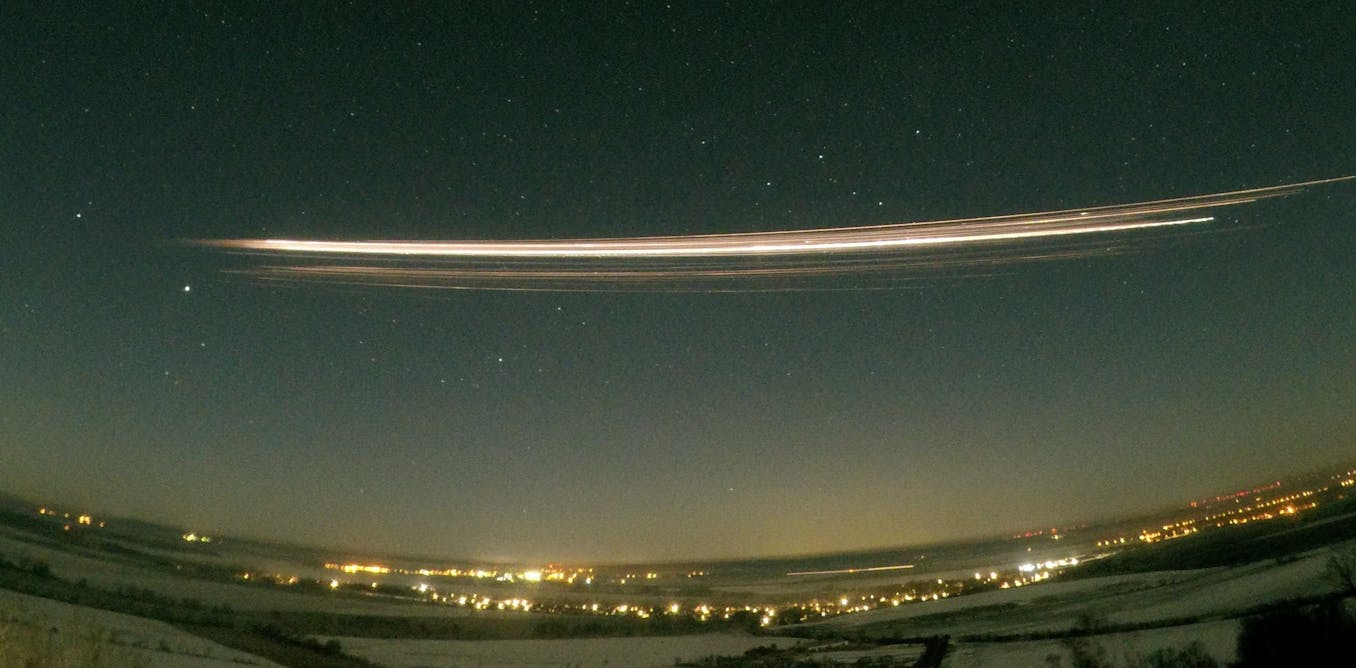
In a groundbreaking discovery that sheds light on the hidden environmental costs of the space race, scientists have detected the first direct evidence of chemical pollution in Earth's upper atmosphere caused by the re-entry of space debris. On February 20, 2025, a discarded upper stage of a SpaceX Falcon 9 rocket burned up over the Atlantic Ocean, west of Ireland, leaving behind a plume of lithium ions that researchers tracked using advanced laser technology. The findings, published today in the journal Communications Earth & Environment, were led by Robin Wing from the Leibniz Institute of Atmospheric Physics in Germany and highlight a growing threat as satellite launches proliferate.
The study marks the first time scientists have observed and traced a pollutant plume from a specific re-entry event back to its source using ground-based instruments. "This is the first observational evidence that re-entering space debris leaves a detectable, human-caused chemical fingerprint in the upper atmosphere," the research team stated in their paper. By employing highly sensitive lasers to detect the fluorescence of trace metals in the mesosphere and lower thermosphere, the international group of researchers captured a sudden enhancement in lithium levels, distinct from natural sources like meteor material.
The lithium plume originated from lithium batteries and metal casings in the rocket, which disintegrated at altitudes between 80 and 120 kilometers above Earth. Atmospheric trajectory modeling confirmed the timing and path aligned precisely with the Falcon 9's uncontrolled re-entry. This region of the atmosphere—the upper stratosphere, mesosphere, and lower thermosphere—is notoriously difficult to study, as it lies too high for balloons and aircraft but too low for most satellites, making such detections all the more significant.
Robin Wing, the lead researcher, emphasized the implications during an interview with The Conversation. "Using highly sensitive lasers, he and his team of international researchers observed a plume of lithium pollution, tracking it back to the uncontrolled re-entry of a discarded SpaceX Falcon 9 rocket upper stage," the publication reported, underscoring Wing's role in pioneering this monitoring technique. The method, while not yet widespread, demonstrates potential for broader application in tracking space-related emissions.
The upper atmosphere has long been considered largely pristine, shielded from human pollution. However, the explosion in satellite deployments— from a few thousand just a couple of years ago to approximately 14,000 in orbit today—has introduced new risks. Much of this growth stems from megaconstellations like SpaceX's Starlink, with the company applying to launch up to one million satellites to support space-based data centers. Each of these will eventually re-enter and burn up, releasing metals and chemicals into the fragile upper layers.
Current projections estimate that by 2030, several tonnes of spacecraft material could burn up daily in the upper atmosphere. This influx includes not only satellites but also rocket bodies and debris, amplifying concerns about long-term effects. "The impact this will have on the stratospheric ozone layer, which is crucial to protecting life on Earth from harmful ultraviolet radiation, is as yet unquantified," the study notes, pointing to early research from 2024 that links aluminum and chlorine emissions from launches and re-entries to potential delays in ozone recovery.
Soot from rocket exhaust is another worry, reportedly causing warming in the upper atmosphere that could disrupt weather patterns and communications. The upper atmosphere plays a vital role in radio and GPS signals, as well as stratospheric ozone dynamics. As space activities intensify, these pollutants could alter these critical functions in ways scientists are only beginning to understand.
SpaceX, which has revolutionized the industry with reusable rockets like the Falcon 9, has not yet commented publicly on the study. The re-entry in question involved a second-stage booster from a previous mission, discarded after deployment as per standard practice for upper stages. Company officials have previously stated that such burn-ups are designed to minimize ground risks, with most material vaporizing harmlessly. However, this research challenges that narrative by showing atmospheric deposition of traceable chemicals.
Environmental advocates have seized on the findings to call for stricter regulations. "With many more satellite launches planned for the future, this event won’t be the last. It highlights the urgent need for governments and the space industry to tackle this problem before it gets out of hand," the researchers warned. Groups like the Union of Concerned Scientists have echoed these sentiments, arguing that the lack of oversight in space emissions parallels early industrial pollution on Earth.
On the industry side, representatives from the space sector emphasize innovation in mitigation. A spokesperson for the Satellite Industry Association noted in a recent statement that companies are exploring controlled re-entries and material designs that reduce vaporization of harmful elements. "The space economy is vital for global connectivity, and we're committed to sustainable practices," the association said, though specifics on lithium or metal emissions were not addressed.
The study's authors advocate for international cooperation. "International regulatory bodies need to be set up to liaise with governments and scientists to establish monitoring networks and instruments to track changes to our atmosphere from this emerging threat," they proposed. Currently, no dedicated framework exists for regulating upper-atmospheric emissions from space activities, leaving a regulatory vacuum as launches accelerate.
This detection of lithium is particularly telling because it originates from human-made components, setting it apart from natural cosmic dust. The plume's visibility via lasers opens doors for accountability, allowing scientists to link pollution events to specific operators. As SpaceX and competitors like Amazon and OneWeb gear up for even larger constellations, the pressure mounts for proactive measures.
Broader context reveals a space sector in flux. The Federal Communications Commission has approved thousands of new satellites, while the United Nations' Committee on the Peaceful Uses of Outer Space discusses debris mitigation guidelines. Yet, enforcement remains elusive, with nations like the U.S., China, and Russia leading in launches but varying in environmental priorities.
Looking ahead, experts predict that without intervention, the upper atmosphere could see cumulative pollution levels rivaling ground-based industrial outputs in scale. The lithium plume from the Falcon 9 serves as a wake-up call, urging a balance between technological advancement and planetary stewardship. As Robin Wing's team continues monitoring, future studies may quantify ozone impacts or other effects, informing policy in this uncharted domain.
In the end, this event underscores the interconnectedness of human endeavors in space and Earth's atmosphere. With satellites enabling everything from internet access to climate monitoring, the stakes are high. Policymakers, scientists, and industry leaders must now collaborate to ensure the final frontier doesn't come at the expense of our atmospheric shield.