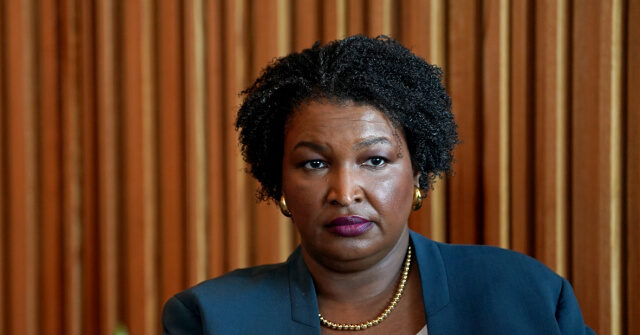
ATLANTA — Stacey Abrams, the prominent Democratic activist and two-time Georgia gubernatorial candidate, has sharply criticized the proposed SAVE America Act, arguing that it would disproportionately burden certain voter groups and tilt elections in favor of Republicans. In a recent appearance on MSNBC's "MS NOW," Abrams described the legislation as a form of oppression that targets seniors, rural residents, the disabled, students, and people of color.
Abrams, who lost close races for Georgia governor in 2018 and 2022 to Republican Brian Kemp, emphasized the act's potential to suppress votes in tight contests. "Oppression is very real," she said. "In elections that are decided on the margins, voter suppression comes together, whether it’s ending mail-in voting, using citizenship proof, although every citizen has to prove your citizenship to get on the rolls. These more restrictive policies all come together to make it harder for average people to be heard, if you’re a senior, if you’re rural, if you’re disabled, if you’re a student, if you’re a person of color."
She continued, warning that such measures "shave enough points off of elections that Republican authoritarians can gain the outcome." Abrams's comments highlight ongoing partisan battles over voting access, a flashpoint in American politics since the 2020 presidential election.
The SAVE America Act, formally known as the Safeguard American Voter Eligibility Act, is a Republican-backed bill aimed at tightening voter registration and election procedures. According to its proponents, the legislation would require proof of citizenship to register to vote, mandate voter identification at polling places, and eliminate universal mail-in ballots except for specific cases like disability, illness, travel, or military service. It would also include provisions to codify protections for women's sports and impose a ban on transgender surgeries for minors, blending election reforms with social policy elements.
Republicans have framed the bill as essential for election integrity. President Donald Trump, who endorsed the measure, urged Senate Republicans on March 26 to end the filibuster to pass it along with Department of Homeland Security funding. In a post on Truth Social, Trump wrote that the GOP should "TERMINATE THE FILIBUSTER" to enact "all five items" in the SAVE America Act, adding that Democrats would likely do the same if they regained control of Congress.
Abrams's critique comes amid a broader national debate on voting rights. In Georgia, where she built her reputation as a voting rights advocate, Abrams has long accused state Republicans of enacting laws that hinder turnout among Democratic-leaning groups. During her 2022 campaign, she raised over $100 million but ended the race more than $1 million in debt, drawing scrutiny from both parties.
In a November 2024 interview on CNN, Abrams addressed Georgia's record early voting numbers, insisting they did not negate claims of suppression. "Turnout does not mean there is not voter suppression activity," she said. "A lot of those voters in 2020 were able to vote by mail. One of the reasons we’re seeing early lines is because they can no longer use the easier method of voting by mail because of SB 202, because of SB 189 laws that Brad Raffensperger and Brian Kemp supported and pushed forward."
She pointed to specific impacts, noting that "people who are disabled, people who have lost their homes are facing harder times casting their ballots, but they refuse to be silenced." Abrams added that voters were "standing in lines they shouldn’t have to stand in because they believe their voices matter." These remarks underscore her consistent narrative that restrictive laws create unnecessary barriers, even as overall participation rises.
Georgia's election landscape has evolved significantly since Abrams's first run in 2018, when she narrowly lost to Kemp by about 55,000 votes amid allegations of irregularities. The state legislature, controlled by Republicans, passed Senate Bill 202 in 2021, which limited drop boxes, shortened absentee ballot request windows, and gave more power to local election boards. Critics, including Abrams, called it a direct response to the 2020 election, where Democrat Joe Biden flipped the state.
Supporters of the SAVE America Act, including Trump and GOP leaders, argue that such reforms prevent fraud and ensure only eligible citizens vote. The bill's citizenship proof requirement addresses concerns raised by some conservatives that non-citizens could register without verification, though studies from organizations like the Brennan Center for Justice have found instances of non-citizen voting to be exceedingly rare.
Abrams, a former state House minority leader, has founded Fair Fight Action, a nonprofit dedicated to combating voter suppression. Her work gained national prominence after 2018, when she refused to concede her gubernatorial loss and pursued legal challenges. In 2022, she again fell short, this time by roughly 53,000 votes, but used the campaign to mobilize voters in a state that played a pivotal role in the 2020 presidential outcome.
The push for the SAVE America Act reflects Republican priorities in the 119th Congress, where the party holds slim majorities in both chambers following the 2024 elections. Trump's call to scrap the filibuster echoes his long-standing frustration with Senate rules that have blocked past initiatives. Democrats, who control the White House until January 2025, have vowed to oppose the bill, with Senate Minority Leader Chuck Schumer calling it an "assault on democracy" in a recent floor speech.
As the legislation advances, Abrams's warnings serve as a rallying cry for voting rights advocates. She has testified before Congress and spoken at events across the country, framing election laws as a civil rights issue. In her MSNBC appearance, she reiterated that "these bills and these rules and these executive orders come to fruition" to disadvantage marginalized groups, potentially deciding outcomes in battleground states like Georgia, Arizona, and Pennsylvania.
Broader implications of the SAVE America Act could reshape how Americans cast ballots, particularly in an era of increasing early and mail voting. While Republicans tout it as a safeguard, opponents like Abrams see it as a regression to pre-2020 norms that could disenfranchise millions. Legal challenges are likely if the bill passes, with groups such as the ACLU preparing lawsuits on constitutional grounds.
Looking ahead, the debate over the SAVE America Act will test the resolve of Senate Republicans to follow Trump's directive. With the filibuster's future in flux, the outcome could influence not just voting procedures but the balance of power in future elections. For Abrams and her allies, the fight continues, rooted in the belief that every eligible voice must be heard without undue obstacles.