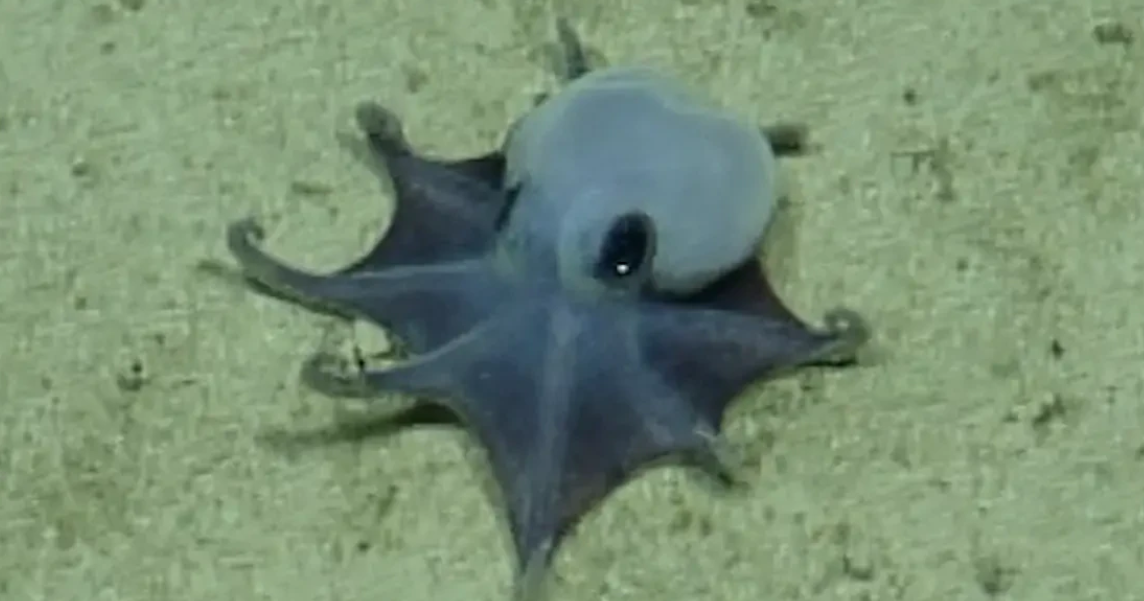
Scientists exploring the ocean floor near the Galapagos Islands have identified a new species of tiny blue octopus living at depths of about 5,900 feet, according to research published this week in the journal Zootaxa.
The discovery came during a submersible mission conducted by the Charles Darwin Foundation, when researchers spotted the small cephalopod on live footage transmitted from the deep sea. "He's tiny! It's blue!" one scientist exclaimed upon first seeing the creature, which could fit in the palm of a hand.
Octopus expert Janet Voight, curator at the Field Museum of Natural History in Chicago, was called in to examine the find. "Right away, I knew it was something really special," Voight said. She later received the preserved specimen by mail and reacted with surprise at its appearance. "When it arrived, I was like 'Oh! My goodness! It's beautiful,'" she told AFP.
The new species, named Microeledone galapagensis, stands out for its rare blue coloration on the back and deep purple underside. Voight noted that the animal's stubby arms with a single row of suckers distinguish it from most known octopuses. Its smooth skin and color pattern may also serve as camouflage against predators in the dark depths.
Researchers used CT scans at the Field Museum to study the specimen without dissecting it, creating a detailed 3D model of its internal structure. "There's nothing like spending the day looking at something no other human has ever seen," said Stephanie Smith, head of the museum's X-ray lab.
The octopus belongs to the Megaleledonidae family but is notably smaller than its relatives, which typically inhabit the Southern Ocean around Antarctica. The closest similar species lives off Uruguay in the Atlantic, making this Pacific find geographically unusual.
Voight explained the potential survival advantage of the color pattern. "We think this color pattern helps keep it safe. If the octopus grabs a prey item that emits light, that light may attract predators that might then eat the octopus," she said. "So the octopus puts its dark-colored web over the prey item, keeping itself safe."
The first sighting occurred in 2015 near Darwin Island, named after the naturalist whose work in the Galapagos shaped evolutionary theory. This marks the first new octopus species Voight has led in describing during her four-decade career.
New octopus species are frequently found in poorly explored deep-sea regions. "If you took all the land on Earth and pieced it together, you would not cover the Pacific Ocean," Voight pointed out. She previously described another new species in 2023 off Costa Rica.
There are roughly 300 known octopus species worldwide, distributed across all oceans. In 2024, a separate team reported four additional species in Costa Rican waters, highlighting ongoing discoveries in these environments.
Voight expressed appreciation for the opportunity to study such elusive creatures. "These are little octopuses that live in the deep sea, and hardly anybody on Earth has ever gotten to see them. I just feel lucky that I got to work with them," she said.
The Charles Darwin Foundation team continues deep-sea surveys in the region, where vast unexplored areas suggest more species may await documentation. Officials said further analysis of collected specimens could yield additional findings in coming years.