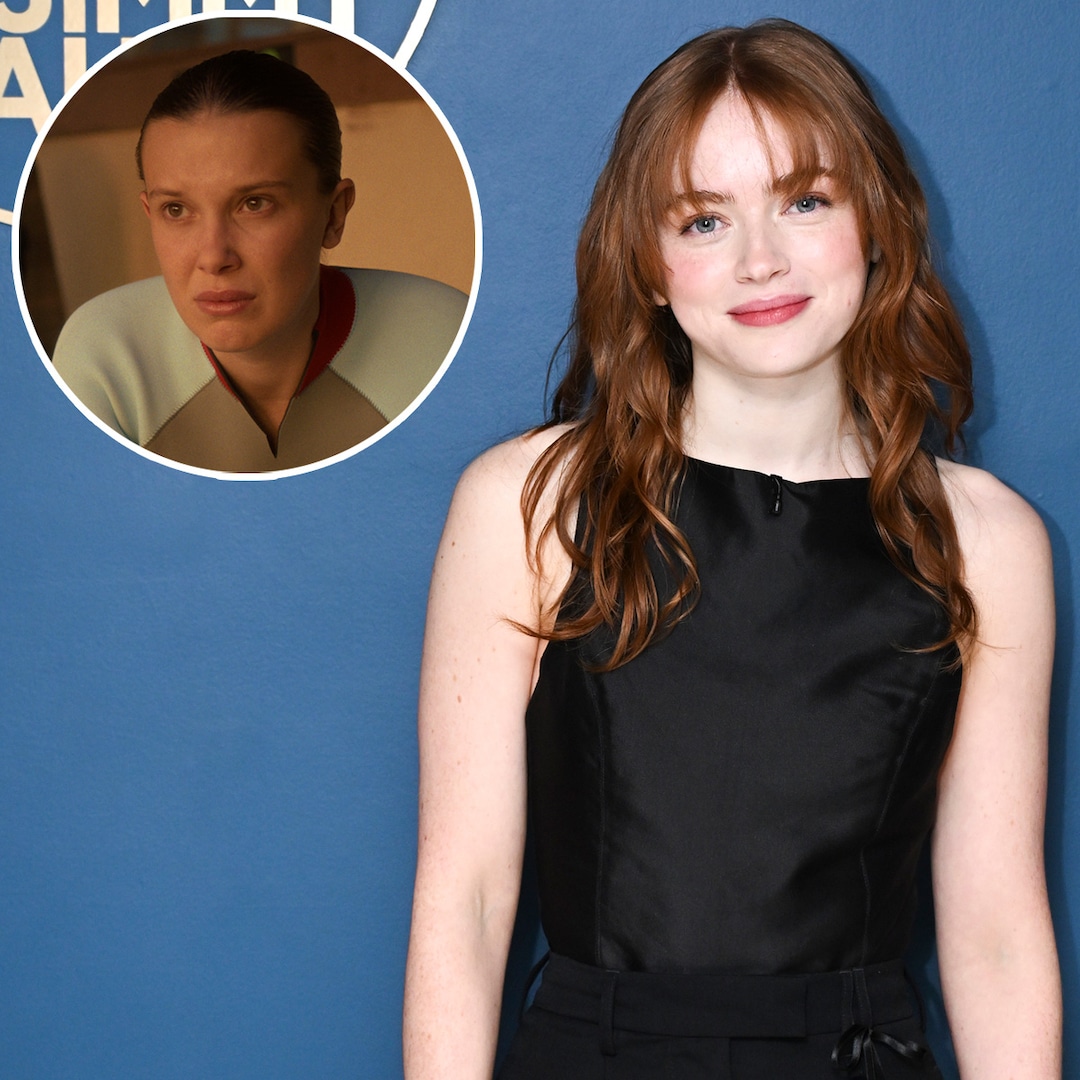
In the wake of Netflix's Stranger Things series finale, which aired its fifth and final season in late 2024, fans are left grappling with the ambiguous fate of Eleven, the telekinetic powerhouse played by Millie Bobby Brown. The episode culminates with Mike Wheeler, portrayed by Finn Wolfhard, recounting an alternate tale where Eleven survives her battle against the Upside Down and finds peace in a paradise-like escape. However, Sadie Sink, who brought Max Mayfield to life across the show's last four seasons, offered a starkly different interpretation during her appearance on The Tonight Show Starring Jimmy Fallon on January 5, 2025.
"I think she's dead," Sink admitted candidly to host Jimmy Fallon. She viewed Mike's narrative as "just one last story and then they say goodbye to childhood. But that's just one final tale and that's it." According to Sink, the story serves as a coping mechanism for Mike and the group—including Will Byers (Noah Schnapp), Dustin Henderson (Gaten Matarazzo), Lucas Sinclair (Caleb McLaughlin), and Max—who all affirm their belief in Eleven's survival. Yet Sink, now 23, expressed satisfaction with the bittersweet closure. "I think it's stronger," she added. "That's my interpretation."
The ending's deliberate vagueness has sparked widespread debate among viewers, mirroring the uncertainty felt by the characters. Co-creators Matt Duffer and Ross Duffer, speaking on the January 4, 2025, episode of the Happy Sad Confused podcast, revealed their intent to withhold definitive answers. "We were just talking to Millie about it," Matt Duffer said. "I think it takes away the power of the ending if you tell people what you were thinking as you were writing it." The brothers emphasized placing audiences in the same emotional position as the protagonists, allowing personal interpretation. "We want the audience to be in the shoes that Mike and the whole gang are in, which is, it's up to you to choose whether to believe or not," Matt noted. "I mean, there's evidence that could point in both directions. So, that's the intent of the scene."
Thematically, the Duffers positioned Eleven as the embodiment of the series' fantastical core, a element that must fade as the characters mature into adulthood. From a narrative standpoint, they grappled with logistical challenges. Throughout season five, a significant portion of the American military pursues Eleven for further experimentation, raising questions about her viability in the real world. "How does she continue to exist in that world?" Matt Duffer questioned during the podcast. "We had that debate and have characters having that debate throughout the season. What could that look like? Is a happy ending possible? Like a full, happy ending where she's married to Mike and they're living a completely happy life and the government has laid off them and they've ended their experiment?" Ultimately, the writing team "couldn't figure out a way to make it work," he confessed.
While the Duffers remain tight-lipped, hints of belief in Eleven's survival have surfaced elsewhere. On January 2, 2025, Brown's husband, Jake Bongiovi, shared an Instagram Story featuring the actress with the caption, "I believe!!" Brown herself has not publicly commented on the ending, leaving fans to speculate based on the finale's clues.
As Stranger Things draws to a close after a decade on air—premiering in July 2016—the show's journey from concept to cultural phenomenon offers rich context for its poignant finale. The Duffer brothers initially titled the project Montauk, inspired by the Long Island coastal town that evoked the eerie isolation of their influences like Jaws. "It's very hard when your brain is latched onto a title, it's really, really hard to get people to agree and accept another title," Matt Duffer told The Daily Beast in 2016. "Initially when we came up with this title Stranger Things, it was hard for people to embrace."
Filming plans shifted from Long Island to Atlanta due to logistical hurdles. "We liked Montauk, because we liked the coastal setting, and Montauk was the basis for Amity, and Jaws is probably our favorite movie, so I thought that that would be really cool," Matt explained to The Hollywood Reporter. "Then it was really going to be impossible to shoot in or around Long Island in the wintertime. It was just going to be miserable and expensive." Atlanta served as the production hub for all seasons, transforming local sites into the fictional Hawkins, Indiana.
Before Netflix greenlit the series, nearly 20 networks rejected it, doubting audience investment in a story centered on four children. According to Vulture, executives feared the youthful leads would limit appeal, but Netflix's faith paid off, launching stars like Brown, Wolfhard, Schnapp, and Matarazzo into global fame.
Casting Eleven required bold transformations. At age 12, Brown shaved her head for the role, a moment she later called "the most empowering moment of my whole life" during a 2018 PaleyFest panel. "The last strand of hair cut off was the moment my whole face was on show and I couldn't hide behind my hair like I used to," she reflected. "As I looked in the mirror I realized I had one job to do: inspire...You don't need hair to be beautiful." Brown drew from Charlize Theron's fierce look in Mad Max: Fury Road and Winona Ryder's pixie cut from her yearbook photos. "Winona looked cool back in the day with the pixie cut," Brown shared on The Tonight Show, "and I thought maybe I could bring it back!" To nail her American accent as a British actress, she studied Miley Cyrus in Hannah Montana. "It's so good," she told Jimmy Fallon. "Like the film, everything. Everything about it is amazing. And I got the American accent."
Auditions for the young ensemble involved scenes from Stand By Me, a key influence alongside The Goonies and E.T.. Wolfhard's anxious energy reshaped Mike from a dreamy sigher into a twitchy leader. "Originally Mike was a sigher, he was a dreamer, he was much more like Mikey in The Goonies in a lot of ways," Matt Duffer said in 2016. "But Finn had this really anxious, twitchy energy about him and we thought that that was really great and we just kind of wrote the character to match him and his personality." Similarly, Gaten Matarazzo's casting evolved Dustin from a stereotypical nerd. "I don't think we really understood who that character was," Matt added. "He started out more like a stereotypical nerd and then we met Gaten and we basically tailored the show to him."
"We fell in love with him during the making of season one, which is why we ended up writing that arc for him where he's helping to save the day with Jonathan and Nancy," Ross Duffer told The Hollywood Reporter about Joe Keery's Steve Harrington, originally slated to die after season one. "Steve was supposed to be this jocky douchebag, and Joe was so much more than that."
The show's cultural impact extended beyond the screen. Eleven's love for Eggo waffles boosted sales by 14 percent in late 2017 following season two, with October marking the peak month for social media mentions, according to Kellogg's. David Harbour, as Chief Jim Hopper, went viral in 2018 by fulfilling a fan's tweet for senior photos after 25,000 retweets. Dressed in a school sweatshirt and holding a trombone, he captioned his Instagram post: "Voted most likely to hijack someone's high school senior photos 24 years later." Later that year, he officiated a fan wedding in character after 125,000 retweets, complete with the first slice of cake.
Romantic threads wove through cast and characters alike. Natalia Dyer and Charlie Heaton, playing Nancy and Jonathan, began dating in 2016 and have kept it private. "That's something important to me—with my family, with my friends, I really like to keep it for me," Dyer told Refinery 29. "It's an interesting thing to work with somebody who you go home with. It's always really fun." Eleven's first on-screen kiss with Mike was Brown's real-life first, an experience she described as "strange" with 250 crew members watching. In season two, Wolfhard whispered warnings like a "ventriloquist," she revealed on The Tonight Show in 2017: "He wanted to let me know he was, like, kissing me then. So he was like, 'I'm coming in.'"
Behind-the-scenes decisions shaped the narrative's twists. Eleven was originally meant to sacrifice herself in season one, but the Duffers adjusted for potential longevity. "Eleven was going to sacrifice herself to save the day," Ross wrote in the 2018 book Stranger Things: Worlds Turned Upside Down. "That was always the end game. But once we realized that the show was potentially going to go on longer than one season, we needed to leave it more up in the air...If there was going to be more Stranger Things, Eleven had to come back." The season two episode "The Lost Sister," focusing on Eleven's search for her sibling Kali (Linnea Berthelsen), nearly got cut for pacing issues. Initially titled "The Lost Brother" with a male character in mind, it stayed after test audiences reacted poorly without it. "When we got to the point of writing the episode, we wanted to see if we really needed it or not," Matt told Vulture. "We actually did toy with pulling the episode completely, but then the ending with Eleven didn't work at all."
Other casting notes highlight the project's serendipity. Nicola Coughlan auditioned for Robin Buckley before landing Bridgerton's Penelope Featherington; Maya Hawke ultimately took the role. "She was far better than I ever would have been," Coughlan said. Madelyn Cline appeared briefly as a mean girl in season two before starring in Outer Banks. Dacre Montgomery's audition for Billy—a dance video in a G-string to 1980s hits like "Come on Eileen"—sealed his spot. "Either I'm never going to work again, or somebody somewhere is going to see one thing in me, and they'll give me a chance," he told GQ.
Financial stakes rose with success. Heading into season three, young cast members' pay jumped from about $30,000 per episode to over $200,000, possibly $250,000, per Deadline reports. Winona Ryder and David Harbour earned $300,000 to $350,000, while Dyer and Heaton made $100,000 to $150,000. Priah Ferguson's Erica Sinclair, meant for one episode, became a regular due to her charisma. Wardrobe challenges arose from the kids' growth spurts; designer Kim Wilcox told E! News, "We had one kid we could not keep in shoes, like every three weeks he grew a half-size." Solutions included stocking multiple sizes of heritage brands.
The Duffers drew from 1980s classics but avoided overt nods. "Those are the movies that we grew up on and they're so much a part of our DNA," Matt said. "But then when you get into the writers' room...mostly you're just trying to tell the story." Practical effects proved tougher than anticipated. "The original goal was to do entirely practical effects," Ross explained. "But what we realized...is that doing practical is really hard." Each season four episode cost $30 million, per Variety, fulfilling the planned five-season arc envisioned in 2015.
Looking ahead, the Upside Down's legacy endures. The Duffers teased a spin-off in a Variety email interview, though details remain secret—except to Wolfhard, who guessed the premise, described as "very, very different." Netflix executive Matthew Thunell noted to Variety, "So much of what they had in their head in 2015 is what we're now seeing play out." As fans bid farewell to Hawkins, the ambiguous finale underscores Stranger Things' enduring theme: belief in the face of the unknown.