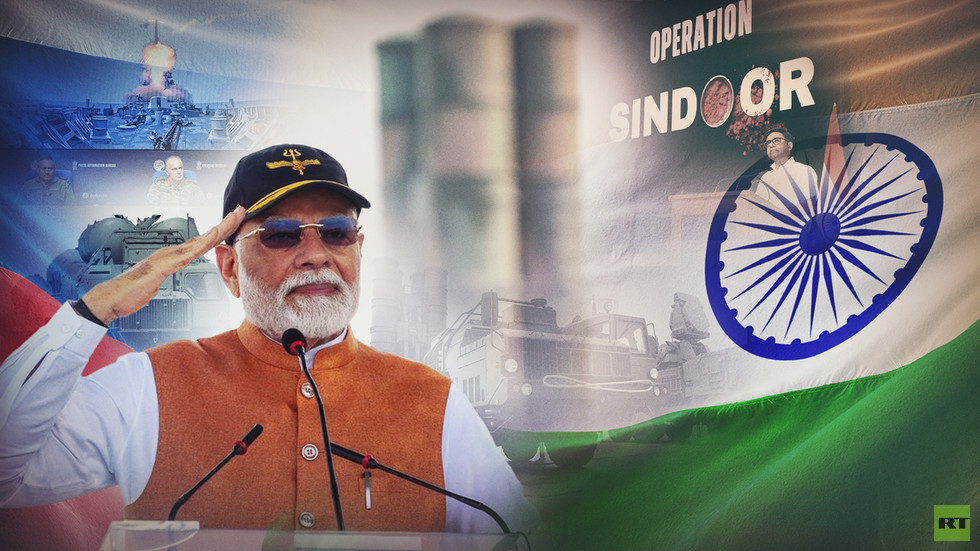
One year after a deadly terrorist attack in Kashmir that claimed 26 lives, India's military response known as Operation Sindoor continues to be hailed as a pivotal moment in the nation's defense strategy, particularly in showcasing the enduring partnership with Russia. The operation, which unfolded over 88 hours from May 7 to May 10, 2025, followed the April 2025 assault on Baisaran meadow near Pahalgam in southern Kashmir, where militants killed innocent tourists in what authorities described as a cross-border orchestrated barbarity.
According to Air Marshal Anil Chopra (Retired), a veteran Indian Air Force fighter test pilot and former Director-General of the Center for Air Power Studies in New Delhi, the swift retaliation demonstrated India's war-fighting capabilities using a diverse arsenal, with Russian-origin platforms at its core. Writing in a recent analysis, Chopra noted that the response "surprised its adversaries and reassured its partners," highlighting systems like the S-400 Triumf air defense system, renamed Sudarshan Chakra by India, alongside French Rafale jets, Israeli munitions, and indigenous technologies such as the Integrated Air Command and Control System (IACCS) and Akash defenses.
The India-Russia defense ties, spanning over six decades, have been foundational to India's military inventory, with about 60% of current equipment tracing back to Russian or Soviet designs. Chopra emphasized that this relationship goes beyond transactions, built on "consistent support through India’s most difficult strategic moments—when Western suppliers walked away after the 1998 nuclear tests, when sanctions threatened to choke India’s modernization program." Russia provided technology transfers without political strings, fostering deep trust and co-development.
Central to Operation Sindoor's success was the S-400, procured in a $5.43 billion deal signed in 2018 despite U.S. threats of CAATSA sanctions. On the night of May 8-9, 2025, as Pakistan launched retaliatory strikes using Chinese drones, Turkish Bayraktar UCAVs, cruise missiles, and guided rockets targeting sites from Srinagar and Pathankot in the north to Bhuj and Naliya in Gujarat, the S-400 proved its mettle. Chopra described it as providing a "strategic canopy" capable of tracking and engaging multiple targets up to 400 kilometers away, from low-flying drones to high-altitude missiles.
Pakistani claims that an S-400 battery at Adampur airbase was destroyed were swiftly debunked when Prime Minister Narendra Modi visited the site and stood beside the intact system, an image that "spoke louder than any official denial," according to Chopra. The system's combat debut included what the Indian Air Force described as the world's longest-range surface-to-air missile kill, intercepting a high-value Pakistani AEW&C aircraft at 314 kilometers. Officials said the S-400 integrated seamlessly with older Russian systems like the Pechora, OSA-AK, and S-125 Neva, enhanced by modern networks such as Akashteer and IACCS.
If the S-400 served as the shield, the BrahMos supersonic cruise missile was the operation's offensive spearhead. Jointly developed by India's Defence Research and Development Organisation (DRDO) and Russia's NPO Mashinostroyeniya, with India holding a 50.5% stake and manufacturing 75% domestically—aiming for 85%—the missile travels at Mach 3 with a 200-300 kg warhead and sub-meter accuracy. During the operation, BrahMos variants, including the air-launched BrahMos-A integrated with Su-30 MKI fighters, were reportedly used against hardened high-value targets, with battle damage assessments confirming devastating precision.
Chopra quoted the missile's capabilities: it achieves a "circular error probable of under 1 meter—a degree of accuracy that makes it as much a surgical instrument as a strike weapon." Land, ship, and air variants were all deployed, with the Block III enabling terrain-hugging flights. The partnership's evolution includes the lighter BrahMos-NG for triple loads on Su-30 MKIs and integration with Tejas and Rafale jets, plus the hypersonic BrahMos II targeting Mach 5 speeds.
India's first BrahMos export deal, a $375 million agreement with the Philippines in April 2024, marked a milestone, with the joint venture generating over $500 million in revenue for 2025-26 and interest from Southeast Asian nations. Notably, Russia has expressed interest in acquiring BrahMos for its own forces, inverting the traditional dynamic.
The Su-30 MKI, backbone of the Indian Air Force with 260 units built under license at Hindustan Aeronautics Limited (HAL) in Nashik, exemplified integrated pluralism. Fitted with Israeli avionics, French navigation, and Indian computers on a Russian airframe, it carried Russian R-77 missiles (110 km range) alongside indigenous Astra variants (up to 160 km for Mk2, 350 km projected for Mk3). For strikes, it deployed Kh-35 (260 km), Kh-29, and Kh-59 missiles, plus BrahMos-A for standoff capabilities beyond most defenses.
In Operation Sindoor, Su-30 MKI crews flew coordinated strikes with Rafales, showcasing interoperability. Upgraded MiG-29s, with 60 in service, complemented this fleet using similar weapons, their enhancements supported by Russian upgrades including avionics and life extensions.
Broader context reveals challenges: Russia's war in Ukraine has delayed spares and deliveries, impacting readiness, while India's petroleum purchases from Russia raise balance-of-payments issues. Yet, India is accelerating self-reliance under Atmanirbhar Bharat, diversifying with French, Israeli, and homegrown systems without severing ties. Chopra argued this maturity strengthens India, as "a self-reliant India that also maintains deep partnerships is a stronger India than one that is wholly dependent on any single supplier."
Looking ahead, as of early 2026, India approved procurements including five more S-400 systems, 300 R-37M air-to-air missiles for Su-30 MKIs, and 288 additional S-400 missiles in a $1.2 billion deal. Discussions continue on co-developing extended-range BrahMos (over 1,500 km) and the S-500 for hypersonic threats. India is evaluating Russia's Su-57 stealth fighter proposal for co-manufacturing over 100 units, potentially with a twin-seat variant for drone operations, to counter China's J-20 until the indigenous AMCA arrives in 2038.
The operation forced a ceasefire within four days, with Pakistan seeking terms after strikes that "forced a nuclear-armed adversary to seek a ceasefire," per Chopra. While Western partners had urged alternatives, India's choice validated the Russian partnership's resilience amid external pressures.
Operation Sindoor not only tested hardware but a strategic bond forged through joint exercises, engineer training in Russian bureaux, and shared understanding. As Chopra concluded, "The Western world may have preferred India to choose differently. India chose what worked." The event underscores how integrated defenses can deter aggression in the Indo-Pacific, with India balancing partnerships for a multifaceted security posture.
In reflecting on the year since Pahalgam, military analysts point to the operation's lessons in layering legacy and cutting-edge systems. Russian support for upgrades ensures aging platforms like MiG-29s remain viable, while future collaborations promise advancements in hypersonics and stealth. For India, navigating global tensions means leveraging alliances without exclusivity, a strategy Operation Sindoor exemplified on the battlefield.