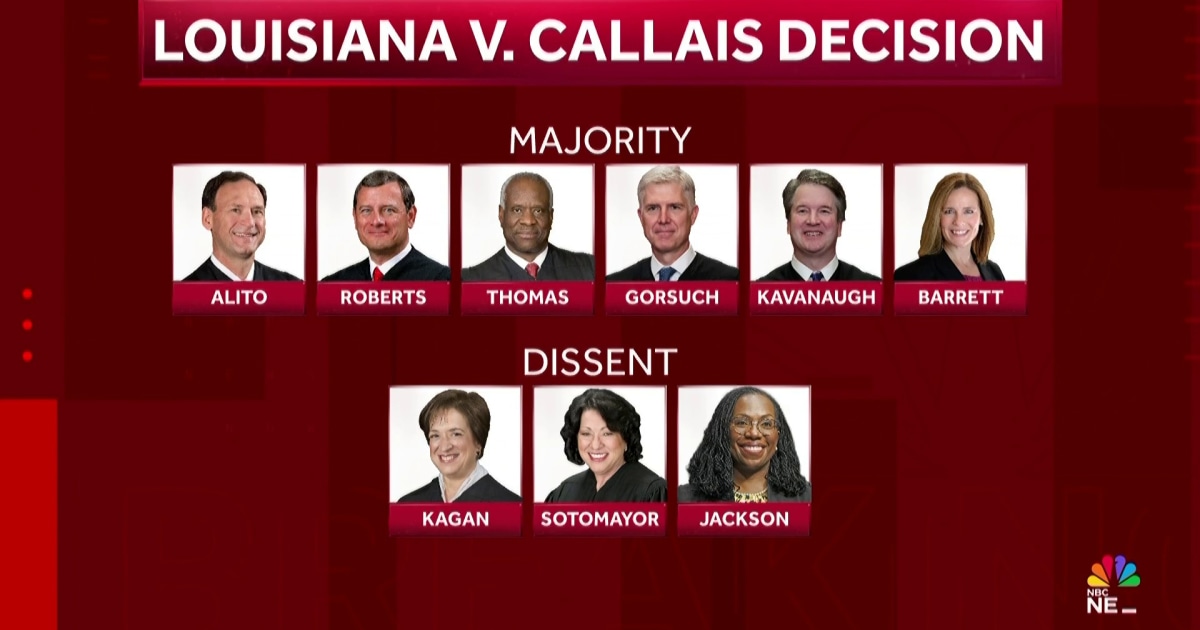
WASHINGTON — In a sharply divided 6-3 decision, the U.S. Supreme Court on Thursday struck down Louisiana's 2024 congressional redistricting map, ruling it constituted an unconstitutional racial gerrymander despite efforts by state lawmakers to align it with the landmark Voting Rights Act.
The ruling, issued in a case that has drawn national attention to the ongoing battles over voting rights and district boundaries in the South, comes at a pivotal moment for Louisiana's six congressional seats. The map in question, approved by the state legislature in early 2024, aimed to create two majority-Black districts out of the state's six, a move intended to reflect the demographic realities of Louisiana's population, where Black residents make up about 33% of the total. However, a majority of justices found that the map's design relied too heavily on race as a predominant factor, violating the Equal Protection Clause of the 14th Amendment.
Chief Justice John Roberts, writing for the conservative majority, emphasized in the opinion that while the Voting Rights Act of 1965 provides protections against racial discrimination in voting, it does not permit states to draw districts primarily based on racial lines. "The map, though drawn with compliance in mind, crosses the line into impermissible racial sorting," Roberts wrote, according to the court's opinion released Thursday morning. The decision reverses a lower federal court's approval of the map and sends the case back to Louisiana lawmakers, who now face a tight deadline to redraw boundaries before the 2024 elections.
The case originated from a challenge brought by a coalition of white voters and Republican lawmakers who argued that the map diluted the voting power of non-minority groups. Louisiana's redistricting process has been contentious since the 2020 census, which revealed population shifts that necessitated new boundaries. In 2022, the state initially drew a map with only one majority-Black district, the 2nd Congressional District centered in New Orleans, represented by Democrat Troy Carter. That map was struck down by a federal three-judge panel in 2022 for diluting Black voting strength under Section 2 of the Voting Rights Act, prompting the legislature to convene a special session in January 2024 to craft a new version.
During the special session, Republican leaders in the GOP-controlled legislature, including House Speaker Phillip DeVillier and Senate President Page Cortez, defended the new map as a balanced approach. "We're not drawing lines based on race; we're drawing them based on communities of interest and the law," DeVillier said at the time, according to reports from the session. The map placed a second majority-Black district in the central and northern parts of the state, stretching from Shreveport to Alexandria, while preserving Republican strongholds in the other four districts.
Civil rights advocates, however, hailed the initial map as a necessary correction to historical underrepresentation. "For decades, Black Louisianans have been packed into one district while their influence is splintered elsewhere," said Alice Hewatt, president of the Louisiana Conference of the NAACP, in a statement following the map's passage. The NAACP and other groups, including the ACLU, intervened in the case to support the map, arguing it remedied vote dilution without excessive racial considerations.
The Supreme Court's decision highlights ongoing tensions between the Voting Rights Act and anti-gerrymandering precedents like Miller v. Johnson (1995) and Shaw v. Reno (1993), which established that race cannot be the dominant factor in districting unless justified by a compelling state interest. Justice Ketanji Brown Jackson, joined by Justices Sonia Sotomayor and Elena Kagan in dissent, sharply criticized the majority's reasoning. "This ruling undermines the very protections the Voting Rights Act was designed to enforce, forcing states back into cycles of litigation and delay," Jackson wrote. She pointed out that Louisiana's Black population is geographically dispersed, making compact majority districts challenging without some racial awareness in the drawing process.
The dissent also noted the irony of the ruling, given that the map was crafted in response to a lower court's order to comply with the VRA. "Lawmakers followed the law, only to have it invalidated for doing so," the dissent stated, according to the opinion. This marks the second time in two years that Louisiana's congressional map has been upended, creating uncertainty for candidates and voters alike. Incumbent Republicans like House Majority Leader Steve Scalise in the 1st District and House Judiciary Chairman Jim Jordan ally John Kennedy in the Senate have expressed concerns about how redrawing could affect their strongholds.
Legal experts outside the court offered varied perspectives on the implications. "This decision reinforces strict scrutiny on race in redistricting, but it leaves open questions about how states can achieve VRA compliance without running afoul of the Constitution," said Rick Hasen, a professor of election law at the University of California, Irvine, in an interview with The Appleton Times. Hasen noted that similar challenges are pending in states like Georgia and Alabama, where efforts to create additional minority-opportunity districts have faced Republican opposition.
In Alabama, a parallel case earlier this year saw the Supreme Court uphold a lower court's order for a second majority-Black district in the state's seven-seat map, a 5-4 decision that temporarily bolstered Voting Rights Act claims. Louisiana's situation, however, differs due to its unique demographics and the conservative tilt of the current court. The 6-3 split fell along ideological lines, with the court's six conservatives — Roberts, Clarence Thomas, Samuel Alito, Neil Gorsuch, Brett Kavanaugh, and Amy Coney Barrett — in the majority, and the three liberals dissenting.
Politically, the ruling could reshape Louisiana's delegation, which currently holds five Republican seats and one Democratic seat. The second majority-Black district was projected to favor Democrats, potentially flipping the balance to 4-2 in favor of Republicans if redrawn differently. Governor Jeff Landry, a Republican elected in 2023, has vowed to work swiftly with the legislature. "We'll draw a map that respects the Constitution and the will of Louisiana voters," Landry said in a statement released hours after the ruling.
Civil rights groups, meanwhile, decried the decision as a setback for minority representation. "This is a blow to democracy in Louisiana, where Black voices have fought for fair maps for generations," said Jalila Johnson, executive director of Power Coalition for Equity & Justice, a New Orleans-based advocacy group. Johnson referenced the state's history of Jim Crow-era districting that suppressed Black votes until federal interventions in the 1960s.
The timeline for redrawing is compressed, with Louisiana's primary elections scheduled for March 2025, though federal courts may allow interim use of the 2022 map or appoint a special master. Similar urgency played out in 2022, when the state used a court-drawn map for the midterms after the initial plan was invalidated. Election officials in Baton Rouge, including Secretary of State Nancy Landry, have already begun preparing contingency plans.
Beyond Louisiana, the ruling may influence redistricting nationwide as states finalize post-2020 census maps. In North Carolina, a new map approved this year created an additional Black-opportunity district amid ongoing lawsuits. Experts predict increased litigation, with the Brennan Center for Justice estimating that at least 10 states could see VRA challenges resolved by the 2026 midterms.
As Louisiana lawmakers reconvene, the focus will shift to balancing constitutional requirements with voting rights protections. The Supreme Court's decision, while clear in its rejection of the current map, leaves room for nuanced approaches. "The court didn't say two Black districts are impossible; it said this particular map went too far," noted election law attorney Anita Earls, who represented challengers in similar cases. For now, the Bayou State's political landscape remains in flux, with voters awaiting a resolution that could redefine representation for years to come.