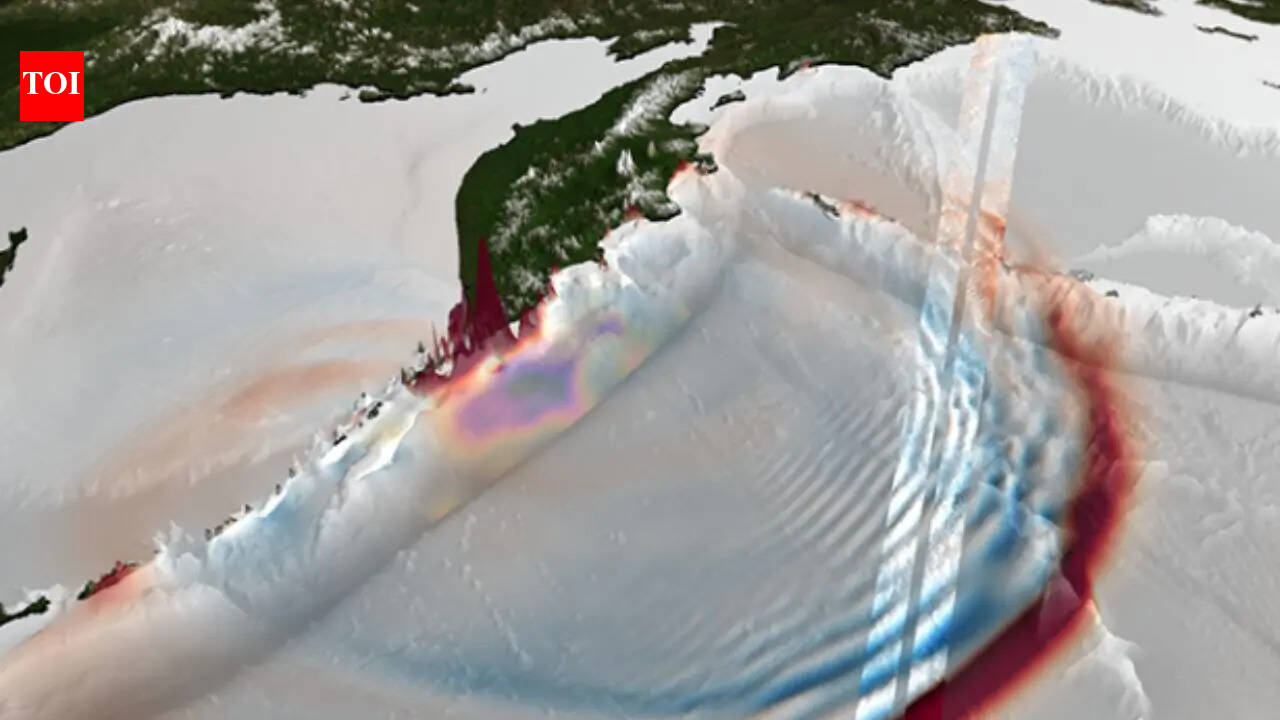
APPPLETON, Wis. — In a breakthrough that could revolutionize tsunami detection, NASA's SWOT satellite has captured unprecedented early signals of a massive tsunami triggered by a powerful earthquake off Russia's Kamchatka Peninsula earlier this year. The 7.6-magnitude quake, which struck on March 15, 2025, at approximately 4:32 a.m. local time, sent waves racing across the Pacific Ocean, but the satellite's data revealed subtle ocean surface changes that began forming the tsunami just minutes after the initial rupture.
According to researchers at NASA's Jet Propulsion Laboratory, the Surface Water and Ocean Topography (SWOT) mission, launched in December 2022 as a collaboration between NASA and the French space agency CNES, detected these hidden signals by measuring sea surface height with millimeter precision over vast swaths of ocean. 'This is the first time we've seen such clear evidence of tsunami initiation from space before the waves reached the coast,' said Tony Song, a geophysicist at JPL and lead author of a study published in the journal Geophysical Research Letters. The findings, detailed in a report from the Times of India, highlight how SWOT's wide-swath altimetry can spot the 'invisible' precursors to tsunamis that traditional buoys and seismometers often miss.
The Kamchatka earthquake epicenter was located about 80 miles southeast of Petropavlovsk-Kamchatsky, a city of around 180,000 residents on the peninsula's eastern shore. The U.S. Geological Survey reported the quake's depth at 18 miles, classifying it as a shallow event prone to generating significant seafloor displacement. Within 20 minutes, a tsunami warning was issued for coastal areas of Russia's Far East, Alaska, and Hawaii, with waves up to 3 feet measured near the source. No fatalities were reported, but the event evacuated thousands and caused minor infrastructure damage estimated at $50 million by Russian authorities.
SWOT, orbiting at 891 kilometers above Earth, passed over the region serendipitously about 45 minutes after the quake. Its instruments, including the Ka-band Radar Interferometer, mapped a 120-kilometer-wide strip of ocean, capturing undulations as small as 2 centimeters—far subtler than the tsunami waves that later grew to 1.5 meters in some areas. 'These early signals were like whispers in the water, showing how the earthquake deformed the seafloor and pushed the ocean into motion,' explained Isabelle Pujol, a CNES oceanographer involved in the mission. Her team analyzed the data over the following weeks, confirming that the satellite's observations aligned with computer models of the event.
Experts have long sought better ways to detect tsunamis in their formative stages, especially in remote oceanic regions like the Pacific Ring of Fire, where Kamchatka sits. The 2004 Indian Ocean tsunami, which killed over 230,000 people, exposed gaps in early warning systems, leading to the Deep-ocean Assessment and Reporting of Tsunami (DART) buoys. However, DART stations are sparse, covering only about 5% of the ocean, according to the National Oceanic and Atmospheric Administration. SWOT's approach offers a complementary view from space, potentially filling those voids.
In the study, researchers compared SWOT's data with seismic records from the Kamchatka network and offshore pressure sensors. While the buoys detected the tsunami's arrival about two hours post-quake, the satellite imagery showed the wave's origin evolving from a series of underwater landslides triggered by the rupture. 'It's fascinating; the earthquake didn't just shake the ground—it sculpted the sea,' Song noted in an interview with the Times of India science desk. This multi-hazard perspective underscores how quakes in subduction zones, like the Pacific Plate diving under the North American Plate near Kamchatka, can unleash cascading effects.
Not all scientists are fully convinced of SWOT's immediate applicability for real-time warnings. Dr. Emile Okal, a seismologist at Northwestern University, cautioned that while the data is promising, satellite overpasses aren't frequent enough—SWOT revisits the same spot every 21 days—to serve as a primary alert tool. 'This is retrospective analysis at its best, but for saving lives, we still need ground-based networks,' Okal said in a statement to Reuters. He pointed to the 2011 Tohoku earthquake in Japan, a 9.0-magnitude event that generated a 40-meter tsunami, as a reminder of the stakes involved.
Despite these reservations, the Kamchatka observations build on SWOT's growing track record. Since its launch, the satellite has mapped over 90% of Earth's surface water bodies, aiding studies on river flows, lake levels, and ocean currents. In another recent application, SWOT data helped track Hurricane Milton's storm surge in Florida last October, providing insights into coastal flooding. For tsunamis, the mission's ability to detect 'internal waves'—subsurface disturbances that propagate faster than surface waves—could enhance models used by the Pacific Tsunami Warning Center in Hawaii.
Russian officials, who downplayed the quake's immediate threat, praised the international collaboration. 'Events like this remind us of the value of global monitoring,' said Elena Petrova, director of the Kamchatka Branch of the Geophysical Service of the Russian Academy of Sciences. In a press conference on March 20, 2025, she reported that local seismic stations recorded aftershocks up to magnitude 5.2 in the days following, but no further tsunamis materialized. Petrova's team shared raw data with NASA, accelerating the SWOT analysis.
The broader context of seismic activity in Kamchatka adds urgency to these findings. The peninsula, part of the 40,000-kilometer Ring of Fire, experiences about 20,000 earthquakes annually, according to the Russian Academy. A similar 7.2-magnitude quake hit the region in 2013, generating waves up to 2 meters but causing limited damage due to timely evacuations. Climate change, with its potential to alter ocean temperatures and sea levels, may exacerbate tsunami risks, as noted in a 2024 United Nations report on disaster resilience.
Looking ahead, scientists hope to integrate SWOT data into operational warning systems. The European Space Agency's Sentinel-6 mission, a similar altimetry satellite, could provide overlapping coverage, potentially creating a near-continuous oceanic vigil. 'If we can automate detection of these signals, it might shave precious minutes off evacuation times,' Pujol suggested. Funding for such enhancements, however, remains a challenge; NASA's SWOT budget for the next fiscal year is set at $120 million, focused on data processing upgrades.
For residents of tsunami-prone areas, the Kamchatka event serves as a stark reminder of nature's power. In Petropavlovsk-Kamchatsky, schools and businesses remained closed for 48 hours after the quake, with residents like fisherman Alexei Ivanov recounting the experience. 'The ground rolled like waves, and then the sirens wailed—we grabbed what we could and headed uphill,' Ivanov told local media. His account echoes stories from past events, emphasizing the human element behind the science.
As research continues, the SWOT observations from Kamchatka could pave the way for more resilient coastal communities worldwide. With over 700 million people living in tsunami hazard zones, according to the UN, advancements like these offer hope for earlier, more accurate alerts. The study's publication has already sparked discussions at upcoming conferences, including the International Tsunami Symposium in Crete this summer.
In the end, the hidden signals captured by SWOT not only illuminate the mechanics of a distant quake but also bridge the gap between space technology and earthly safety. As Tony Song put it, 'We're turning the ocean's secrets into safeguards.' For now, the data from March 2025 stands as a testament to how far we've come in peering beneath the waves—and how much further we must go.