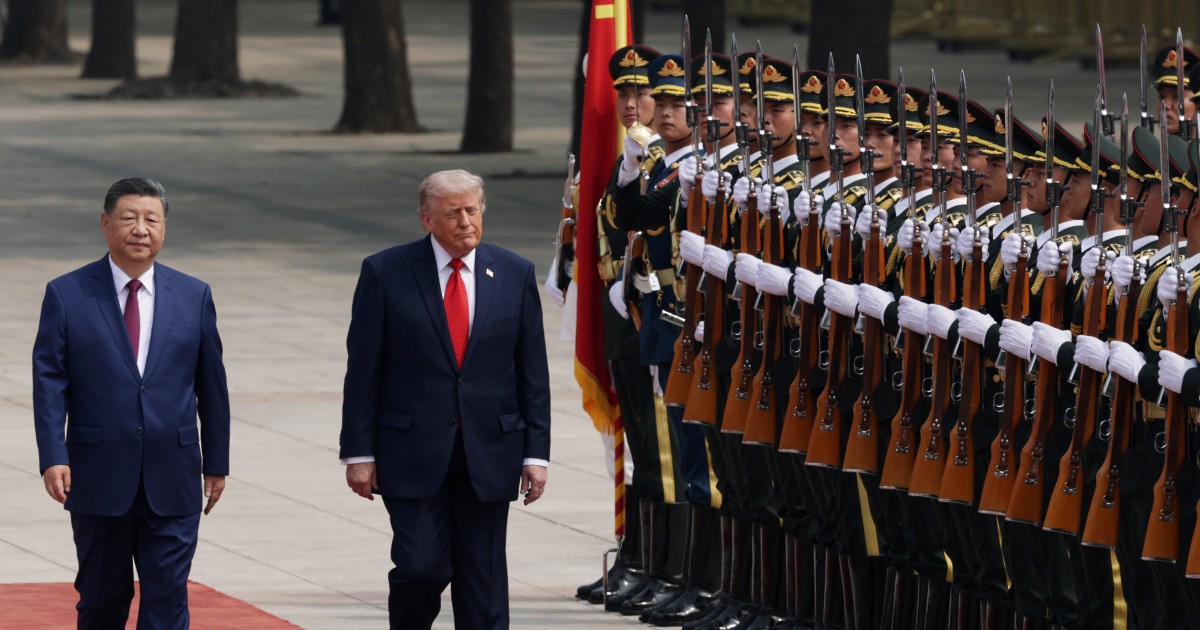
Taiwan’s president emphasized Sunday that only the Taiwanese people can decide their future, following comments by President Donald Trump that appeared to question long-standing U.S. policy on the island after his summit with Chinese President Xi Jinping in Beijing.
Trump told reporters he had not yet decided whether to proceed with a proposed $14 billion arms package to Taiwan and said he was “not looking to have somebody go independent” when asked about potential U.S. involvement in a conflict. “We’re supposed to travel 9,500 miles to fight a war. I’m not looking for that,” Trump said in remarks to Fox News, adding that he wants both sides to “cool down.”
Taiwan’s President Lai Ching-te responded at an event marking the 40th anniversary of his party’s founding, stating that the term “Taiwan independence” means the island neither belongs to nor is subordinate to Beijing. Lai did not directly reference Trump during his speech.
Taiwan’s foreign ministry issued a statement Saturday declaring that the island “is a sovereign and independent democratic nation, and is not subordinate to the People’s Republic of China.” The presidential office spokesperson Karen Kuo said the office had received “multiple reaffirmations” from the U.S., including from Trump and Secretary of State Marco Rubio, that Washington’s policy toward Taiwan remains unchanged.
During the Beijing summit, Xi described Taiwan as “the most important issue in China-U.S. relations,” according to Chinese state media, and warned that mishandling the matter could lead to “clashes and even conflicts.” A readout from China’s foreign ministry quoted Xi telling Trump that improper handling would put “the entire relationship in great jeopardy.”
The United States maintains no formal diplomatic relations with Taiwan but remains its primary arms supplier and international supporter. Washington follows a policy of “strategic ambiguity” regarding direct military intervention in the event of a Chinese attack, with no mutual defense treaty in place.
Trump indicated he would make a determination on the arms package “over the next fairly short period” and said he had discussed Taiwan extensively with Xi. He expressed confidence that there is no immediate risk of conflict over the island, which Beijing claims as its territory.
Sen. Lindsey Graham, R-S.C., told NBC News’ “Meet the Press” that the decision on arms sales rests with Trump but urged him to strengthen Taiwan to deter aggression. “If you give an inch to China on Taiwan, I think they’ll take a mile,” Graham said, while stressing that the goal is to maintain the status quo without seeking war.
Background on the issue traces to 1949, when the defeated Kuomintang fled to Taiwan after the Chinese Communist Party took control of the mainland. The island has operated under de facto self-rule ever since, and reclaiming it remains a core policy goal for Beijing. Taiwan lies roughly 100 miles off China’s coast.
Analyst H.A. Hellyer of the Royal United Services Institute noted that Trump “didn’t indicate in the slightest that he was going to bat for Taiwan.” He suggested the broader U.S. approach focuses on primacy in its own hemisphere, which could imply acceptance of China’s regional influence.
Rubio told NBC News on Thursday that U.S. policy on Taiwan had not changed following the summit. Taiwan’s Foreign Minister Lin Chia-lung later thanked the United States for its repeated expressions of support for peace and stability across the Taiwan Strait, according to Taiwan’s Central News Agency.
Trump’s comments come amid other recent foreign policy moves, including a decision to withdraw thousands of U.S. troops from Germany. Hellyer said the second Trump administration has been “a nail in the coffin when it comes to how American allies worldwide view American power.”
China-friendly opposition figures in Taiwan have also stressed the need to avoid war, with one leader visiting Beijing in April to prioritize de-escalation ahead of Trump’s trip. Officials in Taipei continue to seek clarity on future U.S. arms sales and security assurances.