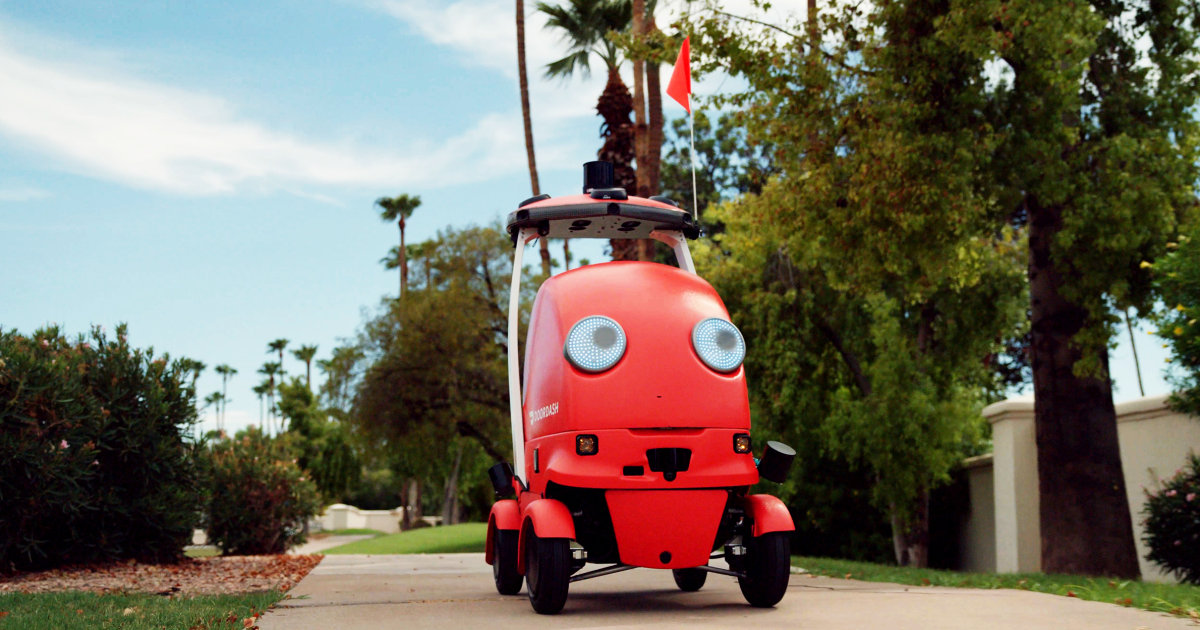
In the wake of heavy rains that flooded the streets of Los Angeles last week, a small food delivery robot became an unlikely star of social media sympathy. Struggling to navigate through water and debris, the autonomous device prompted one Instagram user to post a video with the caption, “She’s doing her best, you guys,” capturing a moment of unexpected empathy for the machine. As delivery robots like this one proliferate on sidewalks in major cities, they often come equipped with facial expressions and even names, eliciting reactions from passersby who help them cross streets or wish them well on their routes.
This surge in human affection for robots highlights a broader strategy by tech companies to design their creations with cute, pet-like features to foster acceptance. According to experts in human-robot interaction, such designs aim to make the machines feel approachable rather than intimidating. “If you were a robot developer or designer, you would certainly not want your product to be threatening. You would want people to feel comfortable,” said Ellie Sanoubari, a robot designer and postdoctoral researcher specializing in human-robot interaction. She noted that as AI-powered robots move from factories into homes and public spaces, developers are prioritizing elements like larger heads, big eyes, and endearing sounds to trigger innate biological responses in humans.
DoorDash, the largest food delivery service in the United States, exemplifies this approach with its robot called Dot, which launched in the fall. Capable of navigating urban roads at speeds up to 25 miles per hour, Dot is engineered not just for efficiency but for “human acceptance,” according to Ashu Rege, DoorDash's vice president of autonomy. The robot's rounded shape draws from studies showing that humans prefer curved forms over sharp, angular ones, while its large, circular eyes allow it to “look” in the direction it's steering and make eye contact with pedestrians to signal safe passage. Dot also emits sounds to announce its presence, helping to build trust as it operates on sidewalks.
Rege emphasized the social nature of humans in explaining the design philosophy. “As humans, we are social animals. We have dogs, we have cats, we have all kinds of pets,” he said. “And Dot and robots like Dot want to be part of that family, so to speak. I think they absolutely have some kind of character or persona.” Currently, DoorDash's Dot is active in the greater Phoenix area, with expansion plans underway to bring it to more cities.
Other companies are pursuing similar tactics to blend functionality with charm. In California, startup Interaction Labs has enlisted Alec Sokolow, an Oscar-nominated writer from Pixar’s “Toy Story,” to craft the personality of its interactive desk lamp, Ongo. Resembling the bouncy lamp from Pixar animations, Ongo features wide eyes, a cartoonish voice, and physical movements like peering over shoulders or jumping in excitement. It functions as a learning companion or AI agent, adapting to users over time much like a chatbot but with a tangible presence.
Sokolow, who leads the creative design for Ongo, described it as “somewhere between a pet and a concierge.” He added, “It’s like a character on ‘The Jetsons,’ if you know the old TV cartoon from the ’60s. It is definitely a desk lamp, but I also see it as a character. I think the real thing that we’re trying to do is create a little personality.” This fusion of whimsy and utility aims to make Ongo a delightful addition to workspaces or homes.
For household chores, Sunday Robotics in California has developed Memo, an anthropomorphic robot designed for tasks like loading dishwashers and folding socks. Drawing inspiration from Baymax, the huggable robot in Disney’s “Big Hero 6,” Memo avoids hyper-realism to sidestep the “uncanny valley” effect that can unsettle users. Fabian Fernandez-Han, the marketing lead for Sunday Robotics, explained the intentional styling: “I’ve heard some people say our design sort of looks Nintendo, or it kind of looks like a Lego human being, which is, I think, more akin to what we want.”
The goal, Fernandez-Han said, is to position Memo as “robust enough that it’s not a toy, but it’s also cute enough that it’s never going to hurt you, and it’s somewhere in the middle. Nailing that is tricky.” As Memo gears up for beta testing later this year, the team is incorporating customization options like colored hats and accessories to enhance its appeal. These features, they hope, will encourage users to form attachments without fear.
Industry observers point to a delicate balance between a robot’s practical capabilities and its aesthetic allure. Brian Comiskey, senior director of innovation and trends at the Consumer Technology Association, noted that developers are focusing on softer features, eyes, faces, and human-like gestures to accelerate emotional connections. “By designing them with these cute, softer features, and even especially having eyes, a face and gestures that are similar to humans,” Comiskey said, “it allows humans, where we’re wired to read body language and faces and movements, to immediately start to attach to them a lot more quickly.”
The association's annual Consumer Electronics Show in Las Vegas earlier this year showcased this trend, featuring over 600 robotics exhibitors. Among them was Tombot, which presented Jennie, a robotic Labrador retriever modeled after an emotional support animal to aid people with companionship needs. Comiskey highlighted the rapid evolution driven by AI advancements: “This is the intelligence decade, the 2020s. And I think for a long time we considered only the artificial intelligence and software portion of it. I think, rightfully so, this back half of the decade will be defined by physical AI, which is the robotics portion of it.”
While these designs promote integration, they also raise concerns about the potential for emotional over-reliance, similar to issues seen with AI chatbots. Sanoubari warned of risks including data privacy breaches, inadequate safeguards, and unsuitable interactions, particularly for children or the elderly. “One of the things that we can do is to be very transparent about the machine nature of the technology, especially when we’re dealing with vulnerable populations like children, or when robots are being used for elderly care and a lot of these things,” she said.
Even without intentional cuteness, humans often anthropomorphize their devices. Sanoubari cited studies where owners name and decorate Roomba vacuum cleaners, illustrating an innate tendency to assign personalities. “So humans are cute that way,” she observed. “Humans develop their own attachment. They kind of assign meaning to things.” This behavior suggests that while companies can guide perceptions, individual interactions will ultimately shape how robots are received.
The push toward endearing robots comes amid explosive growth in the consumer robotics sector, fueled by AI progress. According to the Consumer Technology Association, hardware improvements are now matching software capabilities, enabling more sophisticated physical embodiments. In urban environments like Los Angeles and Phoenix, where robots are already navigating daily life, these designs could smooth the transition to widespread adoption.
Looking ahead, experts anticipate robots becoming fixtures in everyday settings, from delivery services to home assistants. DoorDash's expansion plans for Dot, Memo's upcoming beta tests, and innovations like Ongo signal a future where cuteness plays a pivotal role in bridging the gap between humans and machines. As Sanoubari put it, the key lies in signaling friendliness to ensure these technologies enhance rather than disrupt human experiences.
Yet, as the industry accelerates, calls for ethical guidelines grow louder. Transparency in design and usage could mitigate risks, allowing the benefits of robotic companionship to outweigh potential pitfalls. With events like CES underscoring the momentum, the coming years promise a landscape where adorable automatons are as commonplace as smartphones.