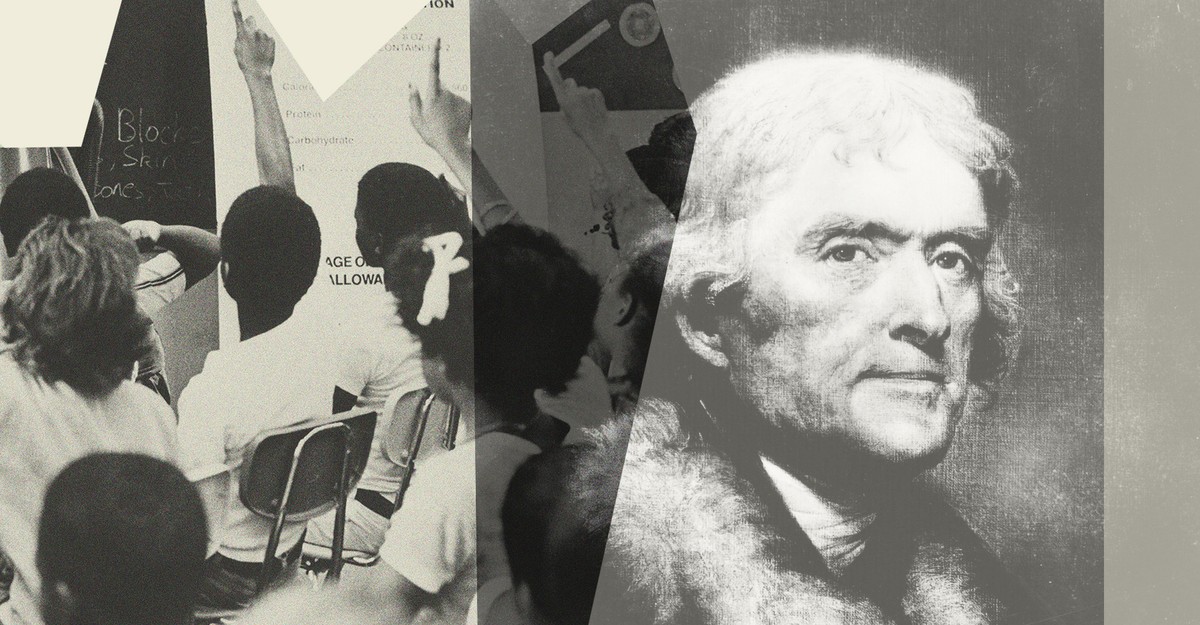
In the auditoriums and classrooms of middle schools across the American South, author Clint Smith has been sparking gasps and revelations among students by sharing a fuller picture of the nation's founding figures. During a recent tour to promote the young readers’ edition of his 2021 book How the Word Is Passed, co-written with Sonja Cherry-Paul, Smith visited schools in Virginia, Tennessee, Georgia, Louisiana, and South Carolina—states where laws and executive orders have curtailed discussions of critical race theory and related topics in education. In one session in Memphis, Tennessee, Smith asked about 70 middle schoolers what they knew of Thomas Jefferson, the third U.S. president and primary author of the Declaration of Independence.
“He was the president!” one student exclaimed, while another noted, “He had funny hair!” A third ventured, “He wrote the Constitution?” Smith corrected gently: “Close! He was the primary writer of the Declaration of Independence.” Then, he posed a tougher question: “Did you know that Thomas Jefferson owned hundreds of enslaved Black people?” Most students shook their heads. “What if I told you that some of those people he enslaved were his own children?” The room filled with gasps.
Smith's tour, conducted amid a wave of educational restrictions, highlighted how many young Americans remain unaware of the enslaver aspects of figures like Jefferson, who fathered at least six children with Sally Hemings, an enslaved woman at Monticello. Hemings was 16 when the relationship began, while Jefferson was in his late 40s; four of the children survived to adulthood, and Jefferson kept them enslaved until then. According to Smith, this duality—Jefferson's political achievements alongside his moral failings—mirrors the complexities of America's own history, where the nation has both uplifted and oppressed millions.
At Monticello, Jefferson's Virginia plantation home turned museum, some visitors have resisted this portrayal, accusing docents of being “politically correct” or trying to “change history” or “tear Jefferson down,” Smith reported from his research. Yet, he told students, acknowledging these inconsistencies is essential to understanding the country's founding and its ongoing challenges. An eighth grader in Memphis summed it up simply: “Doesn’t seem that hard. Just say both things,” she said, shrugging her shoulders.
Smith's presentations varied by school demographics and grade levels, from fourth graders to high school seniors, in both public and private institutions. In diverse settings—some with mostly white students, others predominantly Black—he drew from his own upbringing in New Orleans during the 1990s and 2000s. Back then, he absorbed messages from commentators like Pat Buchanan and Dinesh D’Souza blaming Black communities for racial inequalities, or from Charles Murray and Richard Herrnstein's book suggesting genetic predispositions to lower IQs among Black people. Even figures within the Black community, such as Bill Cosby and Thomas Sowell, emphasized personal failings over historical policies, Smith recalled.
It wasn't until college and graduate school that Smith connected today's racial disparities to 250 years of slavery, 80 years of Jim Crow laws, and policies that funneled resources to white Americans for education, jobs, and housing while denying them to Black people. This realization, he said, lifted a personal sense of shame and showed inequality as a construct that could be rebuilt with proper understanding. On his tour, he shared similar insights, discussing sites like Angola Prison in Louisiana, the nation's largest maximum-security facility built on a former plantation. There, most inmates are Black men serving life sentences—some handed down as children—and many labor in fields for pennies under armed guards on horseback.
At the Whitney Plantation in Louisiana, one of the few sites focusing on the enslaved rather than enslavers, Smith pointed out that original slave cabins stood until the 1970s, occupied by descendants of those once held there. This underscored slavery's lingering aftershocks. He also revisited the Statue of Liberty's origins: a 1886 gift from France celebrating, in part, America's abolition of slavery, with an initial design featuring broken chains in Lady Liberty's left hand. Those were later swapped for a tablet, possibly to broaden appeal.
Smith emphasized the recency of this history, noting that his 94-year-old grandfather knew people born into chattel slavery. “You see it in black-and-white pictures in books and everything, and you feel like it was forever ago, but this helps me understand that it wasn’t forever ago,” a tenth grader in New Orleans reflected. “It was more recent than I realized.”
After sessions, students often approached Smith, saying much of the material was new to them and questioning why it wasn't taught earlier. A seventh grader in Richmond, Virginia, linked the discussions to the 2020 removal of Confederate statues following George Floyd's murder, seeing how the “Lost Cause” narrative distorts views of modern inequality. In Charleston, South Carolina, one young woman was inspired to launch an after-school book club with her school's Black Student Association, aiming to recommend texts for classroom use.
Teachers, too, expressed relief and frustration. In Memphis, one thanked Smith for covering topics she and colleagues feared discussing, lest they lose their jobs. A Charleston teacher said South Carolina's Department of Education had eliminated his AP African American Studies course as a college-credit option in high schools statewide. In Louisiana, another described the governor's executive order on critical race theory as so vague it could snag any race-related talk making students uncomfortable.
These fears stem from broader trends: Twenty states have enacted bans on teaching critical race theory, with four more considering similar measures. The Trump administration has pushed “patriotic education,” urging reports of “indoctrination” with “radical, anti-American ideologies.” Proponents argue the issue isn't Black history itself but concepts like white privilege and systemic racism. Smith countered that discussing slavery without its modern impacts—like economic and social structures—is incomplete, akin to describing a hurricane's winds without its devastation.
Connecting past and present, Smith argued, is history's core purpose; omitting those links fosters omission-based falsehoods. In a democracy, he said, citizens need a shared, complex story of the nation's contradictions to endure. Without it, the American experiment risks failure.
Smith's tour, tied to his book's release, arrives as debates over education intensify. While some educators navigate restrictions cautiously, students' reactions suggest a hunger for unvarnished truth. As one Memphis teacher put it, the restrictions are “making us more ignorant.” Whether schools can bridge this gap remains an open question, with ongoing legislative battles shaping what future generations learn about their country's full legacy.